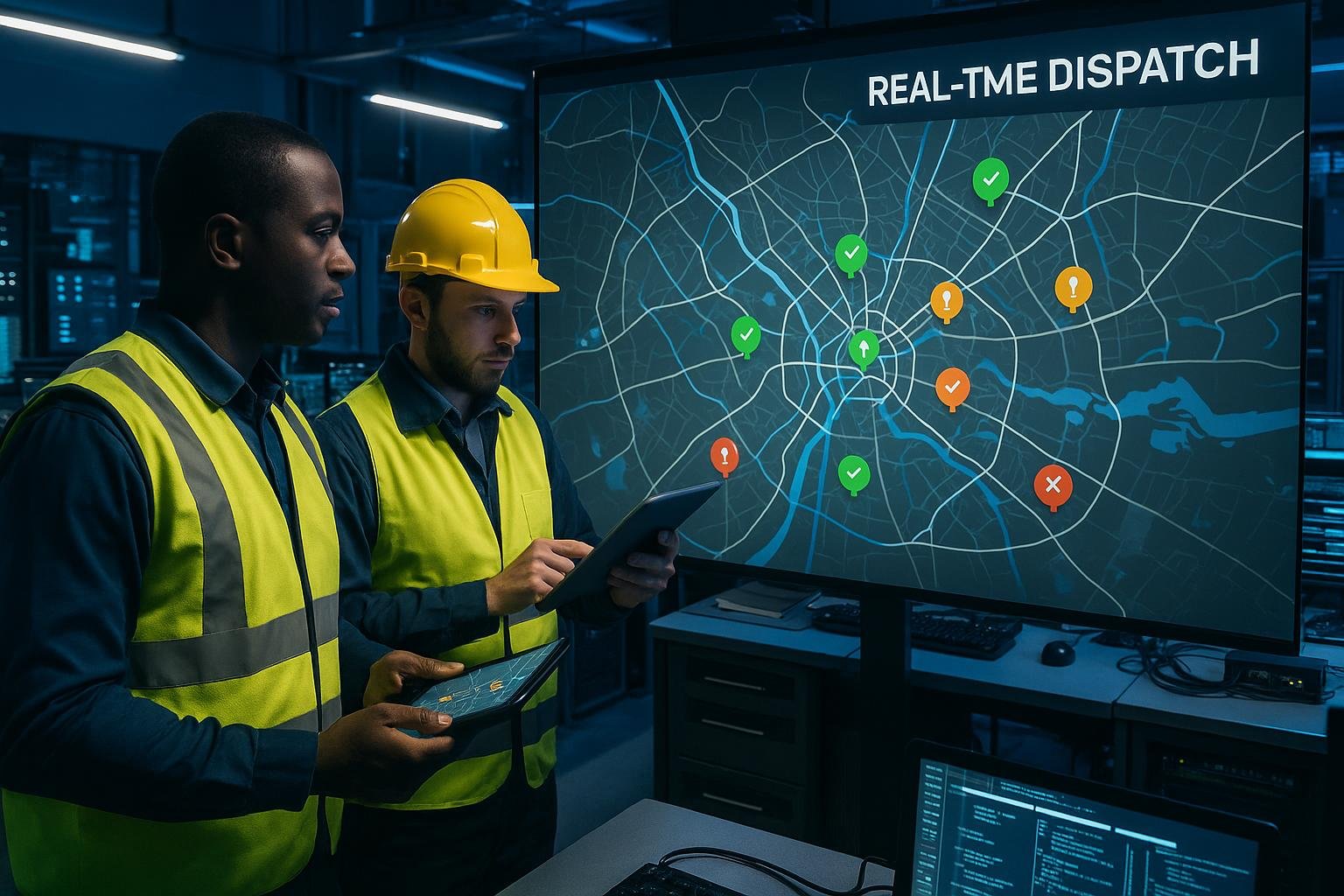
Last week’s scramble in our dispatch office, three simultaneous calls, a stranded technician waiting for a part, another finishing early with no next assignment, and a customer irate at a late arrival, made plain a persistent weakness in many service businesses: office teams are often operating from stale information and limited sight of field activity. That gap does more than raise stress levels; it bleeds productivity and increases operating costs.
Traditional approaches, p...
Continue Reading This Article
Enjoy this article as well as all of our content, including reports, news, tips and more.
By registering or signing into your SRM Today account, you agree to SRM Today's Terms of Use and consent to the processing of your personal information as described in our Privacy Policy.
hone calls, paper notes and spreadsheets, leave managers unable to verify who is on site, how long tasks actually take, or which worker is best placed to pick up an urgent job. Industry guides argue this pattern forces firms into reactive modes, increasing repeat visits and unplanned downtime that harm profitability. According to Makula’s analysis, poor visibility is a primary driver of these avoidable costs.
The remedy most cited across the sector is live field visibility. Real-time location and status updates give managers a live map of their mobile workforce, enabling quicker, smarter dispatching and routing. Forbes notes that instant operational data transforms scheduling and resource allocation, improves customer communication and can meaningfully reduce inefficiencies and expense. When managers can see who is nearest and qualified for a task, drive time falls and billable time rises.
But the shift to continuous tracking is not just a technology install; it is an operational change. Multiple sources warn that successful adoption requires clear training, change management and frontline buy-in. Forbes emphasises that without staff engagement and appropriate training programmes, the potential gains of real-time data will be blunted. Veemo’s field-service overview similarly highlights how communication protocols and documentation practices must evolve alongside new tools to deliver consistent service quality.
Beyond dispatch and routing, the data stream from a modern field-service platform enables more robust decision-making. Automated reports on idle time, route efficiency and task completion yield actionable insights for coaching and workforce optimisation. FieldProxy’s guide shows how features like geofencing and integration with work-order systems create timely alerts and reduce customer uncertainty by providing accurate arrival windows.
Scalability is another common advantage. Companies that outgrow manual methods find that a configurable mobile app can support diverse trades and complex roles, assigning permissions and skills at scale while preserving oversight. SiteCapture’s guidance stresses that digitisation replaces fragmented workflows with a single source of truth, reducing administrative friction and improving allocation of labour across larger territories.
Practical results are already being reported. Case studies from service providers adopting modern platforms show marked improvements in on-time performance and operational consistency. FieldAx’s own materials point to high user satisfaction ratings and examples of teams achieving near-full operational efficiency after implementing live tracking and reporting, though as with any vendor-originated claims, those outcomes should be weighed alongside independent evaluation.
There are also device- and infrastructure-level realities to manage. Ensuring apps have the right permissions, monitoring battery status and maintaining reliable mobile connectivity are small technical details that, if neglected, can create false negatives in visibility. Good implementations include alerts and fallbacks so managers can reroute work quickly when a device goes offline or a technician’s status is unclear.
For firms intent on closing the disconnect between office and field, the path is straightforward in principle: replace guesswork with live data, pair the technology rollout with training and process redesign, and use metrics to guide continuous improvement. The combination reduces idle time, increases accountability and improves customer experience. The choice of platform and the rigor of implementation will determine whether those benefits materialise in everyday operations.
Investing in real-time field visibility is not a panacea,but for businesses that have long suffered the cost of opacity it offers a practicable route to steadier performance and measurable growth.
Source: Noah Wire Services