


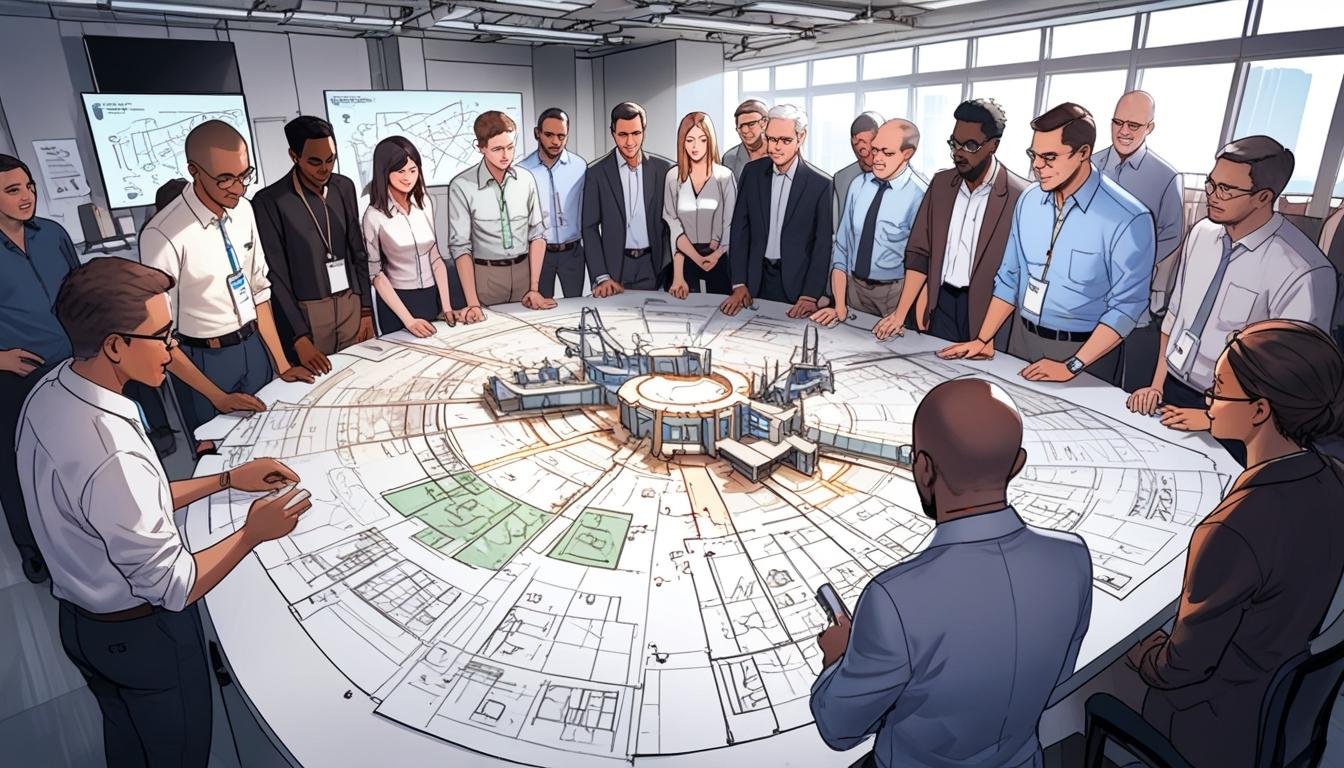
**Carlsbad, California**: Experts at the Western Winter Workshop examined evolving project delivery methods, focusing on the progressive design-build approach and its implications. Discussions highlighted the need for collaboration to navigate complexities such as cost estimation, supply chain disruptions, and innovative funding strategies for infrastructure projects.
In the backdrop of evolving discussions on collaborative project delivery methods, professionals in civil infrastructure recently convened at the Western Winter Workshop held in Carlsbad, California, from March 7-8. The workshop provided a platform for experts to explore the complexities of project management, specifically focusing on the progressive design-build (PDB) method. A pivotal area of discussion was the decision between employing a lump-sum or time-and-materials approach for project contracts.
Monica Born, program manager with the Valley Transportation Authority in Silicon Valley, highlighted the challenges associated with setting a lump sum early in the project timeline. “If you set a lump sum early, it can be constraining,” Born remarked, while referring to the planned $12.7-billion six-mile BART extension to San Jose. Engaging contractors at an early stage can potentially lead to a more flexible exploration of ideas, she added. The initial year-long phase of the project involves stakeholders getting acquainted and determining project scope within financial limits, which presents a risk of uncertainty in cost and schedule.

Pavan Hotha, principal consultant at Intueor Consulting, supported Born’s observations, emphasising that contractor contributions on cost can inform designers and assist contractors in preparing more accurate bids. The input promotes a mutual understanding of risks between owners and bidders, according to Suresh Kataria, manager of risk and project controls at HNTB. Kataria noted that as projects approach final design stages, identifying and pricing risks becomes paramount to avoid unexpected complications.
Risks posed by supply chain disruptions loom large for large-scale infrastructure projects. Devang Dedhia, project controls manager at the Port of Long Beach, suggested that establishing strong relationships with vendors is essential for navigating long-lead items in projects such as the port’s $1.6-billion Pier B on-dock rail initiative. Tim Buresh, chief of construction services for the California State University system, acknowledged the inevitability of ongoing disruptions in projects, including a significant $1.6 billion student housing project in San Luis Obispo. He advised early procurement of materials and consideration of warehousing costs over potential disruptions.
Russ Vakharia, supervising engineer for the LA County Sanitation Districts, underlined the unpredictability inherent in large projects. He relayed an instance where an external agency requested a contingency plan with minimal notice, emphasising the financial implications of project delays, which can escalate costs significantly. He asserted the necessity for project managers and schedulers to collaborate effectively. “The project manager has to own the schedule,” he stated, highlighting the importance of comprehensive oversight to prevent pitfalls.
In a different perspective, the Contra Costa Transportation Authority is exploring a novel collaborative approach for public transit. Executive Director Tim Haile described the initiative, which involves a progressive public-private partnership with the Plenary Group, Flatiron Dragados, and Glydways, aimed at developing an automated transit network for three rural northern Californian communities.
The anticipated first segment of the project includes a 5-mile route from the BART station in Antioch to Brentwood, utilizing a dedicated guideway designed to accommodate up to 10,000 passengers per hour. The proposed autonomous vehicles, measuring 13 ft long and 7 ft high, are expected to significantly reduce operational costs compared to traditional bus rapid transit or BART extensions.
Hamid Rezaei, director of emerging technologies at Flatiron Dragados, added that the partnership allows for an early evaluation of design packages. The collaborative model suggests a shift from a construction manager-general contractor model to the PDB approach at the 30% design stage. Haile indicated that this initiative seeks to leverage the entire network for funding, going beyond conventional farebox revenues or public funding.
The shifting dynamics in project delivery methods and the exploration of alternative funding avenues reflect an industry responding to evolving challenges and opportunities in civil infrastructure, aiming for greater collaboration and innovation in project execution.
Source: Noah Wire Services

