


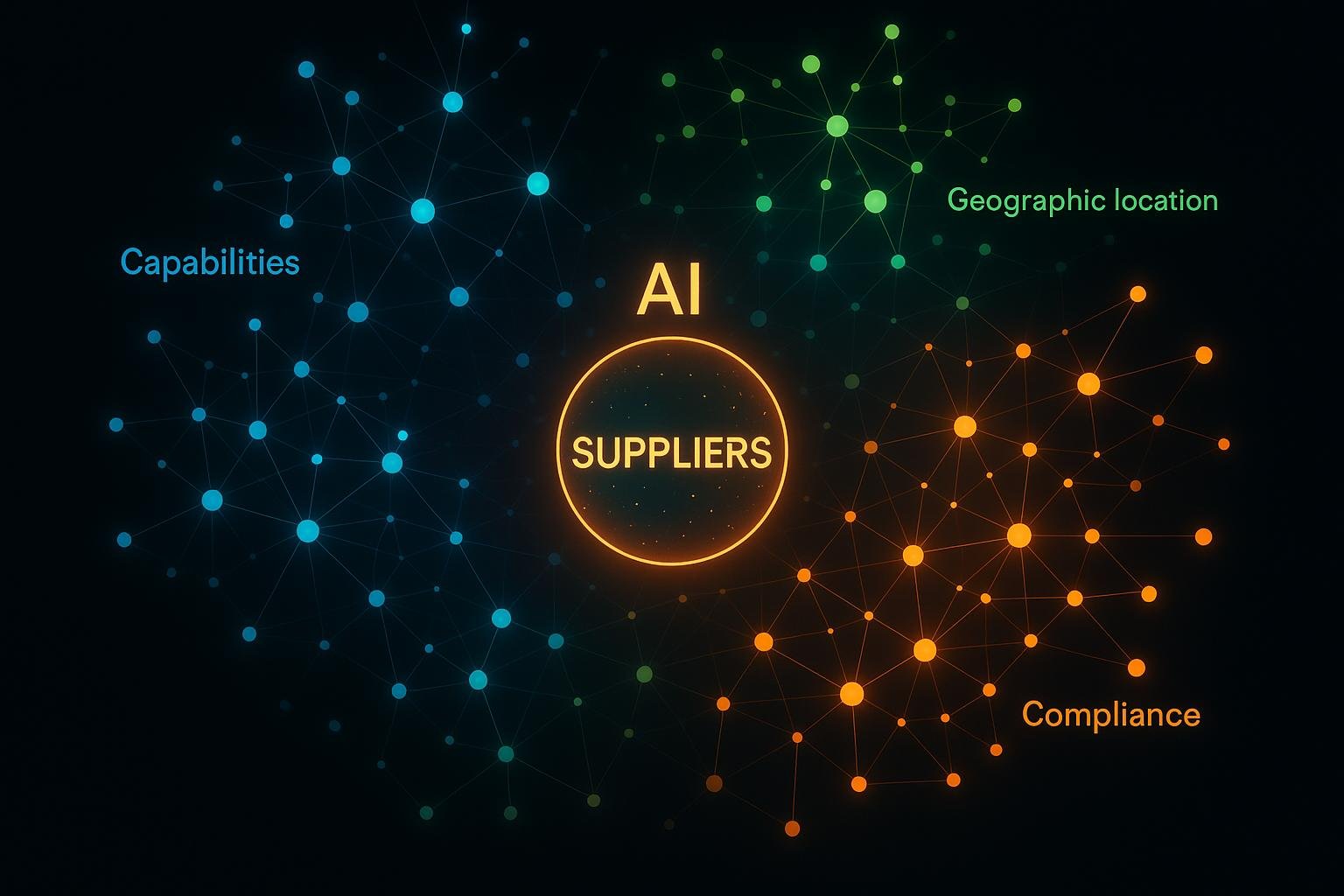
Procurement teams are increasingly moving beyond traditional supplier discovery methods, which often rely on static industry classification systems such as NAICS codes or third-party directories. Instead, a new wave of AI-driven capability maps is transforming how buyers understand and navigate supplier landscapes. These maps do not merely list suppliers by category but build a nuanced, dynamic view of production capacity, compliance histories, technical specialisations, and digital maturity—offering a more detailed and actionable perspective on supplier capabilities.
Traditional supplier mapping tends to classify vendors using broad taxonomy based on self-declared industry codes. However, this approach is inadequate for complex or rapidly evolving categories like power semiconductors, sustainable packaging, or advanced battery materials. Suppliers sharing the same classification can exhibit vast differences in certifications, lead times, or specialised skills. AI-enabled platforms bridge this gap by ingesting diverse digital signals—from certification databases and regulatory filings to patent data, job postings, and product catalogues. Using these inputs, algorithms cluster suppliers based on inferred capabilities such as adherence to medical-grade ISO certifications, proficiency in microtolerance machining, or the integration of AI into quality management systems.

The outcome is an evolving, living capability map that depicts not just a flat list of names but a networked view of who can produce what, at what scale, and under what constraints. This approach allows procurement teams to detect emerging suppliers earlier, generate more competitive shortlists, and better assess capacity risks that static registries often overlook. It fundamentally reshapes the supplier discovery workflow by enabling a signal-driven mapping process—where procurement starts from clearly defined capability needs rather than fixed category codes. For example, buyers can specify requirements like FDA-cleared cleanroom filling or dual-sourced tantalum refinement, and the AI system then identifies suppliers with matching digital footprints.
Visual network clustering further enhances this process by grouping suppliers geographically and by capability clusters, highlighting proximity to demand centres, logistics corridors, or complementary supply tiers. Some platforms also incorporate environmental, social, and governance (ESG) risk data, tariff exposure, and past delivery performance, offering a more comprehensive picture. These maps dynamically update as suppliers expand certifications, announce new facilities, or encounter compliance violations, ensuring procurement teams have real-time visibility rather than waiting for periodic reviews.
This interactive and visual nature of AI capability maps fosters deeper collaboration across functions—from engineering to sustainability—allowing teams to simulate different sourcing scenarios and build shared understanding well beyond traditional spreadsheets or PDFs. In industries experiencing technical convergence, shifting regulations, or frequent supplier churn, such capability mapping is not merely an efficiency tool but a strategic differentiator. Procurement leaders increasingly recognize that long approved supplier lists are less valuable than clear, intelligence-driven capability maps that enhance growth, innovation, and compliance.
Supporting this shift, McKinsey highlights that AI can slash supplier discovery timelines by over 90%, accelerating the identification and onboarding of new suppliers, thereby enhancing cost efficiency and supply chain resilience. Other industry insights emphasise that AI automates supplier evaluation by analysing multiple criteria and risks, improving decision-making and enabling companies to optimise supplier selection. Furthermore, patent filings reveal how machine learning-generated capability maps can predict supplier performance in materials development, aiding original equipment manufacturers in selecting compliant, high-performing materials.
Generative AI and AI agents are also being applied to supplier risk management and cybersecurity, automating compliance checks, continuous monitoring, and dependency mapping. This integration not only helps in identifying alternative suppliers rapidly but also enhances real-time risk assessments and network visualisations—critical in managing today’s complex supply chains.
In manufacturing, AI-driven supplier discovery leverages advanced algorithms, predictive analytics, and natural language processing, with some solutions incorporating blockchain technology to ensure transparency and traceability. These innovations enable procurement teams to filter and match suppliers with unprecedented precision. Additionally, AI’s capacity to process vast amounts of structured and unstructured data from supplier directories, websites, past RFx documents, and other sources accelerates supplier identification, especially in unfamiliar geographies or categories where buyers may lack prior experience.
As procurement evolves into an intelligence-led orchestration function, the companies that excel will be those that adopt these advanced AI-powered capability mapping tools. By transitioning from static lists to strategic pattern recognition, organisations can ensure more resilient, innovative, and compliant supply networks—turning supplier discovery into a powerful competitive advantage.
Source: Noah Wire Services

