


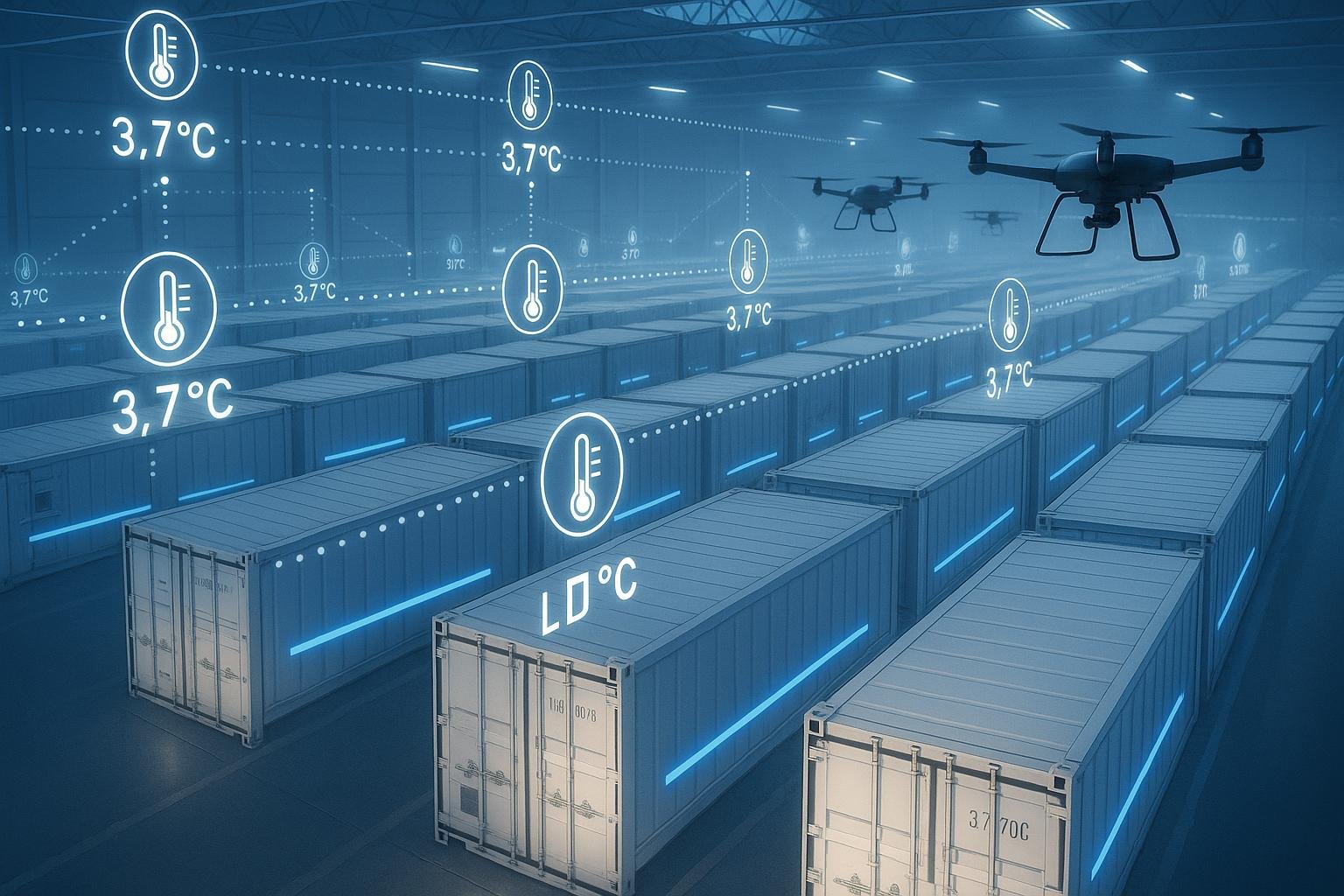
Advancements in sensor technology, cloud computing, and AI are revolutionising cold-chain management, shifting from reactive to proactive risk prevention to meet tighter regulations, improve product safety, and gain competitive edge.

Cold-chain logistics no longer functions as a margin business where occasional lapses can be tolerated. What once relied on periodic checks and threshold alarms has evolved into a system that must anticipate and avert risk. According to an ...
Continue Reading This Article
Enjoy this article as well as all of our content, including reports, news, tips and more.
By registering or signing into your SRM Today account, you agree to SRM Today's Terms of Use and consent to the processing of your personal information as described in our Privacy Policy.
The limitations of legacy approaches are stark. Manual inspections leave long intervals of uncertainty; alarm-triggered systems only register problems after a breach has begun; and archival records, valuable for audits, offer little foresight about what will break next. Industry observers and regulatory guidance converge on the same conclusion: reactive monitoring cannot cope with the complex interactions among equipment wear, ambient conditions and operational load that determine product safety.
Advances in sensors, connectivity and cloud computing have turned prediction from a theoretical benefit into an operational necessity. Reports from trade and academic sources show that inexpensive IoT sensors now provide continuous streams of temperature, humidity and location data, while cloud analytics and machine-learning models convert those feeds into early-warning indicators. A study published by MDPI found that integrating real-time environmental and customer-demographic inputs materially improves the accuracy of forecasting models such as ARIMA and multiple linear regression, and recommended IoT-derived metrics to reduce spoilage and sharpen demand forecasts. MIT researchers working with Americold demonstrated that tailored AI/ML approaches can drive site-level demand forecasts to low error rates, reporting a mean absolute percentage error of 5.28% in their pilot work, underscoring the practical gains from model customisation.
Forecasting applications extend across the cold chain. Predictive maintenance flags gradual compressor degradation through subtle temperature drift, longer cooling cycles or anomalous energy consumption before equipment fails. Route-planning algorithms incorporate weather and traffic forecasts to identify higher-risk transit windows and suggest rerouting or timing adjustments. Load-planning tools evaluate thermal mass, door-opening patterns and packing configurations to reduce internal temperature variance during handling and transport. Industry analysis indicates wide uptake: one market compendium projects IoT sensor deployment rising sharply over recent years and reports that around 60% of operators are using AI for predictive maintenance, helping cut unplanned downtime by roughly a quarter.
Regulation is sharpening the commercial case. Good Distribution Practice guidance and food- and drug-safety frameworks increasingly emphasise risk-based, preventive controls rather than post-facto remediation. The IntelligentHQ overview notes that authorities in major markets expect distributors to demonstrate measures that prevent excursions before they occur. That compliance imperative dovetails with insurer incentives and customer requirements: carriers and buyers favour partners that can show continuous monitoring plus predictive controls, and some underwriters offer lower premiums to firms that can demonstrate such capabilities.
The economics are straightforward. High-value pharmaceutical consignments and large food shipments are vulnerable to instant devaluation when cold chain integrity is lost. Industry commentators point out that predictive systems often amortise quickly by preventing a small number of costly losses, while also enabling operational savings through optimised routing, smarter capacity use and condition-based maintenance. One trade article estimates warehouse-optimisation gains of 15–25% and accuracy improvements approaching 99.5% when AI is applied effectively.
That promise, however, is conditional on implementation quality. Analysts warn against dashboard theatre: visually rich interfaces that only summarise past events without delivering actionable, forward-looking alerts offer little protection. Systems that operate in silos and do not integrate with enterprise resource planning and warehouse management systems cannot trigger automated mitigations such as rerouting, load adjustment or inventory reallocation. Data-sharing gaps, particularly with independent transport providers and manual paperwork flows, remain an obstacle to maximising predictive value, according to practitioners surveyed in industry pieces.
Academic and applied research papers stress another point: model performance depends on the breadth and relevance of input data. The MDPI paper highlights how the absence of granular, real-time environmental inputs and customer-behaviour variables degrades the predictive power of conventional statistical models. The MIT-Americold collaboration reinforces the need to adapt AI/ML models to specific sites and operational patterns rather than relying on off-the-shelf algorithms.
For operators weighing investment, the choice is increasingly binary. Forecasting is no longer an optional enhancement; it is part of the baseline infrastructure that meets regulatory expectations, reduces risk and preserves commercial relationships. The test for any provider is not aesthetics or marketing claims but demonstrable predictive capability, integration across business systems and the ability to convert warnings into timely, automated or human-driven interventions.
As cold chains carry ever more valuable and temperature-sensitive goods, the industry’s centre of gravity has shifted from containment after failure to prevention before it starts. Those who effectively harness continuous sensing, cloud analytics and machine learning to look ahead will not only protect product integrity but also gain competitive advantage in a market that increasingly demands certainty.
Source: Noah Wire Services
Subscribe to Industry Updates

