


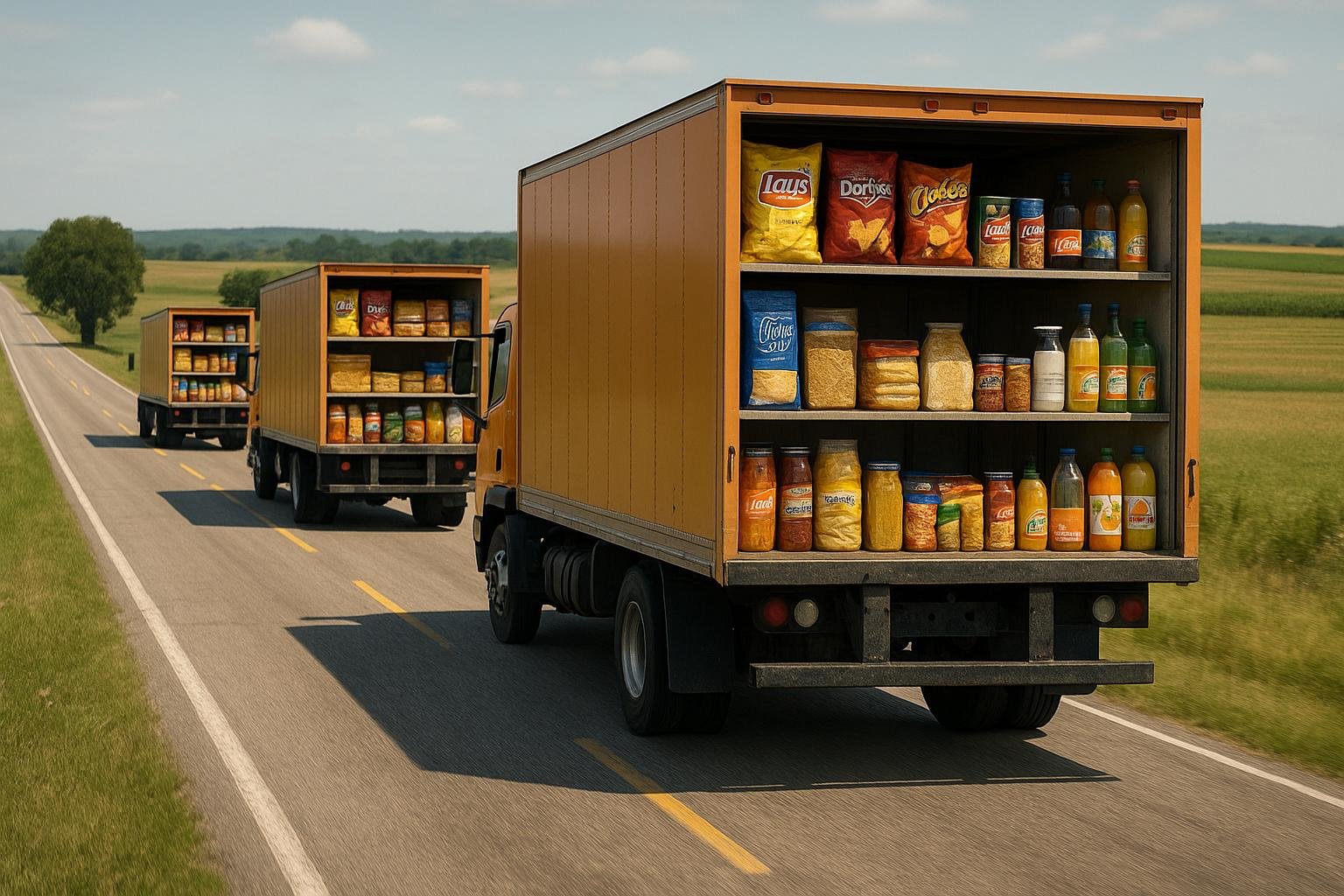
PepsiCo is testing a new integrated distribution model in North America, combining snack and beverage logistics to cut costs and boost flexibility, potentially transforming longstanding delivery practices across the region.

PepsiCo has begun reshaping its North American distribution architecture by testing a model that unites snack and beverage inventory, routing and fleet design , a move that, if scaled, would alter decades of direct store delivery practice and fund gr...
Continue Reading This Article
Enjoy this article as well as all of our content, including reports, news, tips and more.
By registering or signing into your SRM Today account, you agree to SRM Today's Terms of Use and consent to the processing of your personal information as described in our Privacy Policy.
According to SupplyChain360, pilots in parts of Texas and Florida are combining delivery routes, co‑locating stock for snacks and drinks and trialling new vehicle formats that can carry chilled and ambient goods together. Food Dive and Food Business News report the experiments aim to cut cost‑to‑serve and raise service flexibility by replacing duplicate visits with single, multi‑temperature stops and by consolidating back‑of‑store inventory where appropriate. PepsiCo executives say the trials are deliberately selective rather than universal, and will be tailored by geography, customer mix and route economics.
Operationally, the initiative rests on three changes: unified route planning and order capture capable of managing different temperature zones and merchandising needs, redesigned truck bodies and loading sequences to support in‑store execution, and revised node‑route structures that either co‑locate snack and beverage stock or create cross‑dock points where flows converge before last‑mile delivery. Ramon Laguarta has linked these pilots to IT and fleet investments, signalling the shift is as much about asset and systems architecture as it is about organisational design.
The pilots are running alongside a broader productivity programme that management says will underwrite 2026 investments. SupplyChain360 notes PepsiCo is redeploying savings from manufacturing, overhead and stand‑alone logistics into targeted price investments to address affordability, expanded shelf space for Frito‑Lay in spring 2026 resets, and greater granularity in multipack and single‑serve formats. Company statements position these moves as designed to push more volume through largely fixed assets, increasing throughput without a proportional rise in trucks or depots.
That strategy also reflects a wider integration imperative. SupplyChain360 has described a sweeping effort to knit PepsiCo’s roughly $30bn beverage and $30bn Frito‑Lay businesses into a more unified network, including capacity realignments that have involved closing plants and pausing production lines where demand and efficiency dictate. At the same time, the firm is absorbing high‑growth acquisitions , Siete, Poppi, Alani Nu and others , on explicit timelines that bring their volumes and service metrics into the core distribution platform over 2026. SupplyChain360 and industry reporting note these brand integrations increase requirements for coolers, replenishment frequency and execution sensitivity, particularly in convenience and small‑format channels.
Merging food and beverage flows is not without friction. The pilots must manage rising SKU and pack complexity driven by health‑oriented innovation and single‑serve proliferation, retailer demands that span main‑aisle, perimeter and online fulfilment, and the need to maintain service thresholds across categories with different handling and cadence. Analysts caution that combining routes heightens the risk that a disruption in one category , for example a packaging shortage in snacks , could cascade into beverage fulfilment unless master data, demand planning and inventory positioning are tightly synchronised.
PepsiCo has emphasised it will not impose a one‑size‑fits‑all template across the US. Reporting indicates the company is considering modular route archetypes: company‑owned versus franchised delivery, integrated versus category‑specific routes, and shared versus dedicated inventory points, with selective refranchising under review for some territories. That approach acknowledges varied store mixes, labour markets and competitive landscapes; dense urban territories with many small stores may reap greater benefit from fully integrated, high‑frequency routes than sparser rural regions.
Industry parallels inform the logic. Companies such as Tyson and McCormick have been using productivity to fund strategic redesigns rather than merely defend margins, reworking reporting and cost allocation to reveal where profit is created. PepsiCo faces a similar governance challenge: a more heterogeneous route‑to‑market will require clearer economic accountability at the territory and segment level to avoid operational fragmentation.
The pilots also sit within PepsiCo’s wider sustainability and social initiatives. The company’s pep+ transformation, announced in 2021, frames operational change around environmental and social outcomes as well as commercial goals, and recent programmes such as the Planting Pathways initiative reflect continued investment in agricultural and community partnerships. Executives portray the distribution experiments as consistent with those longer‑term objectives , seeking efficiency and resilience while supporting broader corporate commitments.
If the integrated delivery tests scale successfully, PepsiCo expects to gain structural levers that permit more aggressive affordability programmes, expanded single‑serve assortments and smoother absorption of fast‑growing brands without linear increases in logistics cost. Yet the balance between commercial ambition and network discipline will be critical: integrated routes must reduce structural cost‑to‑serve faster than promotional and assortment moves erode realised price.
For a company of PepsiCo’s size, the pilots are thus a double test , of new vehicle and IT capabilities and of whether a productivity‑funded, modular distribution model can sustain an increasingly complex portfolio and stretched consumer demand. The outcome will determine whether PepsiCo can convert a set of selective experiments into a flexible, economically robust route‑to‑market framework across North America.
Source: Noah Wire Services
Subscribe to Industry Updates

