


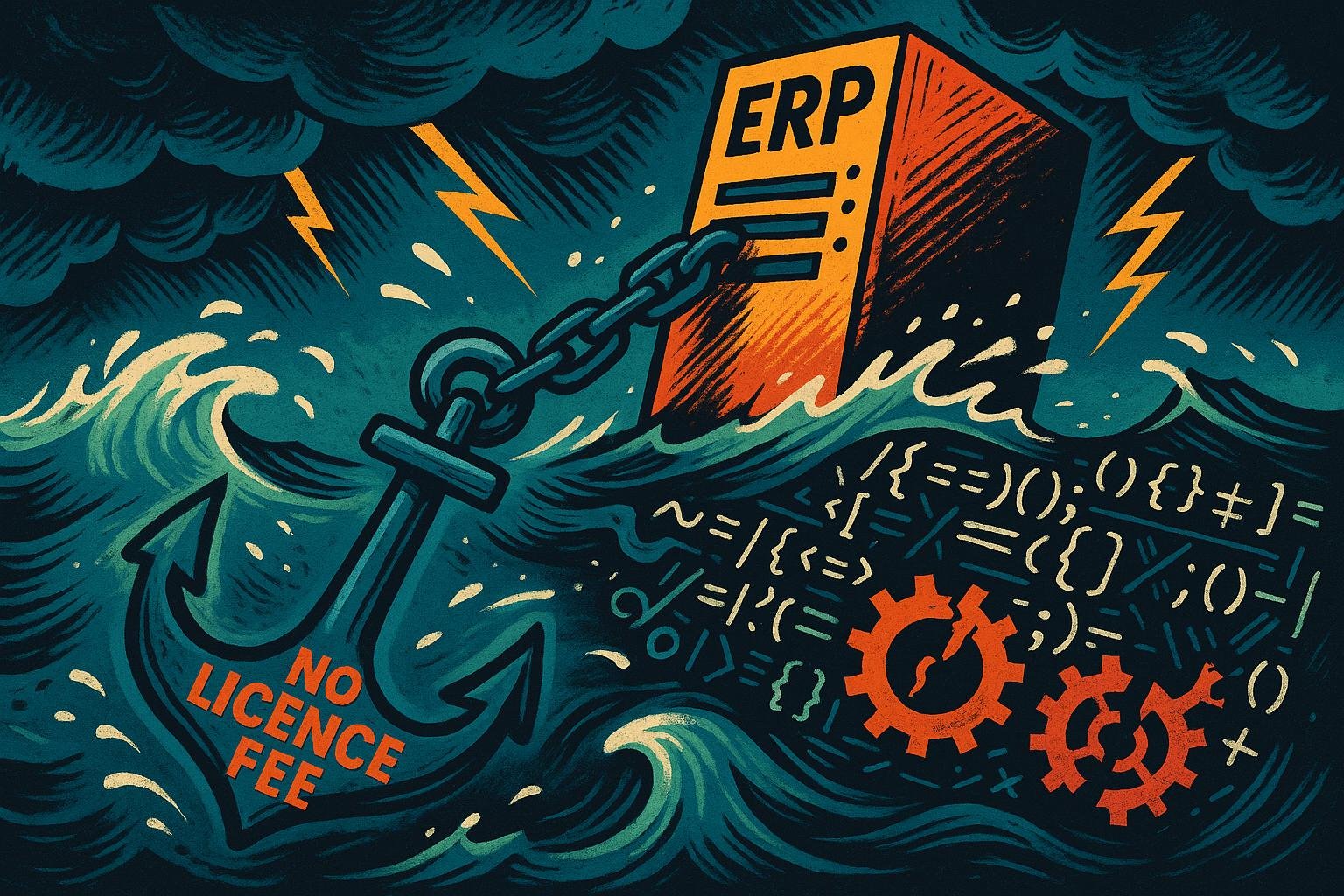
Companies enticed by licence-free ERP often discover that customisation, integrations and specialist staffing create recurring costs, brittle upgrades and heightened security and compliance risk. Practitioners urge treating core-code changes as a last resort, externalising business logic, enforcing governance and budgeting for testing and managed alternatives.

Imagine a mid‑sized company chasing agility and cost savings. It finds an open‑source ERP with “no licence fees”, promises of unlimited customisation and a vibrant developer community, and signs up. Three years later the platform is brittle: every update breaks workflows, custom code is tangled, upgrades feel impossible without a rewrite, and the “free” ERP has become an expensive operational anchor. That scenario — which a vendor blog recently described using a fictionalised account — is familiar to many organisations that underestimate how customisation multiplies cost and risk over time.
What “open‑source ERP” really means — and what it doesn’t say
Open‑source ERP software exposes its source code so businesses can inspect, change and extend it. Vendors and advocates correctly point to licence savings and the flexibility to tailor processes. According to the vendor blog that prompted this analysis, that flexibility is precisely the lure for rapidly growing firms. But the same post also acknowledges — as do independent analysts — that freedom to modify can quietly turn into a long‑term maintenance burden if governance, architecture and resourcing are not planned from day one.
Why customisation so often becomes a liability
Independent commentary from ERP practitioners is clear: custom code is expensive to build and far more expensive to own. Altering core ERP logic undermines the vendor upgrade path and creates “version lock‑in” where organisations either pay repeatedly to re‑implement changes after each upgrade or remain on outdated, vulnerable releases. Best practice guidance urges treating core‑code changes as a last resort and preferring in‑product configuration, third‑party connectors, middleware layers or external services to achieve business requirements.
Hidden and recurring costs beyond licence fees
The headline “no licence fee” obscures many predictable expenses. Analysts and implementation specialists point to costs that are often underestimated or missed entirely during procurement:
- Implementation effort and configuration to match business processes.
- Integration work and middleware for connecting accounting, POS, shipping and other systems.
- Ongoing maintenance: fixing breakages after platform updates, regression testing, and reworking customisations.
- Talent and retention: specialists who understand a customised stack command premium rates and are hard to replace. CIO reporting on ERP markets confirms a persistent skills shortage that drives consultancy fees and extension costs.
- Operational disruption: upgrades or faulty custom workflows can cause downtime that affects revenue and customer service.
- Security and compliance work: without vendor‑led patching and compliance roadmaps, the organisation carries the full burden of meeting evolving regulatory standards.
Panorama Consulting’s long‑running ERP research and independent features on ERP projects show this pattern in aggregate: many projects exceed budget and schedule when customisation and integrations proliferate, and change management, data migration and testing frequently account for large, unplanned spends.
Security, supply‑chain and compliance considerations
Open source brings transparency, but transparency is a double‑edged sword: publicly visible code can make vulnerabilities easier to find and exploit if patches are not applied quickly. Security guidance for open‑source components stresses the need for a software bill of materials (SBOM), dependency scanning, signed artefacts and automated patching pipelines to control supply‑chain risk. Without those controls, organisations using open components may face unmaintained libraries, hidden dependencies or supply‑chain attacks.
The skills bottleneck
Even large ERP suites face resource constraints, and the scramble for people with expertise in master‑data, integrations and BI is intense. The shortage of qualified ERP engineers affects both proprietary and open systems, but it is especially consequential where business‑critical logic sits in bespoke code that only a few people understand. That dependence increases operational risk and raises the price of routine changes.
How organisations get trapped into a “complexity spiral”
Left unchecked, small changes accumulate into a maze of interdependencies. Common patterns include:
- Over‑customising core modules so that upgrades require re‑implementing many changes.
- Building brittle third‑party integrations that stop working after platform patches.
- Fragmented data models from custom modules that make enterprise reporting and analytics difficult.
- Concentration of tribal knowledge in one or two developers, creating single points of failure.
Managing risk: practical approaches that work
Practitioners and consultancies converge on a set of practical rules to reduce long‑term technical debt while preserving the benefits of configurability:
- Treat core code changes as a last resort. First exhaust built‑in configuration, marketplace extensions and middleware patterns. This is the hierarchy recommended by experienced ERP implementers.
- Externalise custom logic. Use microservices, APIs or façade layers so that business rules live outside the ERP core and can evolve independently. Thought leaders in enterprise modernisation argue that shrinking the ERP core and decoupling differentiating features reduces upgrade pain.
- Enforce governance and product thinking. Prioritise customisation only where it creates sustained competitive advantage; retire or consolidate features that do not. Staged migration and roadmaps reduce scope creep.
- Invest in automated testing and CI/CD. Regression suites make upgrades predictable and shorten remediation time when breakages occur.
- Secure your open‑source supply chain. Maintain an SBOM, scan dependencies, apply verified patches and require immutability or signatures for released artefacts. OWASP‑style controls are essential for production‑grade systems.
- Budget realistically for people and change management. Account for training, documentation, and the premium for specialised skills. Consider partnerships with experienced integrators and independent reviews to validate scope and architecture.
- Keep documentation and remove single‑person dependencies. Institutionalise knowledge so that system continuity does not hinge on one developer.
When to consider migrating or buying managed alternatives
If upgrade costs rise, downtime threatens customer service, or routine changes take months and rely on a handful of people, it is prudent to evaluate alternatives. For many organisations the right choice is not “open source or nothing” but a hybrid: a slim ERP core for standard transactional processing, with modular extensions, API‑first integrations and managed platform components that take upgrade and security responsibility off the internal plate. McKinsey and other analysts recommend a platform approach that extracts competitive customisations into dedicated services and treats the ERP as a stable, minimal core.
A balanced conclusion
Open‑source ERP can deliver enormous value for organisations that genuinely have the people, governance and discipline to manage it over the long haul. For others the apparent short‑term savings mask recurring costs and operational risks. The right procurement question is not only “what does this cost today?” but “what will it cost to keep this safe, compliant, upgradable and useful five years from now?”
Before choosing a route, ask concrete questions about in‑house expertise, upgrade cadence, compliance obligations, and the governance processes you will commit to. Independent benchmarking and realistic total‑cost‑of‑ownership modelling — including migration options — will save money and avoid the “custom becomes chaos” trap that many fast‑growing firms encounter.
Source: Noah Wire Services

