


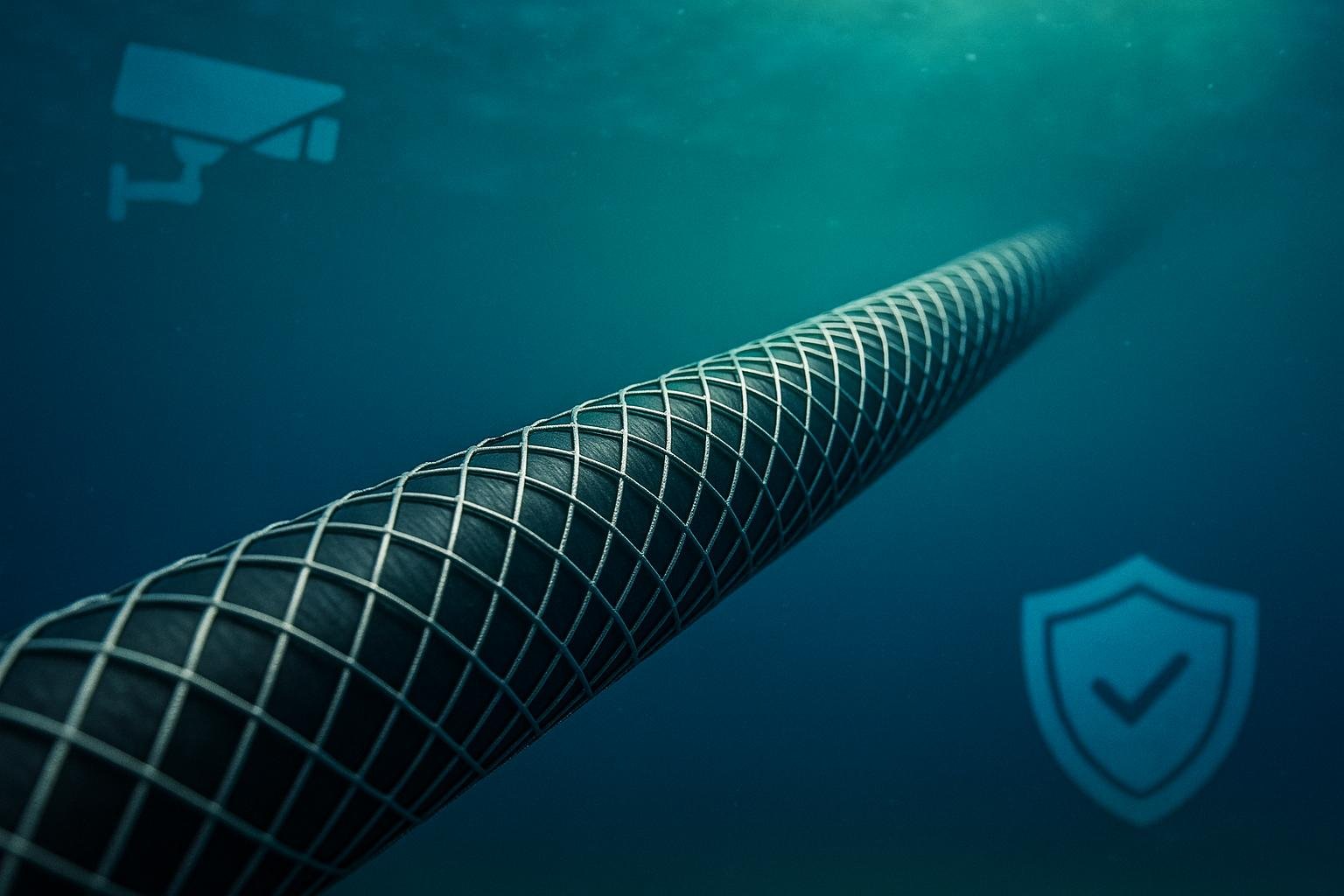
As vulnerabilities in submarine data cables and pipelines grow, experts emphasize the need for technological resilience and inclusive governance to prevent escalation and secure the increasingly vital undersea domain.

Subsea infrastructure has quietly become one of the most consequential and yet least governed strategic domains in the modern security landscape. A single, localized disruption to submarine data cables, energy pipelines or offshore control systems can inte...
Continue Reading This Article
Enjoy this article as well as all of our content, including reports, news, tips and more.
By registering or signing into your SRM Today account, you agree to SRM Today's Terms of Use and consent to the processing of your personal information as described in our Privacy Policy.
The strategic weight of what lies beneath the waves has increased with globalisation and the digitisation of economic and military systems. Industry and government data highlight the scale of dependency: most international data traffic traverses submarine cables, underpinning financial markets, cloud services and command, control, intelligence, surveillance and reconnaissance networks. According to analysis by the Center for Strategic and International Studies, over 95% of global data and an estimated $10 trillion in daily financial transactions depend on these links, meaning that even modest damage can produce outsized economic and operational effects.
Physical and institutional vulnerabilities compound the problem. Subsea assets are geographically dispersed, frequently routed through choke points such as the Suez Canal, the English Channel and the Luzon Strait, and are often owned and operated by private firms. That mix of remoteness, concentration and commercial ownership creates monitoring gaps and blurred responsibilities that state-centric security arrangements struggle to cover. Defence industry commentary notes a wide spectrum of threats: state or proxy probing, small unmanned underwater vehicles, camouflage beneath commercial traffic, cyber-physical attacks on shore stations and deliberate operations designed to exploit plausible deniability.
Technological advances in detection and surveillance offer important capabilities but are no panacea. Providers of maritime AI and autonomous platforms describe systems able to fuse AIS, radar, satellite imagery, acoustic sensors and onboard cameras to build a richer picture of activity near sensitive assets. Companies such as SEA.AI promote AI-enabled, 360° perimeter monitoring and thermal sensing for night operations, while Saildrone and similar firms field unmanned surface and underwater systems that can maintain persistent presence for months, collecting environmental and behavioural data without crewed risk. Windward and ThayerMahan have likewise developed AI-driven behavioural analytics and integrated monitoring services aimed at early warning and incident response.
Yet the limits of these technologies are acute in practice. Machine‑learning anomaly detection reduces information overload and can flag suspicious loitering, AIS manipulation or route deviations, but false positives are frequent in noisy maritime environments where fishing, research and maintenance vessels routinely operate near infrastructure. AI improves detection but rarely resolves the harder problem of attribution: an improved sensor picture may show that an incident occurred, but it does not necessarily establish whether damage was accidental, criminal, state‑sponsored or the work of non‑state actors. As Kolatche and Kolesnikova argue, that failing undercuts classic deterrence by punishment and can make enhanced surveillance counterproductive by compressing decision cycles and prompting pre‑emptive or escalatory responses when uncertainty is high.
Operational resilience therefore becomes the central strategic imperative. Rather than relying primarily on the threat of retaliation, states and operators are investing in redundancy, alternative routing, cyber‑physical hardening and rapid repair capabilities so that critical functions can be maintained under degraded conditions. The concept of “security‑by‑design” is gaining traction: treating subsea systems as distributed, interdependent networks, incorporating embedded monitoring, power and communication support, rather than as isolated cables or pipelines. Such architectures mirror lessons from other domains where sustained capability depends on integrated support infrastructure rather than episodic intervention.
Governance and legal frameworks lag technological and commercial developments. Initiatives described as “cable diplomacy” and calls for common norms aim to clarify behaviours, improve information sharing and enable collective response, but progress is constrained by a deficit of trust among states. Proposals to regulate subsea assets are sometimes perceived as privileging the interests of a small group of powerful actors, which in turn can incentivise interference by those who feel excluded. Analysts point to the Nord Stream sabotage and recent damage to cables in the Baltic as examples that illustrate both vulnerability and the political sensitivity of attribution and response.
Any viable path to greater stability will therefore combine technical measures with durable, inclusive governance arrangements. Functional frameworks might differentiate between infrastructure by use and risk profile, creating categories where access, monitoring and oversight obligations reduce dual‑use ambiguity. The Antarctic Treaty offers a distant analogue: durable governance beyond national jurisdiction became possible where rules were perceived as equitable and non‑discriminatory. For subsea protection to achieve similar confidence‑building effects, arrangements would need mechanisms for monitoring, enforcement, continuity and regular review, and they must address asymmetric interests among participating states.
In the interim, the subsea domain will remain a favoured arena for grey‑zone competition. Industry and naval practitioners warn that absent shared norms, technological improvements in surveillance and autonomy will shift patterns of competition rather than eliminate them. The strategic task ahead is therefore threefold: to scale cyber‑physical resilience across complex public–private systems; to deploy detection and autonomous platforms with calibrated human oversight that mitigates false positives and escalation risks; and to pursue inclusive governance measures that tangibly reduce ambiguity and build reciprocal confidence among the principal capable actors. Only such a combined approach offers the prospect of moving the seabed from a permissive no‑man’s‑land toward a more stable element of the global commons.
Source: Noah Wire Services
Subscribe to Industry Updates

