


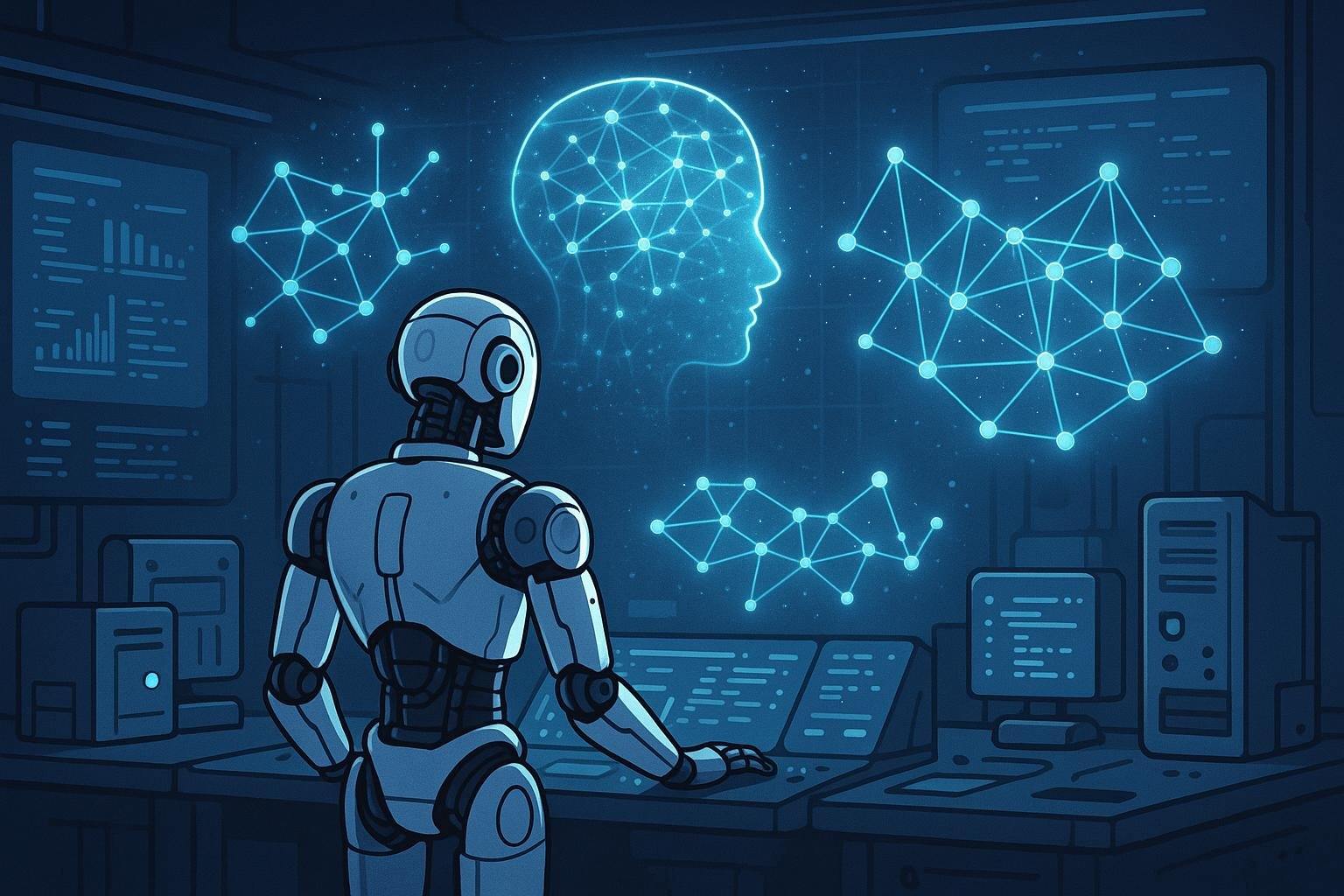
Leading Microsoft Research executives forecast a pivotal 2026, where AI agents evolve into autonomous, context-aware collaborators transforming enterprise workflows, research, and software development, with a focus on trust, security, and governance.

According to ERP.today, Microsoft Research leaders described 2025 as a turning point in which AI moved beyond marginal gains into systems that “reason and adapt while collaborating” with people, and framed 2026 ...
Continue Reading This Article
Enjoy this article as well as all of our content, including reports, news, tips and more.
By registering or signing into your SRM Today account, you agree to SRM Today's Terms of Use and consent to the processing of your personal information as described in our Privacy Policy.
Aparna Chennapragada, Microsoft’s chief product officer for AI experiences, told the audience that 2026 will bring “alliances between people and AI” in which agents act as “digital coworkers” that handle data crunching, content generation and personalisation while humans steer strategy and creativity. She argued organisations that design for people to learn and work with AI will “get the best of both worlds”, enabling small teams to launch global campaigns in days rather than months.
On software engineering, GitHub’s Mario Rodriguez pointed to what he called “repository intelligence”: AI that reasons about code relationships and history to offer smarter suggestions, detect errors earlier and even propose automated fixes as development activity scales. That emphasis on system-level understanding echoes research efforts to move beyond isolated features toward platforms that treat agents, copilots and human users as co-owners of outcomes.
Microsoft researchers and engineers describe a stack of complementary developments that make agentic systems practicable. At the infrastructure level, Azure CTO Mark Russinovich framed the future as orchestration of AI “superfactories”, densely packed, dynamically routed computing designed and measured by the quality of intelligence produced rather than sheer scale. Research groups are also exploring co-designed hardware and adaptive infrastructures, including light-based chips and system intelligence primitives, to squeeze orders-of-magnitude gains in performance and efficiency.
Security and governance are repeatedly foregrounded. Microsoft Security leader Vasu Jakkal urged that “every agent should carry protections comparable to humans”, listing identity, scoped access, managed data and defences against attackers so agents do not become “double agents” carrying unchecked risk. Practical work to evaluate and harden agents is already under way: Microsoft Research’s AIOpsLab framework models realistic cloud faults and tests agents’ ability to manage incidents across microservice environments, a step toward autonomous, self-healing cloud operations dubbed AgentOps.
In research settings, Microsoft Research Asia’s StarTrack Scholars and related convenings have been explicitly focused on making agents useful, transparent and responsible. According to Microsoft Research materials, agentic systems are being designed to gather evidence, test hypotheses and construct narratives with provenance and traceability so advanced research tools are broadly accessible while respecting privacy and reproducibility. The RDA-Microsoft information sessions on November 11, 2025 and November 27, 2025 convened diverse stakeholders to set community priorities for agentic AI in research, reinforcing that the agenda is as much about governance and norms as technical capability.
Work on trustworthy code-generation and safe tool-calling agents complements these efforts. Shraddha Barke of Microsoft Research’s RiSE group is developing post-training models for complex program reasoning and agentic pipelines that produce provable invariants and safety properties, combining formal methods, AI and human–computer interaction to improve dependability. Such work aims to give operators and auditors stronger means to verify agent behaviour in safety-critical settings.
Looking further ahead, Microsoft executives cast quantum computing as an accelerant to hybrid quantum–AI–supercomputing approaches. Jason Zander, Microsoft EVP, pointed to Majorana 1, Microsoft’s topological-qubit system designed to stabilise fragile qubits and reduce errors, as evidence that quantum advantage is moving from decades away to “years, not decades”. He linked those advances to prospects for new discoveries in materials and medicine where hybrid quantum–AI systems could change not just speed but the kind of problems science can solve.
For enterprises, the implications for ERP and industry clouds are concrete. ERP.today and Microsoft Research materials both argue that agent-driven autonomy will push ERP roadmaps from isolated AI features toward platforms where agents maintain long-running context, reason over governed data and act across finance, supply chain and operations. Infrastructure trends, elastic, globally optimised compute; protocol-level system intelligence; and security-by-design for agents, will become baseline architectural concerns rather than optional enhancements. Vendors able to translate these research trajectories into domain-fluent, governable agent capabilities will be better placed to shape the next generation of enterprise solutions.
Taken together, the signals from Microsoft Research and its collaborators suggest 2026 will be judged less by incremental performance gains and more by whether AI systems behave as collaborators that preserve intent, provenance and trust. Industry initiatives, laboratory frameworks and governance discussions point to a twofold test for the coming year: can agents deliver sustained, contextual assistance at enterprise scale, and can organisations embed the controls and social practices necessary to ensure those agents serve, rather than subvert, human goals.
Source: Noah Wire Services
Subscribe to Industry Updates

