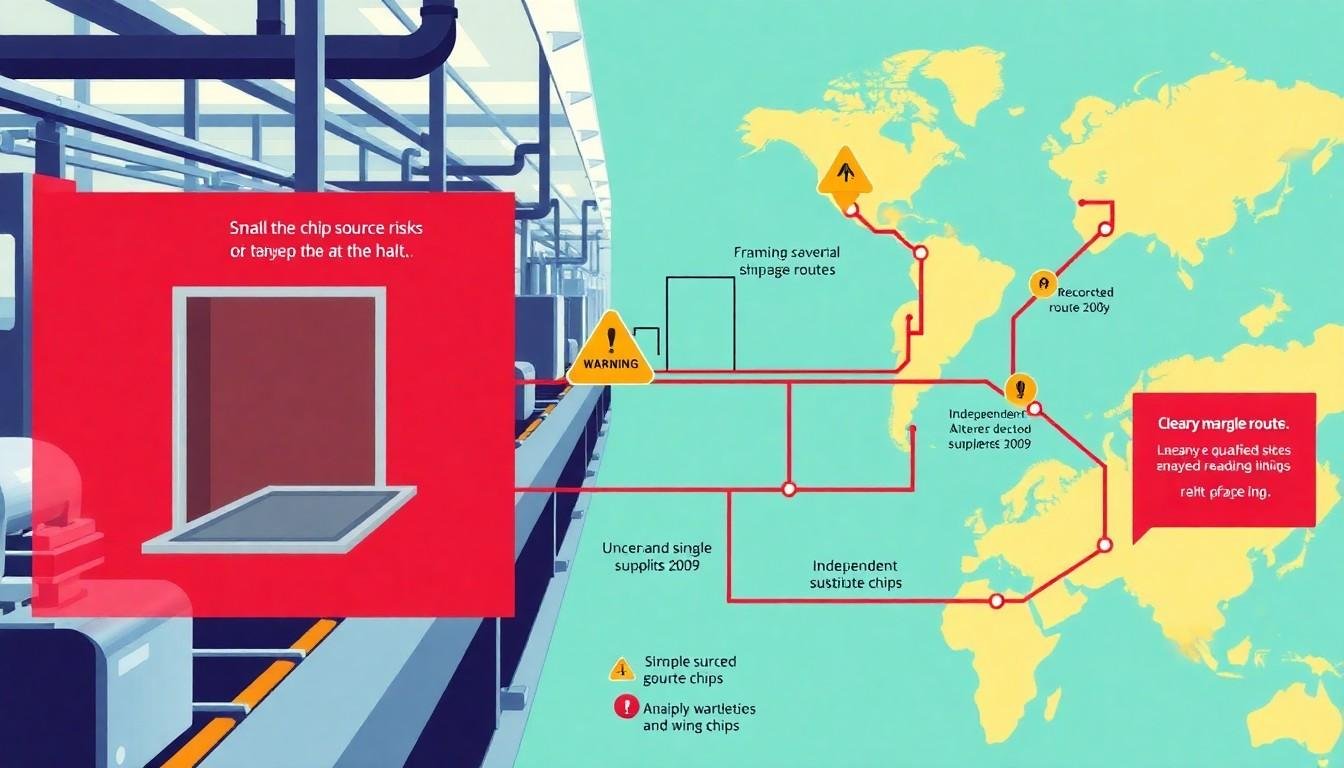
For a small electronics manufacturer, a single unavailable chip can halt an entire product line, even when every other component is ready to ship. The risk is not limited to shortages: parts may be delayed, discontinued, diverted through an unreliable seller or delivered in a condition that cannot be verified. Managing that exposure means identifying which components matter most and preparing practical responses before a disruption occurs.
A useful starting point is a register ...
Continue Reading This Article
Enjoy this article as well as all of our content, including reports, news, tips and more.
By registering or signing into your SRM Today account, you agree to SRM Today's Terms of Use and consent to the processing of your personal information as described in our Privacy Policy.
of critical parts linked to current product bills of materials. For each component, record its exact manufacturer part number and revision, package and grade, lifecycle status, known supply routes, lead times and any firmware or manufacturing dependencies. Rank each part by the consequences of a stockout: whether it stops all production, affects only one model, delays a customer commitment or raises costs. Give particular attention to safety-critical or regulated functions.
The aim is to understand the supply chain behind each part, not merely to count vendors. Two distributors may rely on the same manufacturer, region or allocation, and so offer less protection than their number suggests. NIST’s supply-chain risk-management guidance emphasises that exposure can arise at several tiers and through connected suppliers, while recognising that organisations should scale their controls to their circumstances. For a small business, that can mean documenting the original component manufacturer, authorised distributors, contract-manufacturing routes and known geographic dependencies.
Geographic concentration can make apparently sound supply routes vulnerable to the same event. A US Government Accountability Office report on semiconductor supply-chain projects notes that, as of 2022, roughly three-quarters of chips were manufactured and packaged in Asia, with some logic and memory production particularly concentrated in Taiwan and South Korea. The report also describes the cost and time involved in expanding production capacity. New factories are not an immediate remedy for a small company facing a near-term shortage; mapping dependencies and preparing alternatives are more immediate steps.
An alternative component is only useful once it has been qualified for production. Engineering teams may need to check electrical performance, thermal behaviour, firmware, programming, manufacturing tests and regulatory approvals. A pin-compatible device may still behave differently in the product or require changes to its software and validation. Keep approval records tied to the relevant product revision, and specify exactly where each alternate may be used.
If a critical dependency persists, redesign may be preferable to repeatedly buying scarce stock. That choice takes time and engineering effort, but can reduce long-term reliance on a single part, supplier or region. The GAO’s broader analysis of semiconductor vulnerabilities likewise points to the limits of relying on any one response. At company level, resilience may require a combination of genuinely independent supply routes, qualified alternatives, selective inventory and, where justified, redesign.
There is no universal safety-stock target. A buffer should reflect the part’s business impact, replenishment time and uncertainty, demand, the time needed to activate an alternate, and the risk that stock will become obsolete. A long-lead component with no approved substitute may justify more protection than a widely available part, even if both are used at the same rate. Record the assumptions behind each decision and revisit them when forecasts, lead times, lifecycle notices or customer requirements change. Stock awaiting inspection, held for a quality investigation or unsuitable for the current product revision should not be counted as ready for production.
Authenticity and traceability matter particularly when authorised supply is unavailable. CISA’s guide to supply-chain security in critical manufacturing says buying from the original component manufacturer offers the greatest confidence in authenticity, while open-market sources such as independent brokers carry greater risk. Keep purchase records, seller details, lot and date-code information and inspection results. If a secondary-market purchase is unavoidable, treat it as a documented exception: quarantine the parts and use inspection or testing proportionate to their importance and failure consequences.
CISA’s guide recounts a US Senate Armed Services Committee investigation covering 2009–2011 in which 1,800 counterfeit cases were identified. That is a historical figure from the investigation, not a current estimate of counterfeit rates across the market. It nevertheless illustrates why traceability and careful source selection matter.
Contract requirements should be distinguished from voluntary practice. DFARS rules on counterfeit electronic parts apply to covered Department of Defense acquisitions; they do not automatically govern every commercial electronics company. Applicability depends on the contract, its clauses and the company’s role in the supply chain. Businesses working on covered programmes should review the actual terms and pass relevant obligations to suppliers. Others may adopt similar safeguards as good practice without representing them as universal legal requirements.
Storage and handling are also part of supply protection. ESD controls should cover receiving, inspection, storage, kitting and production where components are sensitive to electrostatic discharge. The EOS/ESD Association’s standards resources provide guidance for developing and maintaining a control programme; a single package labelled “anti-static” is not a substitute for appropriate procedures, training and verification. Follow manufacturers’ instructions for moisture-sensitive devices, packaging and shelf life, and keep that information with the part record.
Supplier continuity reviews should include more than delivery performance. Where suppliers handle forecasts, design files, firmware or purchasing credentials, consider how they manage access, protect shared information and respond to incidents. Assign an owner to each high-risk part and define what should happen after an allocation notice, a sharp lead-time change, an end-of-life warning, a supplier incident or a failed incoming inspection. Regular reviews, combined with event-driven checks, can help teams act before an issue becomes a line stoppage.
A small company can build a useful baseline in a month: identify product-stopping components, verify which supply routes are genuinely independent, decide where limited buffers are justified, and begin qualifying the most promising alternatives. The result is not immunity from shortages. It is a clearer picture of where production is exposed and a set of decisions that can be acted on before time runs out.
Source: Noah Wire Services