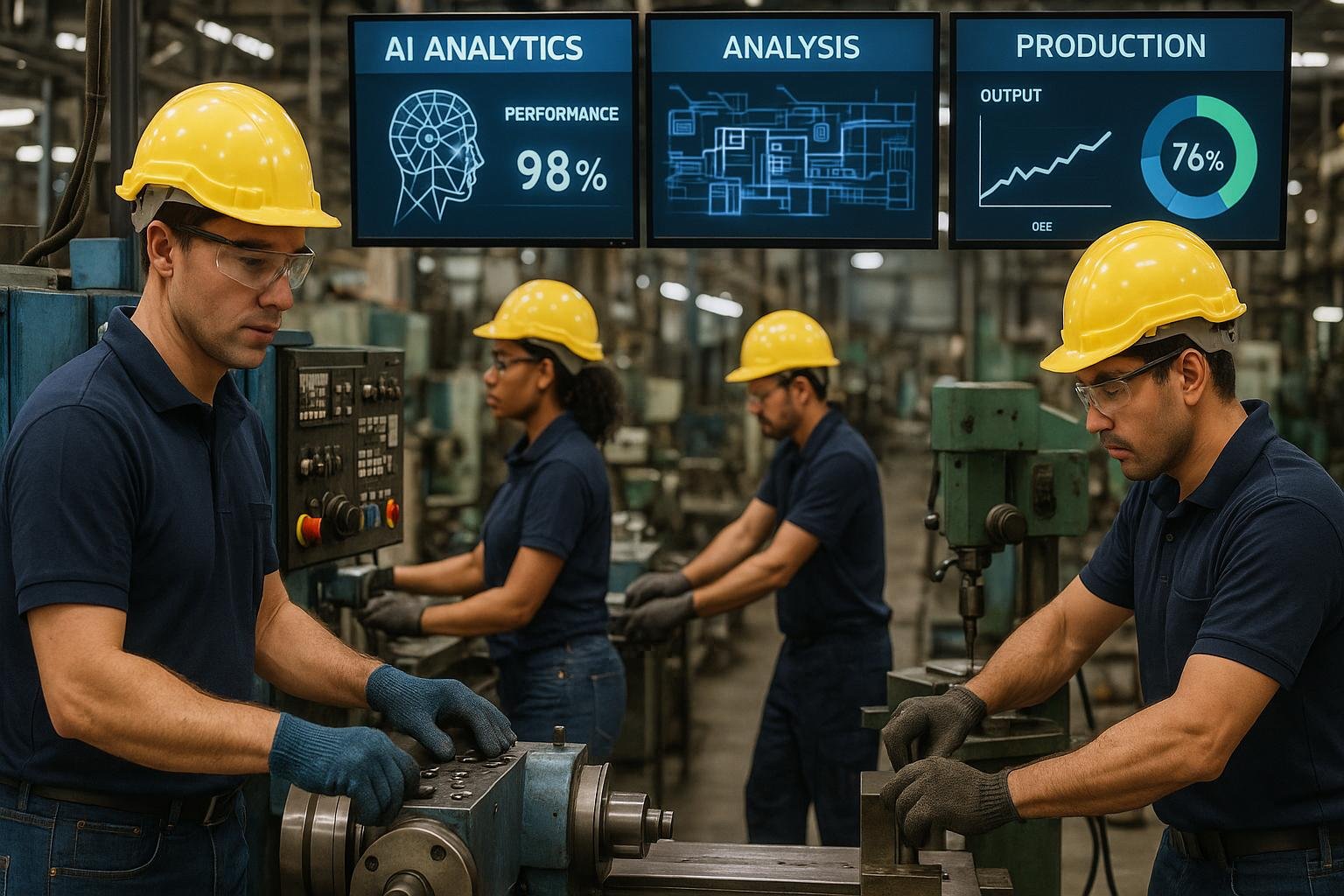
Manufacturing firms are increasingly leveraging real-time operational data and AI analytics to enhance decision-making, improve efficiency, and unlock untapped value across the supply chain, signalling a new era of data-driven industry transformation.

Manufacturing firms are treating operational data as a strategic asset, reshaping decisions from the shop floor to the boardroom. Where factories once measured success in machines, people and materials, executives now fact...
Continue Reading This Article
Enjoy this article as well as all of our content, including reports, news, tips and more.
By registering or signing into your SRM Today account, you agree to SRM Today's Terms of Use and consent to the processing of your personal information as described in our Privacy Policy.
The shift reflects two parallel developments: vastly improved data capture across production environments and more sophisticated analytics that translate raw signals into business-ready insight. According to Forbes, adopting a data‑first approach brings concrete benefits including faster time‑to‑value, improved customer experience and stronger sustainability management. That alignment of operational metrics with commercial goals is turning everyday manufacturing information into a form of capital, the article argues.
Real‑time visibility has replaced delayed, shift‑end reports. IIoT devices, connected equipment and automated inspection systems continuously monitor variables such as temperature, vibration, throughput and product dimensions. These feeds are consolidated in manufacturing execution systems and analytics platforms so managers can spot bottlenecks, trigger corrective action and quantify the impact of operational changes almost immediately. Industry commentary notes that embedding analytics into production enables organisations to detect quality deviations earlier, cut rework and reduce downstream warranty exposure.
That capability is already altering executive decision making. Production dashboards give senior leaders evidence on whether capacity can support new product launches or higher demand, and reveal where targeted investment , in automation, maintenance or new tooling , will produce measurable returns. IBM’s Manufacturing 4.0 research highlights the large upside from sharing and analysing process data, estimating potential value in the tens of billions; the report also warns that only a minority of manufacturers are yet extracting continuous improvement insight from equipment and system data, indicating substantial untapped opportunity.
Predictive analytics is extending the value chain from hindsight to foresight. Predictive maintenance models use historical trends and live telemetry to forecast likely breakdowns, enabling planned interventions that avoid costly stoppages. Demand‑forecasting models that combine production data with market signals allow firms to rebalance inventory and schedules proactively. The expanding deployment of high‑speed data capture hardware and robust circuit‑board infrastructures underpins these capabilities by ensuring reliable, low‑latency information flows.
National ecosystems are accelerating adoption. According to ITPro, 53% of UK manufacturers already use AI on the factory floor and a striking 98% plan implementation, driven by use cases such as computer vision for quality control and predictive maintenance. The UK’s mix of startups, systems integrators, institutional funding and reskilling initiatives is presented as a competitive enabler that could consolidate the country’s leadership in AI‑driven manufacturing across Europe.
Technology trends set to deepen the transformation include broader IIoT sensor roll‑outs, 5G connectivity to carry richer data streams, virtualised process control and wider use of digital twins to simulate production scenarios. A 2024 industry press release also flagged “dark factories” and greater automation as forces that will make data the default medium for control and optimisation.
Yet technology alone will not deliver results. Business leaders must cultivate data literacy and cross‑functional collaboration so that operators, engineers and executives share a common understanding of metrics and trade‑offs. Training programmes that teach personnel to read dashboards and to interrogate trend data are becoming a standard component of digital transformation roadmaps. Forbes has pointed out that firms that treat data as capital and embed analytic thinking across functions win improvements in customer loyalty, process efficiency and sustainability outcomes.
There are risks and caveats. IBM’s findings suggest many organisations struggle to convert equipment data into continuous process improvement, while rapid AI uptake creates challenges around skills, governance and integration. Companies should therefore balance technology investments with clear use cases, robust data governance and an incremental approach to scaling analytics.
As manufacturers continue to digitise, operational intelligence will play a larger role in shaping corporate strategy. Organisations that can reliably capture, contextualise and act on production data will gain more predictable operations, faster innovation cycles and clearer evidence for strategic bets. The ongoing wave of sensors, connectivity and analytics promises to make the data that once lived on the factory floor an indispensable input to boardroom decisions.
Source: Noah Wire Services
Subscribe to Industry Updates