


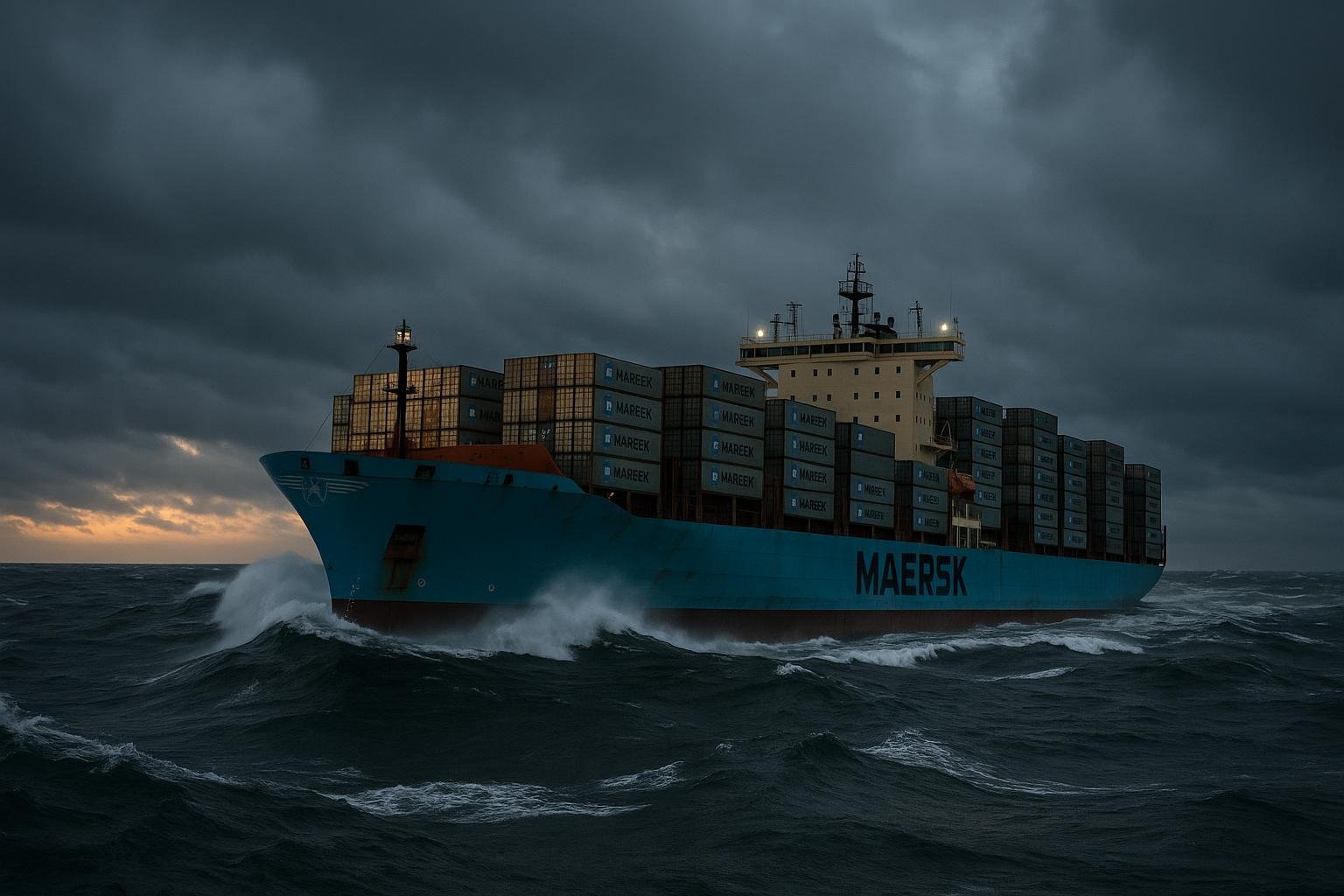
Maersk and Hapag-Lloyd’s collaborative Gemini network has achieved over 90 per cent schedule reliability, promising a seismic shift in ocean freight predictability amid geopolitical and environmental challenges.

Would you take a bus to work if it only arrived on time three days a week?” Bhavik Mota, Director, Regional Ocean Market, Maersk Line India Pvt. Ltd, asks, setting out the case for a radical redesign of ocean networks. “That has been the reality for sh...
Continue Reading This Article
Enjoy this article as well as all of our content, including reports, news, tips and more.
By registering or signing into your SRM Today account, you agree to SRM Today's Terms of Use and consent to the processing of your personal information as described in our Privacy Policy.
What followed was the Gemini Cooperation, a joint operational network between Maersk and Hapag‑Lloyd intended to deliver sharply higher schedule reliability through a hub‑and‑spoke design, leaner loops and fewer port calls. According to Maersk, the initiative was phased in from February 2025 with an ambition to lift schedule reliability above 90 per cent; Mota says the network has “consistently delivered 90 per cent.” Sea Intelligence is cited by Maersk as the independent measure for that KPI. The aim, he adds, was not only faster transit but predictability: “Delivering reliability during transition was as important as the end‑goal itself.”
The partnership’s origins and scale are described differently in public statements. Maersk’s January 2024 announcement framed Gemini as a collaboration combining roughly 290 vessels with a combined capacity of about 3.4m TEU, split 60:40 between Maersk and Hapag‑Lloyd. Hapag‑Lloyd’s January 2025 release, by contrast, said the network would operate with around 340 vessels and emphasised the ambition to transform reliability and connectivity across East‑West trades. Reporting thus shows some variance on fleet numbers and structure as the venture moved from design into operation.
Operational discipline underpins Gemini’s promise. Mota describes a three‑month rollout focus on phasing ships and shuttles into the new loops, protecting customers during the transition and aligning internal systems to guarantee on‑time connections. The network is modular by design so that “disruptions can be isolated without disturbing the entire schedule,” he says. That isolation strategy rests on fewer, strategically located hub calls where Maersk says productivity has nearly doubled since 2016 and terminal capacity is being increased by a targeted 40 per cent by 2027.
The commercial trade‑offs are acknowledged. Tighter controls on overbooking and reduced tolerance for rollovers initially “caused some discomfort,” Mota admits, but he argues customers are increasingly willing to accept discipline in return for the certainty they lacked. Maersk has framed its immediate priority as delivering the product rather than pursuing price competition; Mota expects stronger reliability will encourage longer contracts and greater customer commitment in time.
The network’s benefits are tangible, he says. Digital scenario planning, running simulations up to two weeks ahead, has helped equipment availability and reduced inventory risk for shippers, with retail, automotive and reefer cargo singled out as major beneficiaries. For Indian exporters, including seasonal shippers such as grape growers targeting European supermarkets within an 8–10 week window, Mota says Gemini’s predictability has already been “transformative.” Maersk points to enhanced multimodal links in India, including dedicated rail rakes from the NCR and Punjab, to align inland timing with Gemini sailings.
Risk management has remained paramount. Since attacks in late 2023 by Yemen’s Houthi forces precipitated a broad industry avoidance of the Red Sea, Maersk and Hapag‑Lloyd said they rerouted many sailings via the Cape of Good Hope to maintain safety and reliability. In November 2025 the two partners told media there was no specific timeline to resume regular Red Sea transits until security conditions improved, stressing that any return would be conditional on safety. That cautious stance began to change in December 2025 when Reuters reported Maersk completed a Red Sea transit on 19 December 2025 with the vessel Maersk Sebarok, a step signalling how carriers are reacting to a October 2025 ceasefire and tentative moves toward resuming Suez Canal services.
The shift back toward the Suez route may shorten voyages and reduce costs versus round‑Africa routings, but it exposes operators to a security calculus that remains fluid. Gemini’s modular design and hub focus are intended to give partners the flexibility to reroute and protect schedules when geopolitical events, weather, strikes or hinterland congestion threaten connections.
Environmental trends are also reshaping strategic choices. Industry announcements in December 2025 show Hapag‑Lloyd and other carriers preparing to deploy low‑emission e‑fuels from 2027, signalling that networks such as Gemini will need to balance reliability and speed with decarbonisation pathways and fuel availability. For now, Gemini’s commercial pitch centres on time certainty as a currency; for shippers burned by years of schedule volatility, the value of a reliably timed supply chain can be measured in lower inventory costs and reduced working capital.
Gemini’s longer‑term test will be sustaining the 90 per cent reliability threshold under shifting trade patterns, fuel transitions and geopolitical pressures. Maersk and Hapag‑Lloyd have publicly framed the cooperation as a design‑led response to a structural weakness in liner shipping: the mismatch between shipper need for predictability and networks built around long strings with many port calls. If the partners can maintain consistent performance while adapting to changing routes and cleaner fuels, Gemini could mark a durable shift in how ocean logistics trade off speed, cost and certainty. If not, the experiment will be a lesson in the difficulty of delivering industrial‑scale reliability across a capricious global system.
Source: Noah Wire Services
Subscribe to Industry Updates

