


Trade retaliation and legal disputes threaten Kentucky’s bourbon industry, with rising inventories and declining exports risking thousands of jobs and billions in revenue, as producers grapple with volatile international markets and legal uncertainty.

When tariffs and retaliation became tools of presidential trade policy, Kentucky’s bourbon makers found themselves squeezed between rising costs at home and collapsing demand abroad, threatening an industry whose s...
Continue Reading This Article
Enjoy this article as well as all of our content, including reports, news, tips and more.
By registering or signing into your SRM Today account, you agree to SRM Today's Terms of Use and consent to the processing of your personal information as described in our Privacy Policy.
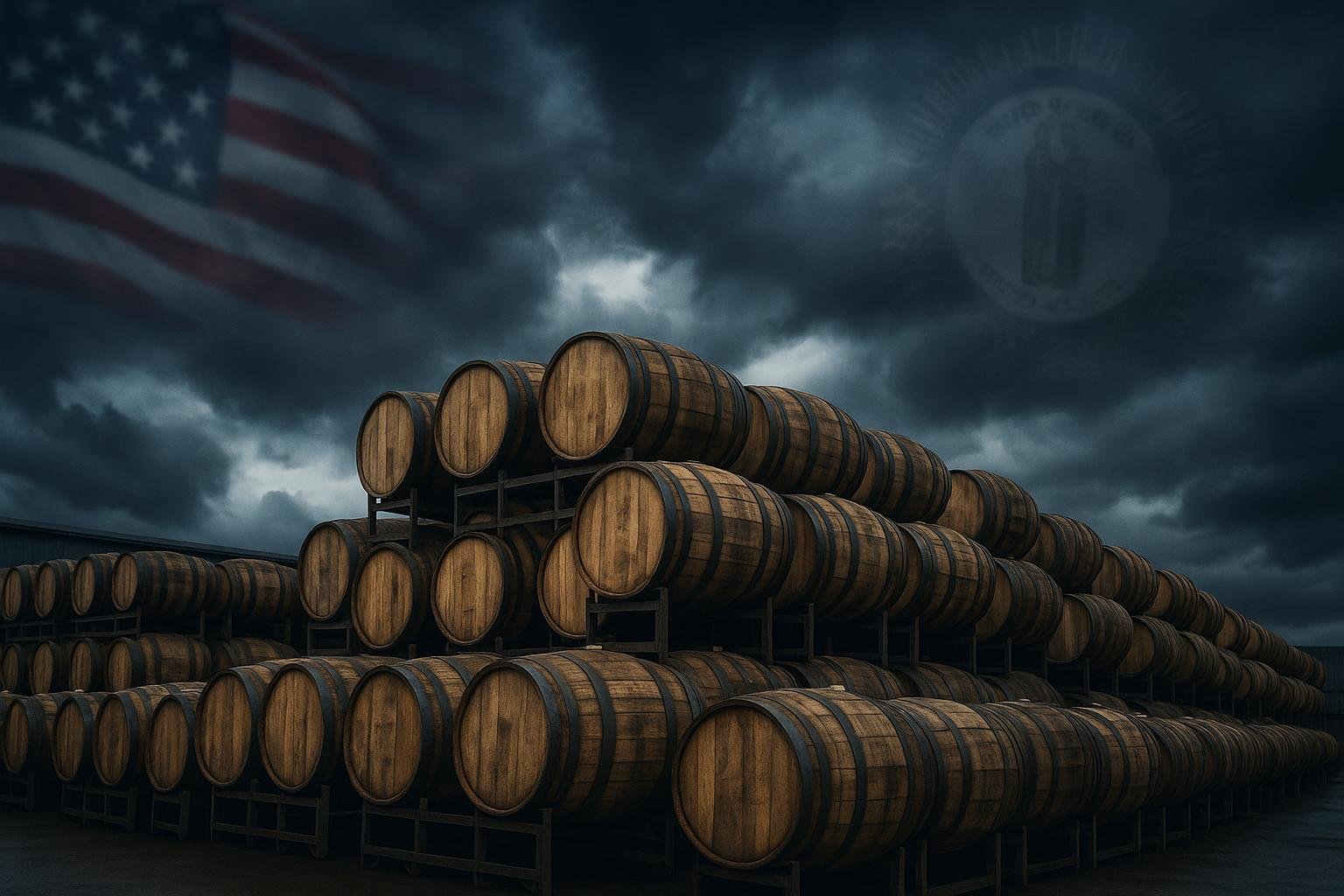
Distillers across the state are sitting on an unprecedented inventory , roughly 16 million barrels , even as overseas orders have evaporated. According to a recent economic assessment commissioned by the Kentucky Distillers’ Association, the sector, now valued at about $10.6 billion, faces “mounting headwinds. Foreign demand, a major driver of past expansion and success, has been curtailed by retaliatory tariffs and other trade policy countermeasures imposed in 2018 and 2025,” the report says. The study warns that if the recent mid‑year decline in exports persists, the state could see a 30% drop in export volumes for the year, erasing some $225 million in annual sales and imperilling roughly 778 jobs and $65.6 million in labour income supported across distilleries, cooperages, transport and corn producers.
Executives and growers say the damage is not only from the headline rates but from the uncertainty that accompanies them. Long production lead times and sensitivity to retail price points make stable foreign contracts essential; sudden swings in duties and the threat of new levies make exporters reluctant to invest in overseas marketing or expand production. “The industry must maintain existing markets and develop new international markets to grow. Given the heightened level of volatility associated with recent trade policy, making investments in foreign markets has become increasingly uncertain. This could have a cooling effect on potential investments and slow future growth in one of Kentucky’s signature industries,” the economists wrote.
The commercial consequences are already visible in corporate results. Brown‑Forman, maker of Jack Daniel’s and other brands, reported a mid‑year profit decline of about 14% , nearly $60 million , compared with the same period in 2024, after retailers in retaliatory markets such as Canada pulled American spirits from shelves in 2025. Lawson Whiting, Brown‑Forman’s chief executive, said at the time that seeing bottles removed felt worse than the tariffs themselves.
Broader economic analysis suggests the burden of higher tariffs has fallen unevenly but often heavily on U.S. businesses. A JPMorganChase Institute report found that tariff payments by midsize American firms roughly tripled over the preceding year, forcing many to raise prices, pare staff or accept shrunk margins. Industry groups and small business owners have pressed the administration to narrow its approach, arguing that the costs are paid largely by U.S. companies and consumers rather than foreign producers.
The legal landscape has added another layer of volatility. On 20 February 2026 the U.S. Supreme Court ruled 6‑3 that the president exceeded his authority by imposing sweeping reciprocal tariffs under the International Emergency Economic Powers Act, holding that such taxation powers belong to Congress. Chief Justice Roberts’ majority opinion invoked the major questions doctrine and emphasised congressional primacy over broad economic policy. The decision was welcomed by trade challengers and small businesses seeking relief, but it did not end the uncertainty: the White House immediately signalled alternatives, and the president moved to impose a temporary 10% global tariff for 150 days under different statutory authority.
That pattern, tariffs struck down or restrained in court, then reintroduced through other legal routes, has kept exporters guessing. The administrative and compliance costs of shifting trade policy, plus disputes over refunds for previously collected duties, mean that even favourable court outcomes can leave companies exposed for months.
Internationally, measures targeting U.S. spirits have been part of wider transatlantic and hemispheric tensions. Canadian provincial decisions to stop selling American whiskey in 2025 hit export channels hard, and European officials have contemplated steep levies on American wines and other alcohols in response to U.S. steel and aluminium measures. Reports that the United States floated punitive tariffs of up to 200% on European wines raised the prospect of reciprocal escalation that would further constrict cross‑border sales and raise prices for consumers on both sides of the Atlantic.
For Kentucky’s smaller distillers the arithmetic is particularly grim. Bourbon ages in wood for years; it cannot be sold quickly without risking brand dilution, nor can it be kept indefinitely without loss. Industry analysts note an annual barrel loss rate of around 2% to evaporation and wood absorption; extended storage without viable markets risks both waste and the financial strain of carrying inventory. Flooding discount channels is seen as a last resort because it would erode premium positioning that producers have spent decades building.
Despite the pressures, many local firms have been cautious in their public comments, framing their concerns within broader support for policies that strengthen American manufacturing while urging more predictable trade rules. That reticence reflects the political geography: distilleries are often key employers in rural and exurban communities that politically favour protectionist agendas, even as those same policies undercut exporters.
Economic forecasters say the immediate policy choices will determine the industry’s trajectory. If duties stabilise and retaliatory measures are rolled back, distillers might avoid painful cutbacks and resume overseas growth. If policy oscillation continues, some producers could scale back investment, delay hiring or, in the worst cases, leave the market. The combination of legal uncertainty, volatile diplomacy and the biological realities of barrel ageing has turned what was once a steady export success into a brittle balancing act for one of Kentucky’s heritage industries.
Source: Noah Wire Services
Subscribe to Industry Updates

