


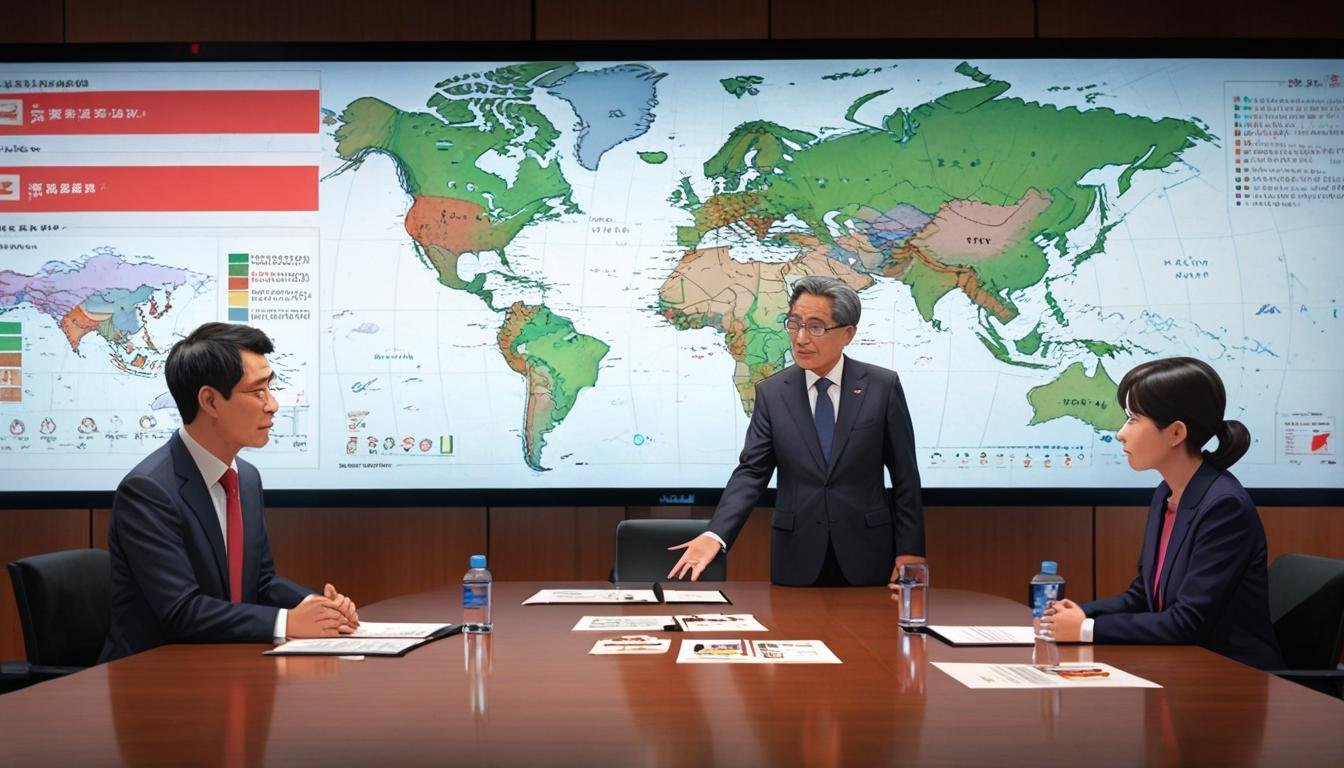
**Seoul**: In a pivotal meeting, Japan, South Korea, and China focused on strengthening economic cooperation and accelerating negotiations for a comprehensive free trade agreement, amidst rising U.S. tariff pressures affecting their markets, and pledged to create a fair and stable business environment in the region.
In a significant move aimed at bolstering economic cooperation, Japan, South Korea, and China convened for an emergency meeting in Seoul on Saturday to discuss trade-related challenges and strategies amidst increasing tariff pressures from the United States. This meeting marked the first tripartite discussion of such nature since 2020, demonstrating a renewed commitment to align policies among these three major East Asian economies.
South Korea’s Minister of Industry, Ahn Duk-geun, Japan’s Minister of Economy, Trade and Industry, Yoji Muto, and China’s Minister of Commerce, Wang Wentao, collectively voiced their intention to provide a “predictable environment” for businesses while focusing on “accelerating” negotiations for a free trade agreement. In a joint statement issued following their discussions, the ministers expressed their dedication to “continue discussions aimed at accelerating negotiations for a comprehensive and ‘fair’ trilateral free trade agreement.”

Negotiations on this free trade agreement originally commenced in 2013 but were stalled in 2019, only to be revitalised earlier this year during a special summit in Seoul that gathered the leaders of the three nations. Acknowledging the hurdles posed by U.S. trade policies, the ministers underscored their intent to ensure fair competition conditions in the global marketplace, striving to foster a business environment that is “predictable, free, open, fair, non-discriminatory, transparent, and inclusive”.
South Korea further highlighted the necessity of enhancing cooperation to stabilise supply chains, improve communication regarding export controls, and ultimately create a more reliable trade environment. The joint efforts also encompass pushing for reforms within the World Trade Organization (WTO) and welcoming new members into the vast Regional Comprehensive Economic Partnership (RCEP), which includes China and 14 other Asian countries.
The backdrop of these discussions is the recent imposition of tariffs by the U.S. administration, which included a 25% levy on steel and aluminum imports and a forthcoming 25% tariff on automobiles, actions that affect Japan and South Korea significantly, as they are responsible for 16% and 15% of the total U.S. automobile imports. China faces a blanket tariff of 20% on all its exports to the U.S., contributing to the urgency of the recent meeting.
Together, China, Japan, and South Korea constitute roughly 20% of the global population, a quarter of the world’s economy, and account for about 20% of global trade, highlighting their pivotal roles in international commerce. As the three nations seek to navigate these complexities in the current geopolitical landscape, their ongoing discussions may serve as a strategic countermeasure to the uncertainties spurred by U.S. trade policies.
Source: Noah Wire Services

