


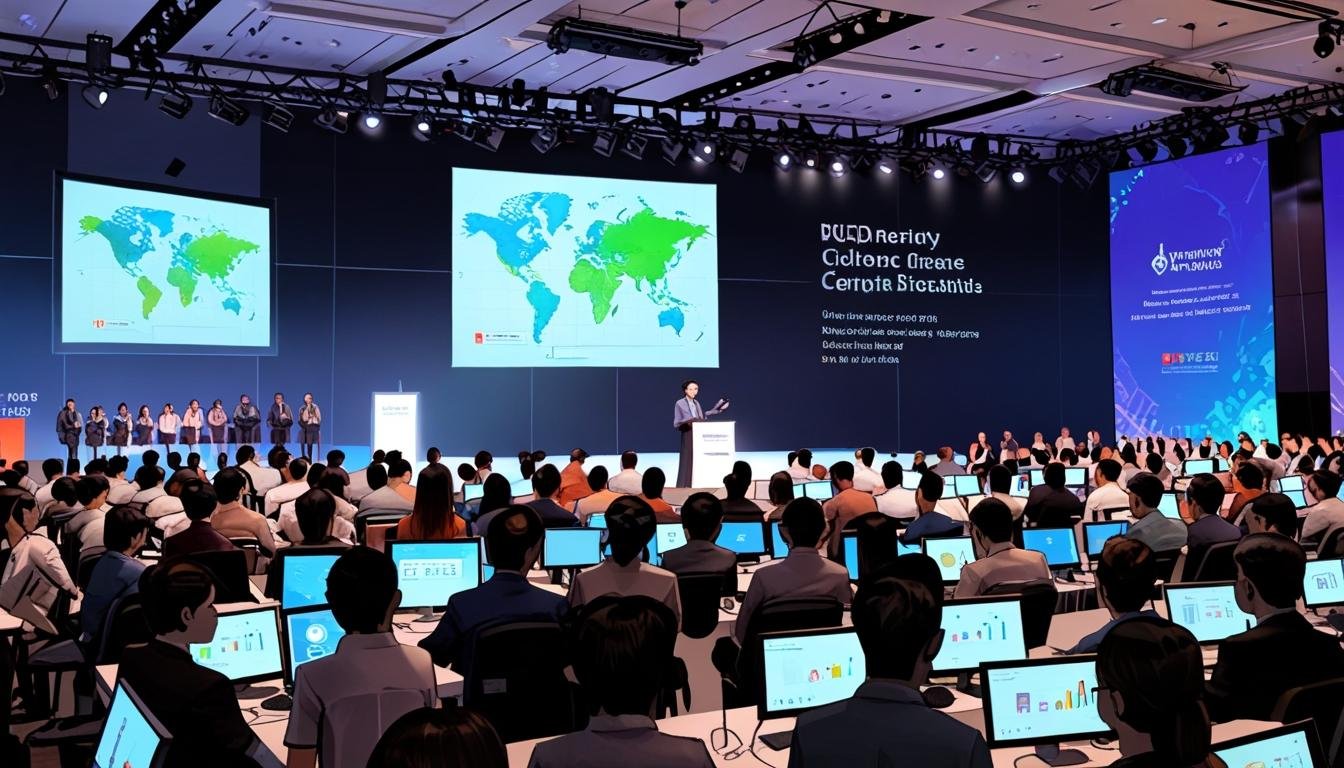
**Hanoi**: The 14th International Business and Finance Conference brought together leaders to discuss supply chain vulnerabilities due to geopolitical shifts, highlighting Vietnam’s electronics sector and U.S. tariffs. Calls for strategic collaboration in technology and enhanced local capabilities were prominent amidst ongoing global trade challenges.
In Hanoi, Vietnam, from the 27th to the 29th of September 2023, the 14th International Business and Finance Conference convened, bringing together industry leaders and experts to discuss the evolving nature of supply chains in the context of recent geopolitical developments. The conference has been a focal point for discussions around the implications of U.S. tariff policies and the broader need for countries like Korea and Vietnam to adapt their supply chain strategies.
Jo Joo-hyun, president of the Korea Small Business and Venture Business Agency, underscored the pressing need for supply chain risk management, particularly in light of the possibility of a second Trump administration. He emphasised that “Korea and Vietnam must seek new opportunities based on a complementary supply chain amid these global environmental changes.” His remarks reflect a growing recognition of the instability stemming from recent global events, such as the COVID-19 pandemic and the ongoing conflict in Ukraine, which have both contributed to increased supply chain vulnerabilities.

The conference highlighted concerns regarding the U.S. trade deficit with Vietnam, which some experts have suggested may be exacerbated by the circumvention of Chinese exports. This raises the spectre of potential U.S. tariffs on Vietnam, akin to those already imposed on Mexico and Canada. The electronics sector, which represents a significant portion of Vietnam’s exports, has been noted as particularly at risk. Currently, Vietnam’s role in this sector remains predominantly that of an assembly hub for low-value-added products, with only a 2% contribution to global added value in electronics despite 61% of its exports being processed intermediate goods.
Kim Yong-kyun, head of the Vietnam Center at Seoul National University’s Asia Research Institute, provided insights into the Vietnamese government’s efforts to bolster its national capabilities. He observed, “The Vietnamese government has been pursuing technology advancement policies to enable its companies to supply materials and components to Korean global companies, but it has not yet reaped results,” indicating that much of this market space is still dominated by Chinese suppliers.
Attorney Hwang Min-seo of the law firm Kim & Chang addressed additional challenges posed by the U.S. “Uyghur Forced Labor Prevention Act (UFLPA).” He pointed out that this legislation, effective since June 2022, has introduced further complications for industries reliant on supply chains connected to China. Countries such as Vietnam, Malaysia, and Thailand are particularly under scrutiny due to the potential for forced labour in their supply chains, necessitating careful management and documentation.
Amid these challenges, various proposals were put forward at the conference, advocating for a medium- to long-term strategic outlook. Jo highlighted critical growth areas where cooperation could be strengthened, specifically in semiconductors, IT, and electric vehicle battery production. His assertion that Vietnam should transition from being seen merely as a manufacturing base to becoming a technical partner was echoed by other speakers. This sentiment was reinforced by calls for establishing a joint manual to tackle tariff risks and improve standards in origin management and technology transfer.
Furthermore, suggestions emerged to localise operations more effectively. Director Kim noted that enhancing the involvement of Korean firms in Vietnam’s value chain, alongside the hiring and training of local specialised personnel, would be beneficial for both countries’ economic development.
Discussions at the conference also introduced the notion that the ongoing geopolitical tensions between the U.S. and China could lead to both risks and opportunities for Vietnam. Vu Thai Huong, Deputy Dean of the College of Business Administration at Hanoi National University, remarked, “The U.S. and China are engaged in a technological war to reduce their interdependence… this has become a factor for Vietnam to enter the global supply chain and has emerged as a destination for the ‘China Plus One’ strategy.” He highlighted the necessity for Vietnam to develop a national strategy to leverage artificial intelligence technology—an area where the country currently lags—asserting that competitiveness in AI is vital for Vietnam’s progression from a manufacturing hub to a developed economy.
As global supply chains continue to evolve amid these changing dynamics, the discussions from the conference may well inform future strategies for cooperation and development between Korea and Vietnam.
Source: Noah Wire Services

