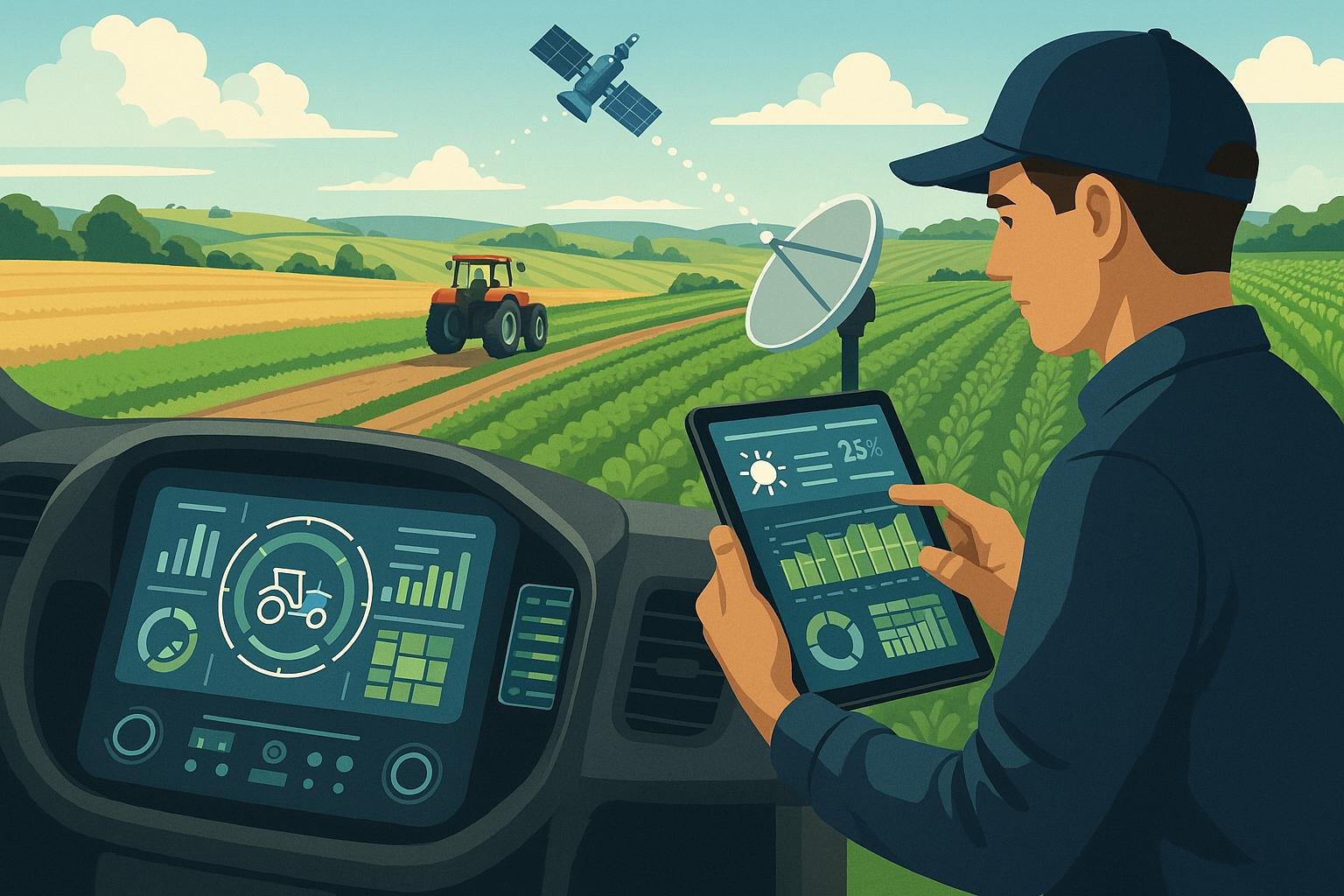
For generations, Indian farming relied on local knowledge and close reading of weather and livestock. In recent years a quieter transformation has begun: digital sensors, satellite imagery and machine learning are being introduced into fields and herds, initially in clustered projects around states such as Maharashtra and Madhya Pradesh.
Practical applications of artificial intelligence on farms are already diverse. Algorithms trained on satellite and drone imagery are being us...
Continue Reading This Article
Enjoy this article as well as all of our content, including reports, news, tips and more.
By registering or signing into your SRM Today account, you agree to SRM Today's Terms of Use and consent to the processing of your personal information as described in our Privacy Policy.
ed to flag nutrient shortfalls in soils, and to spot early signs of pests and disease. Collar-mounted devices on cattle track activity, fertility cycles and health indicators in real time. Robotics, still at an experimental stage, promise targeted mechanical weeding as an alternative to manual labour or blanket herbicide spraying. “AI-enabled robots can be sent into farms to do weeding, as an alternative to herbicides, which have hazardous effects on human health,” noted Dr Bharat Kakade, President and Managing Trustee, BAIF Development Research Foundation, Pune.
Partnerships between research institutions, non-governmental groups and technology firms have produced some measurable gains. According to reporting on pilot projects in western India, an initiative involving the Agriculture Development Trust Baramati, Microsoft and Oxford University has driven sugarcane yields up by roughly a quarter. Those same systems are being retooled for vegetable crops such as tomato and brinjal, with the aim of delivering crop- and farm-specific advisories rather than broad prescriptions. “What we are doing in sugarcane – soil health management, soil moisture, soil nutrients, crop health, crop nutrition, and crop protection – similar things will be done for vegetables,” Dr Kakade said.
Central government programmes are attempting to scale these capabilities. The Digital Agriculture Mission, approved with an allocation of Rs 2,817 crore in 2024, is building a foundation of verified datasets on landholdings, crops and livestock intended to feed AI tools. AgriStack, the digital identity layer at the heart of the plan, had produced over 7.63 crore Farmer IDs by November 2025, including 1.93 crore for women farmers, industry reporting and government releases show. The Press Information Bureau says the mission has surveyed some 23.5 crore crop plots and that new systems such as the National Pest Surveillance System cover dozens of crops and hundreds of pest types while supplying real‑time advisories to extension workers.
Several national platforms already reach millions. According to the Press Information Bureau, the Kisan e‑Mitra chatbot has fielded more than 9.3 million queries in 11 regional languages, and an AI pilot offering local monsoon‑onset forecasts for Kharif 2025 communicated by SMS reached 3.88 crore farmers across 13 states; substantial proportions of those surveyed reported changing sowing decisions on the basis of the forecasts. Government and industry analyses also point to technology-driven improvements in crop insurance processes: YES‑TECH, a yield estimation system using remote sensing and AI, has been taken up by nine states and enabled a move away from exhaustive ground‑based crop-cutting experiments in places such as Madhya Pradesh. The CROPIC tool allows farmers to upload geotagged, time‑stamped photos to support faster damage assessments under the Pradhan Mantri Fasal Bima Yojana.
Field-level reporting illustrates both benefits and limits. Farmers in Maharashtra who subscribe to AI‑enabled advisory apps receive frequent updates on soil moisture, nutrient status and disease risk; they report savings on inputs and higher productivity. Yet practitioners and researchers emphasise that current systems are not yet autonomous. Data gaps remain, and many AI outputs require verification by agronomists or extension officers before they can be acted on safely. “Unless you have sufficient data collected, gathered, analysed, and until accuracy reaches a certain level, you can’t rely on solutions. As data increases, accuracy and reliability improve,” Dr Kakade said.
The government’s own AI Playbook for Agriculture, produced with the World Economic Forum, acknowledges systemic obstacles: fragmented data ecosystems, uneven digital infrastructure, affordability constraints and the challenges of last‑mile delivery. Skilled human resources who understand both agricultural science and data science are in short supply, and early‑stage funding is needed to shepherd pilots to commercially sustainable models, analysts warn.
Beyond technical hurdles, adoption hinges on trust and usability. Voice‑first, multilingual interfaces such as the proposed Bharat‑VISTAAR platform aim to make advisory services accessible to smallholders who are uncomfortable with text‑based apps. Yet privacy, data governance and the concentration of agricultural data into large digital stacks remain subjects of policy debate, and analysts caution that farmers must retain control over the information that underpins decision‑making.
For now, India’s agricultural landscape is being reshaped incrementally. AI is shifting some decisions from gut feeling to data‑driven signals, improving timeliness and, in specific pilots, raising yields and reducing costs. But scaling those gains will depend on expanding reliable datasets, strengthening extension networks to validate machine outputs, and designing affordable, locally appropriate solutions that farmers trust and can use day to day.
Source: Noah Wire Services