


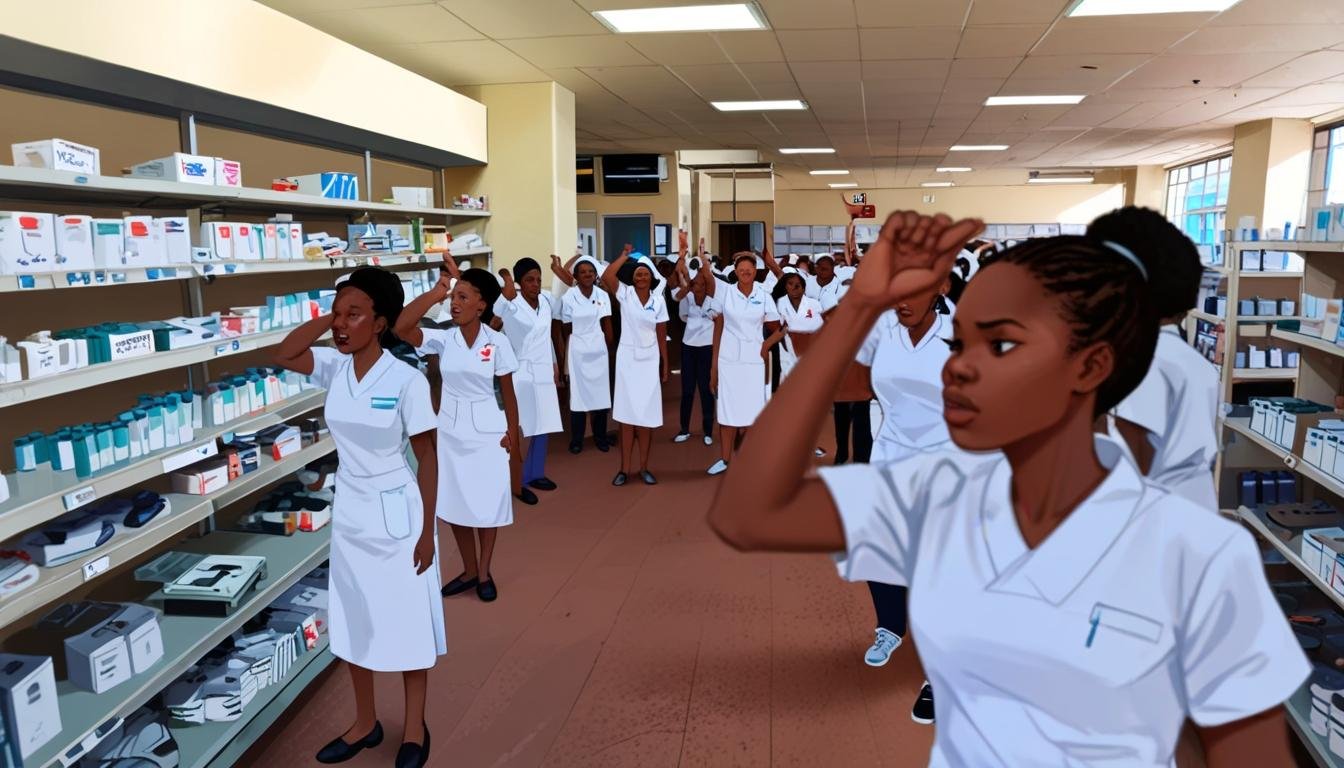
Pharmacy counters at public hospitals across Eswatini are increasingly bare, leaving both patients and healthcare professionals frustrated as a severe shortage of essential medications unfolds. Amidst this growing crisis, doctors and nurses are taking action, staging protests at various government facilities such as Mbabane Government Hospital and Mankayane Government Hospital. Their aim is clear: to provoke government intervention, urging a prioritisation of the healthcare sector and sufficient provisioning of essential medicines.
This shortage, once a sporadic concern, has escalated into what many are now calling a national emergency. Criticism has predominantly focused on local pharmaceutical suppliers, facing allegations of negligence and profiteering. However, two suppliers have emerged to share their perspectives, highlighting a system significantly hampered by bureaucratic inefficiencies and regulatory challenges. Speaking under anonymity, they describe an intricate web of paperwork and procedural hurdles that turns a seemingly direct process into a daunting ordeal.

The journey for a medicine order begins with the Ministry of Health, where an apparently straightforward request descends into a convoluted process. Each medication—be it a blister pack of antibiotics or a vial of insulin—must be logged within the Medicines Regulatory Unit (MRU) database, with suppliers required to ensure all registration documents remain current. If any requisite certificate has lapsed, they are compelled to retrace earlier steps to acquire resubmission.
One supplier recounted the meticulous process: “Once we have our Proforma Invoice (PFI) from the manufacturer, we submit it to the MRU, which requires a scheduled meeting to approve import requests. The pacing of this system can extend from a few days to several weeks, influenced heavily by bureaucratic scheduling.” The approval of import permits takes an additional week, further straining an already sluggish process. These compounded delays mean that from start to finish, obtaining an import permit can take upwards of a month.
When compounded with global supply chain limitations—such as dependency on manufacturers in India and China—this bureaucratic red tape can drastically extend the time it takes to receive critical medications. Delays stretch from receiving orders to processing payments at overseas banks, which require the appropriate import permit to authorise transactions. The supplier explained: “Manufacturers often don’t keep stock on hand; they rely on upfront payments for production. So, if our permit takes too long, by the time we can pay, the available stock is often sold out.”
These logistical challenges bring to light broader issues affecting pharmaceutical supply chains worldwide. A recent report indicated that the global market for generic medicines is facing significant strains, with manufacturing challenges and weak supply logistics contributing to shortages. Generics, which make up the majority of prescriptions, are increasingly unattractive for production due to low pricing and narrow profit margins. Alternatives such as reshoring manufacturing and revising procurement practices have been suggested, yet structural issues persist in addressing these supply woes.
In the United States, similar shortages have prompted proposals for hospitals to maintain three-month stockpiles of critical drugs, but experts warn that such plans are fraught with inadequacies and could disadvantage those serving the most vulnerable populations. A survey from various health systems revealed that over half had to cancel procedures due to product shortages— a sentiment echoed across nations facing similar challenges.
As the situation in Eswatini continues to evolve, calls for change are being acknowledged at governmental levels, with Khanya Mabuza, Principal Secretary in the Ministry of Health, stating that new guidelines are being developed to enhance procurement processes. However, these proposed changes will need to be swift and effective, as the ramifications of the current delays and shortages continue to impact patient care and health outcomes across the nation.
Efforts to reform the procurement and distribution of medicinal supplies not only have implications for Eswatini but resonate on a global scale, underscoring the interconnected nature of healthcare systems and the urgent need for reform across the board in managing supply chains effectively amidst rising challenges.
Reference Map
- Paragraphs 1, 2, 3, 4, 5
- Paragraphs 6, 7
- Paragraphs 8, 9
- Paragraphs 10
- Paragraphs 11
- Paragraph 12
- Paragraph 13
Source: Noah Wire Services

