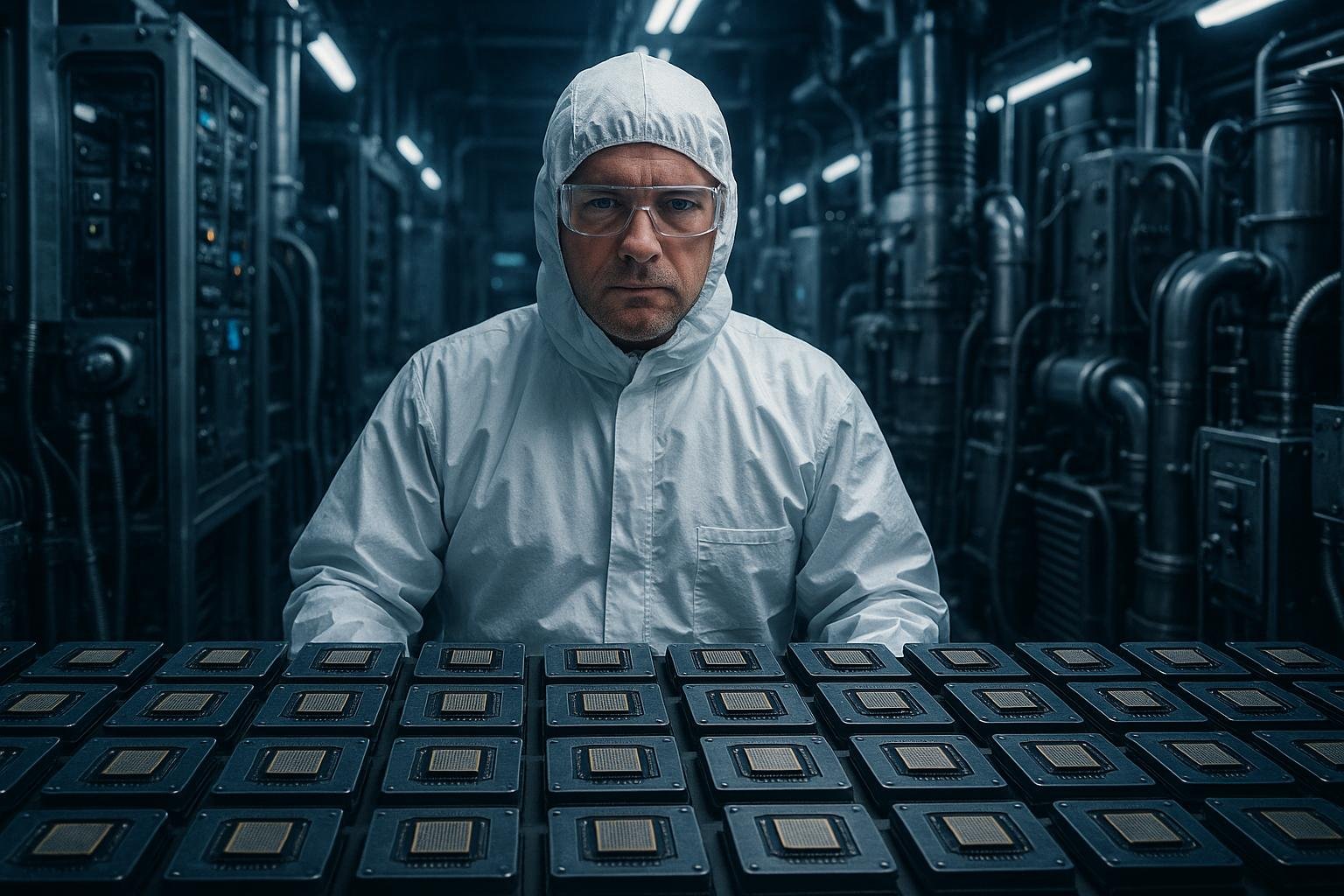
Tom Caulfield highlights strategic pivots at GlobalFoundries, emphasising operational discipline, technological focus, and the importance of long-term planning amid industry challenges and regional concentration.

Tom Caulfield, reflecting on years in chipmaking leadership, told a December 3, 2025 fireside conversation at the PDF Solutions Users Conference that hard choices about manufacturing define strategy and determine who prosperes in semiconductors. Speaking with J...
Continue Reading This Article
Enjoy this article as well as all of our content, including reports, news, tips and more.
By registering or signing into your SRM Today account, you agree to SRM Today's Terms of Use and consent to the processing of your personal information as described in our Privacy Policy.
Faced with the economics of cutting‑edge nodes, Caulfield said the board’s expectation to pursue 7nm proved untenable for a firm of roughly $5 billion in revenue. Rather than attempt a high‑risk chase for the most advanced transistor geometries, he opted to withdraw from 7nm work and redirect resources where the company could sustain competitive advantage. That decision, he argued, clarified priorities and freed the business to invest in areas where volume, longevity and reliability matter more than transistor density.
Caulfield drew lessons from factory floors where physics and materials tolerance leave little room for ambiguity. High performing fabs, he said, distinguish themselves through relentless process control, data‑driven problem solving and unambiguous ownership of outcomes. He described a culture shift from defensive behaviour to rapid remediation once leaders made responsibility explicit: when accountability is visible, teams move faster and fear diminishes.
Automation and analytics play an enabling role, yet Caulfield cautioned against treating artificial intelligence as a panacea. According to his account, AI delivers tangible gains in digital domains, design verification, predictive maintenance, forecasting and equipment utilisation, but it must be deployed where it produces step‑change impact. Manufacturing remains governed by material realities and human judgement; AI is leverage, not replacement, for operational rigour.
GlobalFoundries’ Singapore site stands as a case study for the approach he outlined. According to the Economic Development Board of Singapore, the company opened a US$4 billion expansion that added a 23,000 square‑metre fab, about 1,000 high‑value jobs and capacity for an additional 450,000 300mm wafers annually, bringing the campus to roughly 1.5 million wafers a year. Caulfield pointed to sustained reinvestment and repeatable processes at Singapore as the template the company seeks to replicate: global manufacturing, in his view, means reproducible capability across sites rather than mere geographic dispersion.
That emphasis on repeatability feeds directly into supply resilience. Caulfield characterised the industry’s extreme regional concentration of advanced production as a leadership and governance shortfall rather than a purely geopolitical problem. He welcomed policy moves such as the CHIPS Act to alter supply economics but warned that durable capacity expansion requires long‑term commercial commitments from customers as well as governments. Building and qualifying fabs unfolds over years; leadership must plan on that horizon.
The conversation also addressed how AI is shifting where value accrues across the tech stack. With software and algorithmic capabilities reducing design cost and time, system companies are increasingly motivated to create bespoke silicon. The result, Caulfield suggested, is pressure on traditional separations between system houses, fabless designers and foundries, making strategic focus and differentiation as important as scale.
Talent strategy, he added, must be institutionalised. The semiconductor workforce now spans time zones and disciplines; remote and distributed engineering can be a competitive advantage when organisations embed the practices that enable continuous, global collaboration rather than reverting to old norms when the crisis passes.
Finally, Caulfield made the case for broader educational foundations in an AI‑accelerated world. Engineering teaches how to construct systems; liberal arts cultivate the contextual judgement, ethical reflection and decision‑making under uncertainty that machines cannot replicate. As routine tasks become more automated, human value increasingly lies in framing questions, assessing trade‑offs and guiding organisations through ambiguous terrain.
Taken together, Caulfield’s reflections framed manufacturing not as a backend function but as a strategic lever: leaders must choose where to play, accept uncomfortable trade‑offs, and build repeatable, accountable operations that convert factories into durable competitive advantage.
Source: Noah Wire Services
Subscribe to Industry Updates