


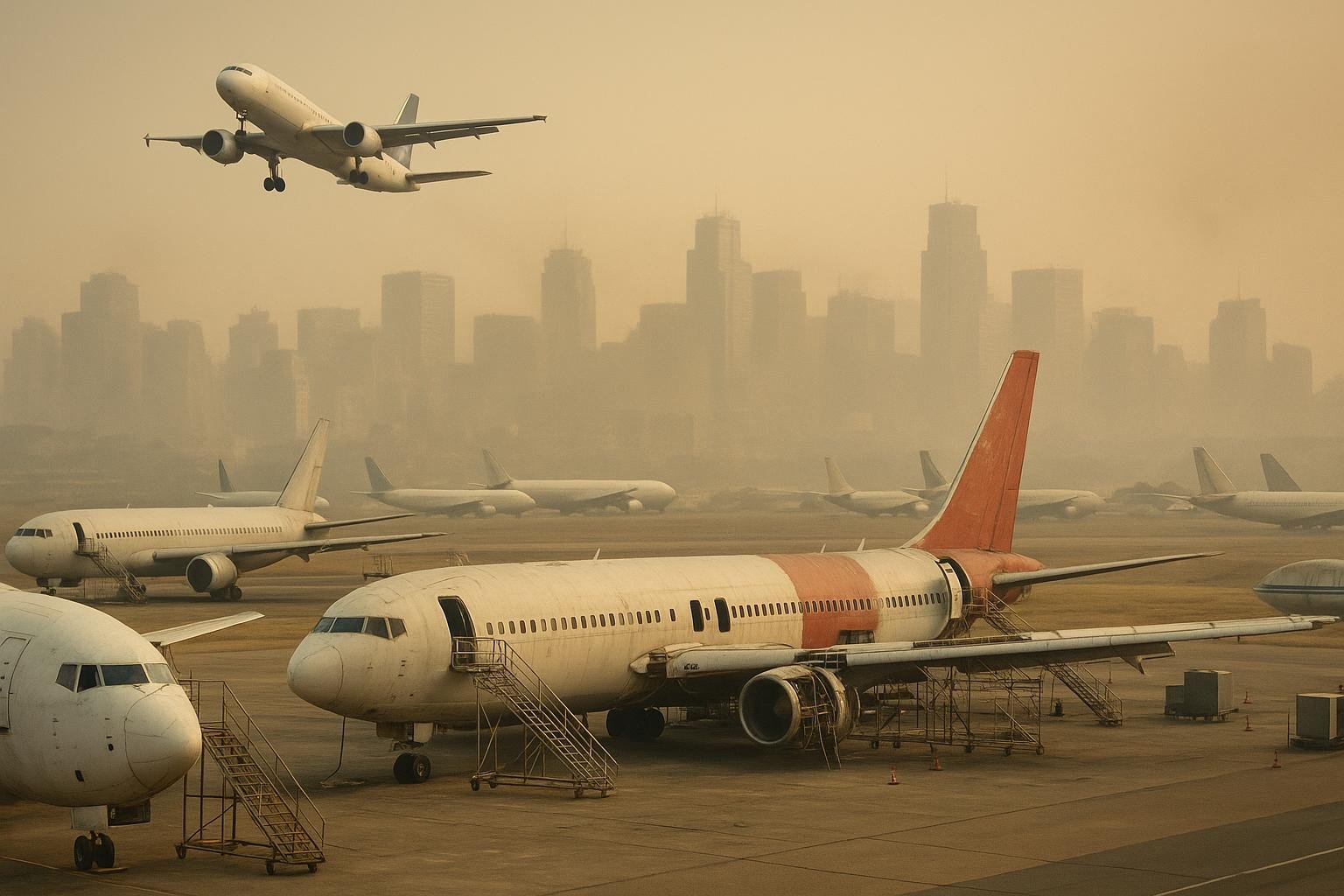
Years after pandemic disruption, the aviation industry continues to grapple with severe supply chain bottlenecks, leading to higher operational costs, longer aircraft lifespans, and delays in new aircraft deliveries, with industry experts warning of persistent challenges until at least 2034.

Years after pandemic-era disruption, the global aviation supply chain remains strained, forcing airlines to prolong the service life of older aircraft, pay more for spare parts and ...
Continue Reading This Article
Enjoy this article as well as all of our content, including reports, news, tips and more.
By registering or signing into your SRM Today account, you agree to SRM Today's Terms of Use and consent to the processing of your personal information as described in our Privacy Policy.
According to the International Air Transport Association (IATA), the mismatch between surging passenger demand and constrained production capacity cost carriers more than $11 billion in 2025. IATA and Oliver Wyman attribute that sum to four main drivers: higher fuel bills from burning less efficient aeroplanes, elevated maintenance outlays on ageing fleets, steeper engine leasing charges as engines spend longer off-line, and the cost of holding extra inventory to cover unpredictable shortages. The industry’s backlog of new orders reached a historic peak of more than 17,000 aircraft in 2024, intensifying the bottleneck. Industry data shows passenger traffic jumped strongly in 2024 and 2025, outpacing manufacturers’ ability to deliver capacity and sending load factors to record levels.
Executives speaking at the Singapore Airshow warned the problems have hardened into an entrenched state. Jeffrey Lam, chief operating officer and president of commercial aerospace at ST Engineering, described ongoing delays as the “new norm,” adding the situation was “completely unacceptable.” ST Engineering cautioned that while some components, engine nacelles, for example, can be manufactured in weeks, total lead times for many parts and materials now stretch to a year or more, versus roughly nine months prior to the pandemic.
Manufacturers themselves acknowledge exceptional demand. Gael Meheust, chief executive of CFM International, the GE-Safran joint venture that supplies many narrowbody engines, said production rose by about 25% in 2025 but still lags the unprecedented level of orders; he flagged plans to grow output by at least 10% a year. IATA’s December update warned that deliveries only began to recover late in 2025 and that the structural imbalance between what airlines need and what factories can supply is unlikely to be resolved before about 2031–2034. The association also put cumulative delivery shortfalls at least 5,300 aircraft and said the average fleet age has climbed past 15 years.
Operationally, the consequences are immediate. Scoot’s chief executive Leslie Thng told a conference panel that the carrier has bought spare engines at its own cost to reduce disruptions, a reflection of how airlines increasingly self-insure against parts scarcity. IATA’s analysis breaks down the 2025 hit into roughly $4.2 billion in excess fuel costs, $3.1 billion in added maintenance, $2.6 billion in engine-leasing expenses and $1.4 billion in inventory carrying costs.
Geopolitics and commodity shortages have amplified the strain. Paul Wingfield of Future Metals, part of the Berkshire Hathaway group, said the war in Ukraine dramatically curtailed access to Russian titanium supplies that previously accounted for about half the global market, pushing lead times for titanium and nickel tubing to 50–60 weeks from pre-pandemic norms nearer 20 weeks. Tariffs, trade tensions and a scarcity of skilled labour have also contributed to slower certification and longer production cycles, the trade body reported.
The disruption has, however, created openings for alternative suppliers and lower-cost producers. Feng Haotian, a sales engineer at Chinese carbon brake-disc maker Shandong Stopart Brake Material, said Western OEM shortages doubled the company’s international sales last year; Stopart’s sets, he noted, were offered at roughly half the price of comparable Western parts. Such shifts underline a broader reconfiguration of supply relationships as airlines and MROs seek reliable sources amid global shortfalls.
For Oman’s carriers and maintenance businesses, the extended recovery implies both pressures and prospects. A special analysis for Omanet argued that higher operational and maintenance costs will force local airlines to refine fleet strategies and tighten cost structures, while opening space for regional suppliers, aftermarket service providers and technology firms to capture market share by addressing bottlenecks.
IATA cautions that while production should accelerate through 2026, demand is forecast to continue outpacing supply for years. The association and industry commentators urge coordinated action across manufacturers, suppliers and policymakers to expand capacity, diversify material sources and rebuild resilience in a network that remains fragile after years of disruption.
Speaking to industry media about the wider implications, IATA director general Willie Walsh called the situation “very frustrating,” pressing suppliers to speed improvements to ease the financial burden on airlines. Industry watchers say that unless investment in supply chains and workforce skills is stepped up, carriers worldwide will face higher costs and constrained growth for the better part of the coming decade.
Source: Noah Wire Services
Subscribe to Industry Updates

