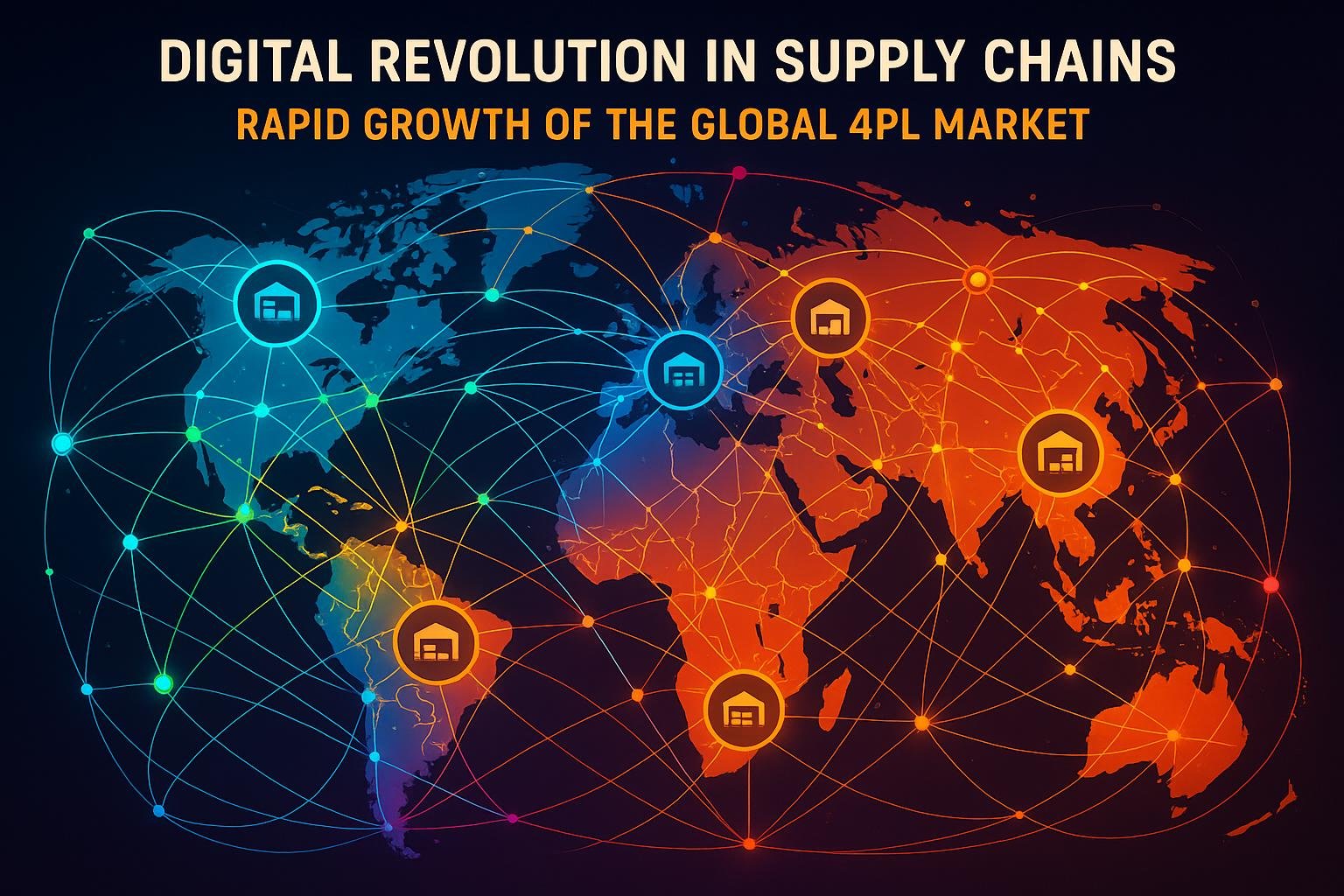
The worldwide 4PL market, valued at nearly US$ 72 billion in 2023, is projected to reach over US$ 122 billion by 2031, driven by digitalisation, e-commerce growth, and sustainability initiatives disrupting traditional supply chain management.

In today’s business environment, where operational efficiency and cost optimisation are critical, Fourth Party Logistics (4PL) providers are increasingly being recognised as pivotal in transforming supply chain management. According to a report from The Insight Partners, the global 4PL market, valued at approximately US$ 71.89 billion in 2023, is projected to surge to US$ 121.63 billion by 2031, registering a compound annual growth rate (CAGR) of 6.79%. This growth reflects a rising demand for integrated logistics solutions that transcend traditional transportation and warehousing, encompassing inventory management, procurement, and advanced data analytics.
Distinct from Third Party Logistics (3PL) providers, who typically manage discrete components of supply chains such as transport or storage, 4PL providers serve as a comprehensive single point of contact responsible for the entire logistics ecosystem. This strategic umbrella organisation affords businesses enhanced supply chain visibility, improved collaboration among stakeholders, and the ability to apply data-driven insights to optimise operational decisions. Consequently, companies can reduce overhead costs, scale logistics operations flexibly, and concentrate on their core business competencies without the burden of managing complex logistics.
Several key benefits underline this shift towards 4PL adoption. Holistic supply chain management offers streamlined coordination of procurement, distribution, and warehousing, fostering operational smoothness and cost efficiency. Advanced tracking technologies and data analytics enable real-time supply chain visibility, empowering businesses to respond proactively to potential disruptions. Furthermore, 4PL solutions can scale in tandem with business growth, adapting to evolving demands and complexities without compromising service quality.
Market dynamics strongly favour this integrative approach. The e-commerce boom, particularly seen in sectors such as retail, has driven demand for agile, responsive logistics frameworks that 4PL providers are uniquely positioned to satisfy. Additionally, ongoing digital transformation, through technologies like the Internet of Things (IoT), artificial intelligence (AI), and blockchain, is revolutionising supply chain processes, allowing 4PL providers to deliver unmatched operational transparency and efficiency. Sustainability is another influential trend; environmental concerns have nudged businesses toward greener logistics practices, including optimised routing and eco-friendly packaging, areas where 4PL operators are increasingly innovating.
Regional demographics and market expansion also play a significant role in shaping 4PL service uptake. The necessity for seamless cross-border logistics in a globalised economy enhances the appeal of 4PL providers who can expertly navigate regulatory and operational complexities across regions. Notably, companies expanding their footprint into Asia Pacific and Europe are leveraging 4PL expertise to manage diverse supply chain challenges effectively.
The competitive landscape features industry leaders such as DHL Supply Chain, XPO Logistics, Kuehne + Nagel, C.H. Robinson, and DB Schenker. These companies are actively investing in technology and innovation to deepen their service offerings and maintain leadership in the burgeoning 4PL market.
As supply chains become ever more intricate and the pressure for efficiency mounts, 4PL’s integrated logistics management model emerges as a vital solution for organisations aiming for agility, cost savings, and enhanced operational control. By embracing 4PL partnerships, businesses can navigate the increasingly complex logistics landscape with greater confidence and strategic advantage.
Source: Noah Wire Services