


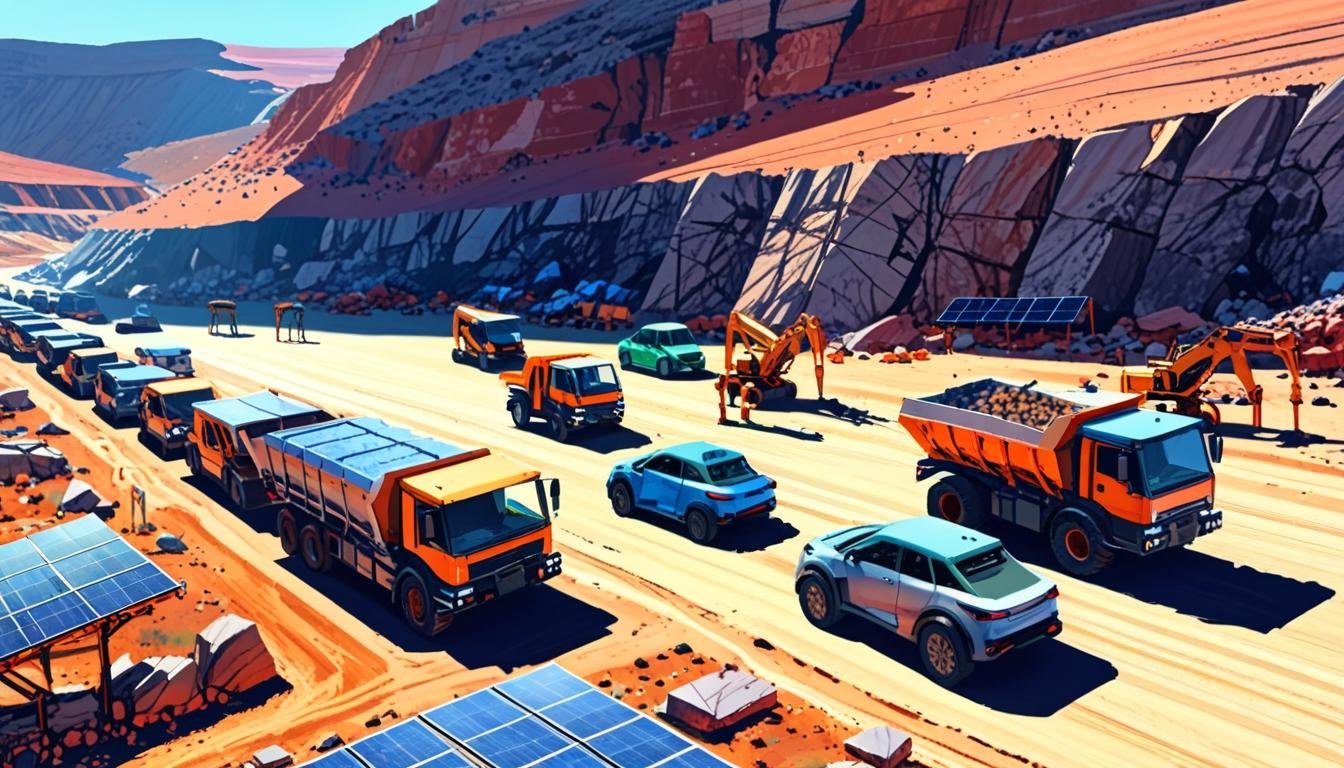
**Brussels**: The EU’s reliance on critical raw materials such as lithium and cobalt is at the forefront of economic discussions. With new legislation and ambitious targets set by 2030, the EU aims to reduce dependency on imports and enhance domestic supply chains for sustainable growth.
Recent coverage by the European Newsroom (ENR), which includes contributions from the Bulgarian News Agency, highlights the growing significance of critical raw materials such as scandium, beryllium, and gallium in the context of the EU’s economic and strategic future. These materials, while not widely known, are essential for various sectors and are becoming a focal point of political and economic discussions.
The European Union (EU) has identified 34 critical raw materials (CRM), with 17 classified as strategic raw materials (SRM). These include cobalt, copper, tungsten, lithium, and nickel, which are vital for the EU’s economic stability and progress. According to John Siemen, a researcher at the French Institute for International Relations (Ifri), “some of these elements are more or less irreplaceable or are of a high price,” highlighting the risk associated with supply interruptions.

The EU’s dependence on imports for these resources, particularly from countries such as China, has led to the implementation of the EU Critical Raw Materials Act, which comes into force in May 2024. This legislation aims to bolster the EU’s strategic economy through enhanced and diversified supply chains. The targets set for 2030 include achieving 10% of annual mining needs from EU territory, processing 40% domestically, and recycling 25%. Additionally, no more than 65% of any strategic material should come from non-EU sources at any processing stage.
The demand for critical raw materials is anticipated to rise sharply in the coming years due to the EU’s commitment to transition away from fossil fuels. Components integral to this green transition—like batteries and solar panels—depend heavily on these materials. For example, the European Commission predicts a twelvefold increase in the demand for lithium batteries for electric vehicles and energy storage by 2030, with expectations that this will grow to twenty-one times by 2050.
To achieve its goals, the European Commission intends to support around 50 projects across member states focusing on the supply, processing, and recycling of rare earth metals. The Commission recently announced a list of 47 “strategic projects,” which includes plans to discover new lithium and tungsten mines to reduce reliance on China.
Currently, the EU can only fulfil part of its demand for certain critical raw materials from within its own member states. There are known deposits of rare earth elements in Portugal, which has the largest lithium reserves in Europe, though local communities have raised opposition to mining activities. Similarly, the Spanish Confederation of Mineral Raw Materials Producers (Primigea) advocates for extensive geological surveys to reclaim autonomy lost due to decades of reliance on foreign resources. Spain is a significant producer of copper and manganese within the EU. However, local resistance to mining projects remains a substantial challenge, particularly regarding environmental concerns.
The EU is primarily importing most of its critical raw materials from outside the bloc. For instance, as of 2024, Turkey supplies 98% of the EU’s boron, while China is responsible for all heavy rare earth element imports. South Africa provides 71% of the EU’s platinum metals, and the Democratic Republic of the Congo (DRC) accounts for 63% of global cobalt supplies, essential for batteries and various industries.
Efforts to diversify sources for critical materials are ongoing but have faced various obstacles. A recent memorandum of understanding was signed between the EU and Rwanda to source critical materials such as lithium and tin, aimed at further reducing dependence on China. However, tensions have emerged due to Rwanda’s involvement in conflicts in resource-rich regions of the DRC, leading the European Parliament to call for the suspension of the agreement, further complicated by Rwanda’s diplomatic break with Belgium over this issue.
Greenland’s mineral resources have also attracted attention, especially following past comments by former US President Donald Trump regarding the territory’s potential resources, which include lithium and other critical materials. Despite significant interest, the actual number of mining projects is limited. Challenges such as administrative barriers, harsh climatic conditions, and underdeveloped infrastructure hinder economic viability.
In contrast, the EU has identified Ukraine as a potential source of critical materials like manganese, titanium, and graphite, essential for electric batteries. However, significant deposits are located in eastern Ukraine, an area under Russian control due to the ongoing conflict. Discussions are reportedly underway for Ukraine to enter agreements regarding its mineral resources, both with the US and France, with varying approaches towards incentivising resource development.
The evolving landscape surrounding critical raw materials underscores the challenges and complexities the EU faces in reducing its dependence on external sources while ensuring sustainable economic growth.
Source: Noah Wire Services

