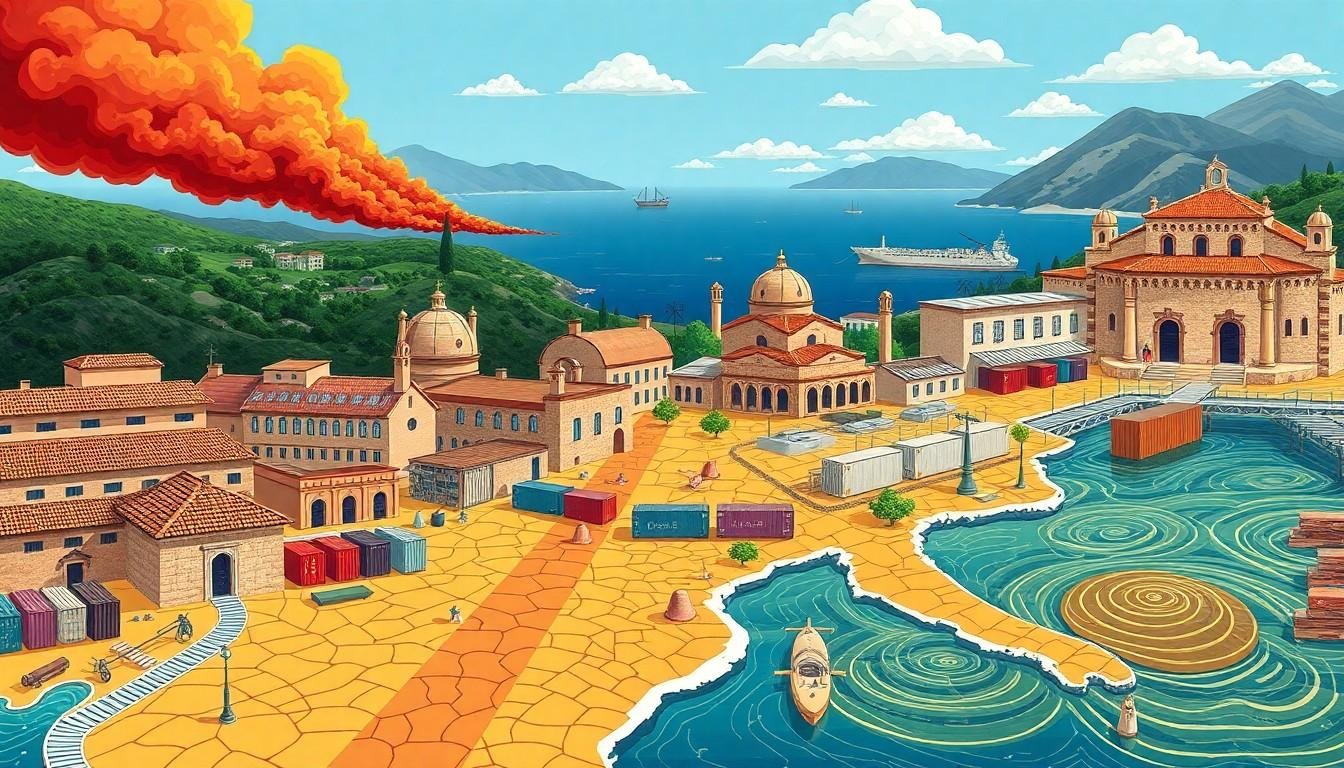
Europe’s textile and materials districts are increasingly sitting at the centre of its climate disasters.
Covilhã, on the western side of Portugal’s Serra da Estrela, has long depended on the cold mountain water that helps wool take finish properly. The town’s mills still reflect that history: Paulo de Oliveira, founded in 1936, spins, weaves, dyes and finishes there, and describes itself as the largest producer of wool fabrics on the Iberian Peninsula. But in August 202...
Continue Reading This Article
Enjoy this article as well as all of our content, including reports, news, tips and more.
By registering or signing into your SRM Today account, you agree to SRM Today's Terms of Use and consent to the processing of your personal information as described in our Privacy Policy.
5, a blaze that started in Arganil spread for 11 days across five districts, scorched about 57,000 hectares and reached Covilhã, Unhais da Serra and Cortes do Meio.
The wider pattern was far worse. According to the European Forest Fire Information System, 1,079,538 hectares burned across the EU in 2025, the highest figure ever recorded and almost twice the 2006-2024 average. The European Commission’s Joint Research Centre said Portugal and Spain alone accounted for 43% of the total burnt area, as fires peaked in August during a severe heatwave. Copernicus and EFFIS have both warned that the season has become longer, hotter and more destructive, while 2026 is already tracking ahead of the previous year.
What makes the risk more acute for fashion and materials sourcing is that the vulnerable districts are also highly concentrated industrial zones. Italy’s tanning sector, for instance, is unusually clustered: 877 companies generate more than €4 billion in turnover, employ over 17,000 people, and produce 65% of leather output in the European Union and 27% of global production value. Half of that national output comes from Arzignano and the Chiampo valley in Vicenza, while Santa Croce sull’Arno in Tuscany accounts for another large share. Tanning is among the most water-intensive steps in the supply chain, and the Po has recently reached record low flow.
Greek cotton is even more geographically concentrated. Greece produces more than 80% of Europe’s cotton across roughly 210,000 hectares, with cultivation centred in Thessaly, Central Macedonia, Thrace and Sterea Ellada. Much of that fibre flows into Turkey’s spinning and weaving industry, which supplies a significant share of European fast fashion. When Storm Daniel struck in September 2023, satellite mapping showed more than 282 square kilometres of flooded cotton, or about 30% of central Greece’s cotton area. The US Department of Agriculture has since pointed to tighter irrigation water availability as a constraint on the 2025/26 crop.
The problem is not simply that these sectors are exposed. It is that climate-risk mapping has largely been built elsewhere. The most detailed research on apparel production and climate hazards has focused on Asia, not Europe. Cornell University’s Global Labor Institute and Schroders’ 2023 report Higher Ground? mapped more than 8,000 factories across 32 production hubs, with a particular focus on Bangladesh, Cambodia, Pakistan and Vietnam. It concluded that those countries could lose $65.89 billion in export earnings by 2030 under a non-adaptive scenario, and 8.64 million jobs by 2050.
That work helped establish the scale of the threat, but it also highlighted a major blind spot: the European tier of the same supply chain, where luxury and premium production is heavily concentrated, has not been assessed in comparable depth. Portugal’s wool districts, Biella’s fine-yarn mills in Piedmont, the finishing plants of the Ave valley and Prato’s recycled-wool operations in Tuscany all sit in areas already identified by hazard tools as at risk from fire and drought.
The other barrier is disclosure. H&M Group publishes a detailed supplier list covering more than 554 commercial product suppliers and over 969 tier 1 factories across Europe, Asia and North America, and says its public list represents 99% of the products it sells. It also includes tier 2 facilities such as tanneries, dyeing operations and printers. PVH also maintains a comparable factory list. By contrast, Inditex publishes only the number of suppliers it works with in 12 core countries, without naming individual factories, despite pressure from investors to provide more detail. Ethos found no equivalent facility-level list from Kering.
In practice, the underlying data already exists to build a much clearer map. EFFIS publishes fire perimeters. The Copernicus European Drought Observatory publishes drought severity. Aqueduct provides water-stress and drought-risk scores. Matching factory addresses to those layers is not especially difficult. What remains missing is the finished European dataset: a public list of mills, tanneries, dye houses and finishing plants ranked by how often fire or water scarcity has come near them, and how often it is projected to do so again.
As one investor told Reuters in relation to Inditex, the company appears to have the information but has not been willing to publish it. The result is that some of Europe’s most important materials districts are becoming climate fault lines in plain sight, even as brands and investors continue to disclose far less than the hazard maps already show.
The fire above Covilhã last year burned on the very slope that feeds its mills. That is now the larger story across the continent: the places that make Europe’s wool, leather and cotton are increasingly the places most likely to burn, dry out or flood first.
Source: Noah Wire Services