


**London:** An emergency summit of European leaders took place to demonstrate solidarity with Ukrainian President Zelenskyy. The event underscored the need for military readiness in response to threats from Russia, amid rising defence spending across Europe and optimism in defence stocks.
An emergency summit of European leaders took place this week with a primary aim: to demonstrate solidarity and support for Ukrainian President Volodymyr Zelenskyy. As the host, Britain’s Prime Minister Keir Starmer highlighted the gathering as a “once-in-a-generation moment,” underscoring the significance of unity among European states in light of ongoing conflict with Russia. After a weekend visit to the White House, which some leaders viewed as humiliating due to a reduction of US defence aid, Zelenskyy was reaffirmed as “one of their own” as leaders rallied around him.
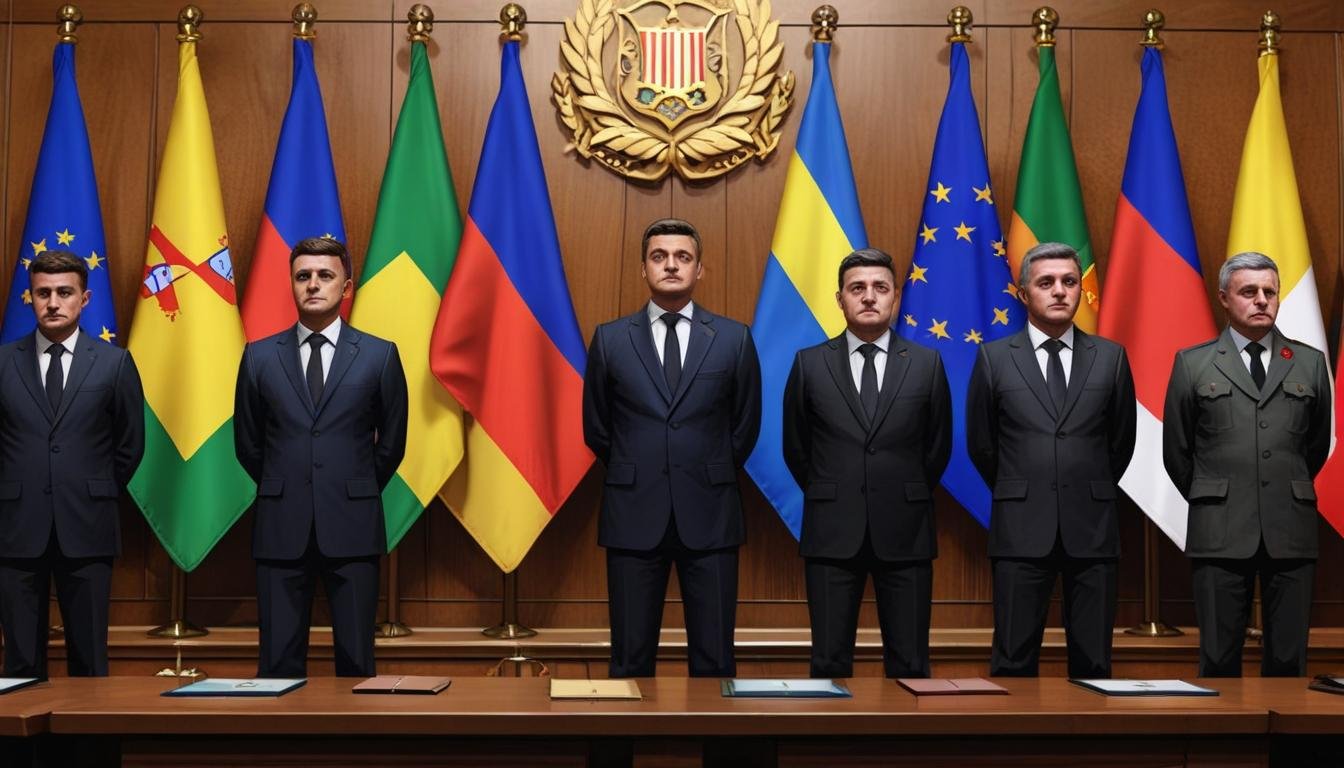
In a bid to visually convey their resolve, the leaders arranged themselves for a group photo where Britain and France’s leaders, the only two European nations with nuclear capabilities, flanked Zelenskyy at the forefront. The photograph aimed to signal a readiness to engage militarily, reflecting a realisation among European nations that military power is now a fundamental currency in international relations. Leaders from Poland and Finland were also prominent, with Poland aspiring to bolster its military to become the largest army in Europe and Finland advocating for a proactive stance against Russian aggression. Meanwhile, the outgoing German Chancellor Olaf Scholz found himself placed somewhat further back in the image.

In terms of military funding, variations in defence spending across European nations remain pronounced, with Starmer indicating that a shift towards strengthening military capabilities was paramount. Consequently, the UK plans to cut its international aid budget to meet a defence spending target of 2.5% of GDP by 2027, aiming for 3% thereafter. Poland’s Prime Minister Donald Tusk echoed this sentiment, announcing an ambitious agenda to build its military strength in light of perceived threats, which includes increasing defence spending to 4% of GDP. The Baltic states are leading the way, nearing 5% in defence investment and calling for increased European commitment.
Market reactions following the summit reflected optimism among investors, with shares in European defence companies witnessing substantial rises. German defence manufacturer Rheinmetall, for instance, saw its stock increase by 14%. In the past year, the company has experienced a 160% boost in its share price, signalling a strong response to the escalating focus on military readiness. Other defence contractors, including BAE Systems from the UK and Leonardo from Italy, also saw significant increases in their stock prices with market observers noting that the strong declarations by European leaders were being taken seriously.
Germany’s potential shift towards a more rigorous arms policy has been highlighted by media reports suggesting the establishment of an additional budget fund for armaments between €200 and €800 billion over the coming years. This could markedly boost Germany’s defence spending, which has typically hovered around 2% of GDP. The discussions also hinted at a departure from Germany’s historical resistance to joint European debt financing for military expansion.
Moreover, Tusk called for a military union, stating, “500 million Europeans are asking 300 million Americans to protect them from 140 million Russians.” His remarks reflect a growing sentiment that Europe needs to consolidate its military capabilities and assert itself as a global power rather than remaining reliant on the United States.
The strengthening of defence sectors also appears to extend to Israel, with Elbit Systems’ shares rising more than 5% on the Tel Aviv Stock Exchange. Israeli defence firms are expected to benefit significantly as Europe ramps up its military spending, with Elbit already having operations in the UK and other European countries, facilitating potential collaborations.
Israeli companies have also secured defence contracts with European nations, such as the Arrow 3 air defence system deal with Germany valued at $3.5 billion. The changing geopolitical landscape is prompting increased interest from European nations in Israeli defence technologies, as these firms are seen to have delivered on commitments during the ongoing conflict in Ukraine, contrasting with concerns over the reliability of US suppliers.
Overall, the emergency summit marks a critical juncture in European defence strategies as nations reassess their military capabilities and funding in response to external threats. The approaching weeks are likely to see further developments in military spending and possible collaborations within Europe and beyond.
Source: Noah Wire Services

