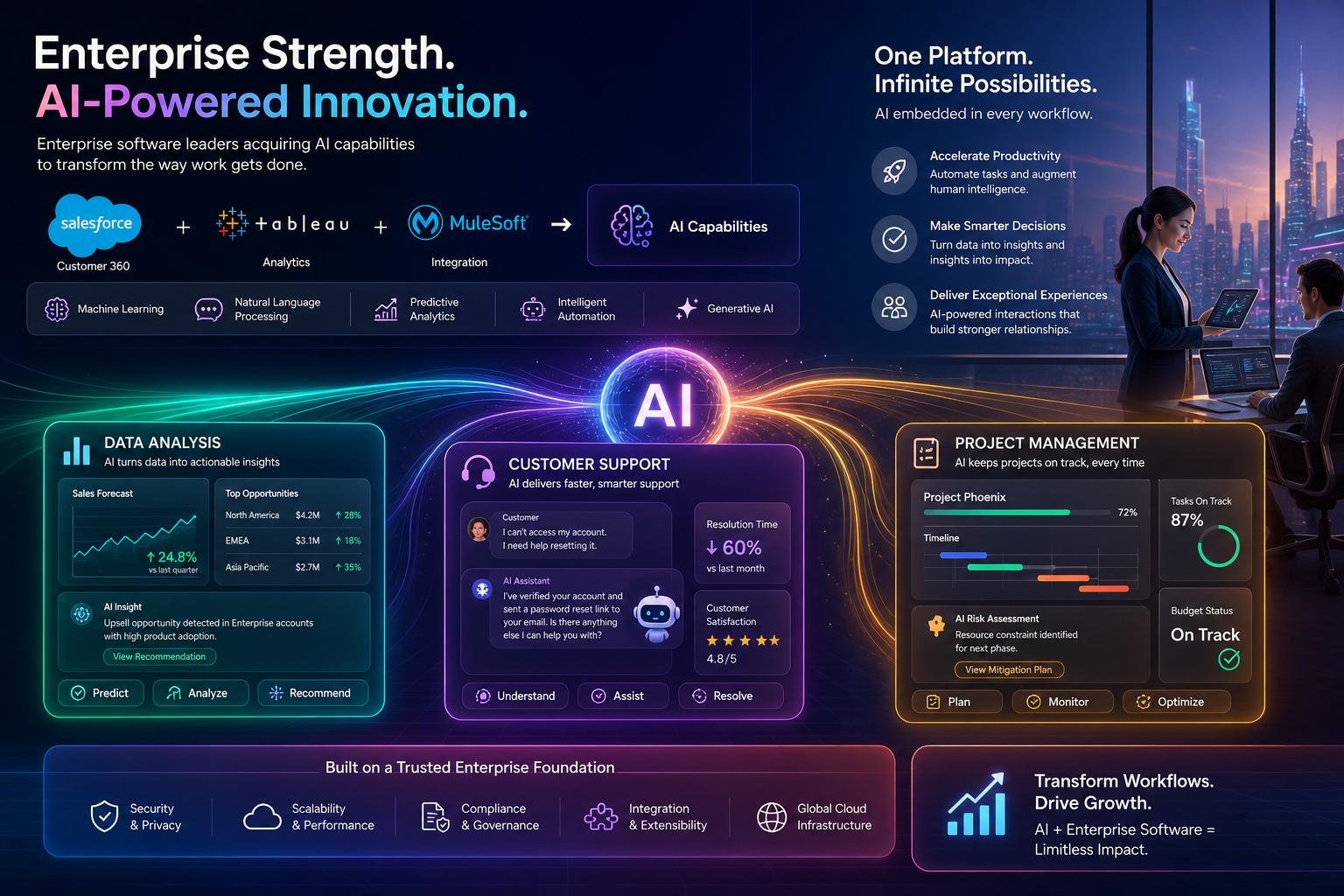
A fresh round of acquisitions is showing how enterprise software vendors are trying to move artificial intelligence beyond chat, summaries and recommendations and into the mechanics of doing actual work.
Asana, Coupa, Salesforce and Vertice have all moved to buy capabilities that deepen their platforms in different parts of the stack, but with a common aim: giving AI systems the data, context, controls and execution layer needed to act inside enterprise workflows. For ERP leade...
Continue Reading This Article
Enjoy this article as well as all of our content, including reports, news, tips and more.
By registering or signing into your SRM Today account, you agree to SRM Today's Terms of Use and consent to the processing of your personal information as described in our Privacy Policy.
rs, the bigger question is no longer whether AI can generate an answer, but whether it can complete a business process safely across multiple systems.
Asana’s purchase of StackAI is a good example of that shift. TechCrunch reported that the deal was valued at $75 million and that StackAI’s founders, Tony Rosinol and Bernard Aceituno, are joining Asana. StackAI is a no-code platform for designing, testing, deploying and governing custom AI agents across enterprise systems, including links into Salesforce, AWS, DocuSign and Oracle. Asana said the technology will sit alongside its own work graph and help power AI Teammates that can pull context, carry out actions and feed results back into the company’s core work management environment.
Dan Rogers, Asana’s chief executive, has described the acquisition as a way to push customers beyond routine automation such as intake and task assignment, towards end-to-end process execution across the tools a business already uses. The message is clear: Asana wants to become a place where human teams and agents work together, rather than simply a place where work is tracked.
Coupa’s acquisition of Rossum follows a similar logic in spend management. According to Coupa and its advisers, Rossum brings intelligent document processing rooted in a specialised transactional large language model trained on tens of millions of documents. The companies had already been working together on complex invoicing for accounts payable teams, and Coupa is now bringing that capability into its wider source-to-pay portfolio.
Coupa said the deal will help customers process documents faster, reduce costs and keep better control over data across both direct and indirect spend. Leagh Turner, Coupa’s chief executive, has said the partnership had already proved its worth in invoicing, while Rossum’s co-founder Tomáš Gogár has pointed to the combination of Rossum’s transaction-focused intelligence with Coupa’s wider spending data as the attraction of the deal. Industry coverage also noted that the acquisition was announced at Coupa Inspire 2026, underscoring how central agentic automation has become to the company’s strategy.
Salesforce is making its own move to support Agentforce, although in a different layer of the enterprise stack. The company said it has agreed to acquire Contentful, the composable content platform used by thousands of brands to deliver digital experiences. Salesforce says the deal will add a native, enterprise-grade content layer to Customer 360 and allow Agentforce to query, assemble and deliver structured content dynamically without the manual publishing steps that typically slow down customer-facing campaigns.
The emphasis here is on safe personalisation at scale. Agents that serve customers need more than records and prompts; they need approved content blocks, structured assets and rules about how those materials can be assembled. Salesforce says Contentful’s API-first, headless architecture will remain intact while becoming more tightly connected to the wider Salesforce estate.
Vertice’s acquisition of Vendr applies the same principle to procurement. The company said the deal will create what it calls the world’s largest procurement intelligence dataset, drawing on more than $75 billion in global indirect spend, more than 2 million pricing data points and more than 250,000 negotiated contracts across more than 32,000 vendors.
Vertice already runs an AI procurement platform with agentic intake, workflows and an autonomous negotiation agent called Ana. Vendr adds pricing intelligence, buying data and a team of negotiators. Vertice said the combined business will strengthen its AI agents across benchmarking, vendor consolidation, third-party risk, renewals and broader procurement orchestration.
Taken together, the four deals point to the same industry conclusion: vendors are now buying the pieces that make AI useful in enterprise settings. That means execution across systems in Asana’s case, document understanding in Coupa’s, structured content orchestration in Salesforce’s and procurement intelligence in Vertice’s.
The opportunity is obvious, but so is the risk. If every major platform builds its own agent layer, companies could end up with overlapping controls, duplicated governance and competing sources of truth across ERP, CRM, procurement, work management and content systems. The winners are likely to be the vendors that can fold these acquisitions into existing architectures without breaking auditability, process context or data control.
For ERP teams, the lesson is straightforward. AI value is moving towards the ability to act, not merely advise. The most important capabilities may turn out to be the less glamorous ones: document intelligence, workflow context, structured content and domain-specific procurement data. Those are the layers that will determine whether agents become productive co-workers or just another interface.
Source: Noah Wire Services