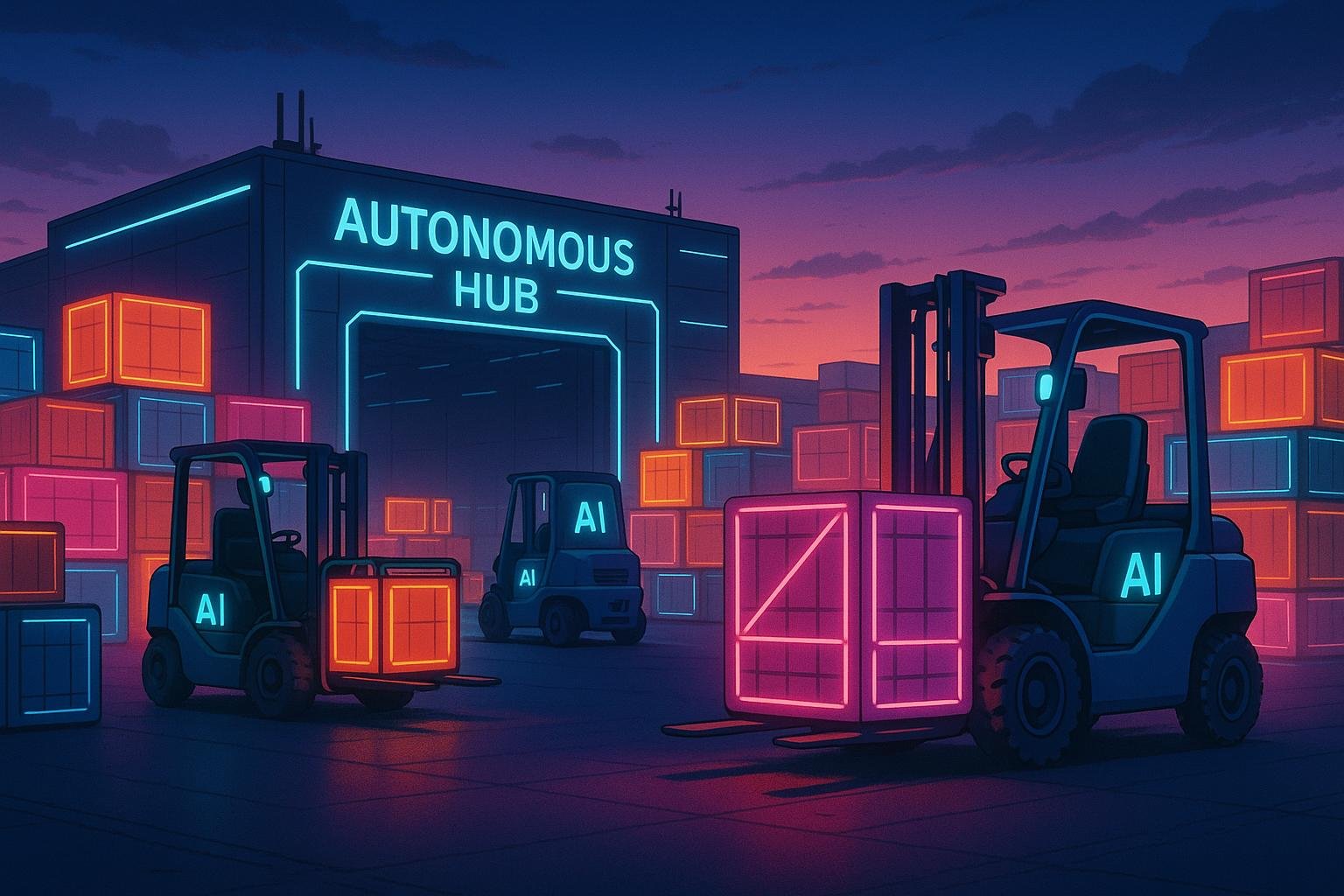
At Davos, Elon Musk revealed that autonomous AI and robotics could drastically reshape supply chains sooner than expected, urging industries to prepare for energy and infrastructure challenges.

At the World Economic Forum in Davos, Elon Musk delivered a blunt appraisal of how artificial intelligence and robotics could upend the logistics industry far sooner than many supply‑chain executives expect. What he framed as a shift from decision support to direct action would...
Continue Reading This Article
Enjoy this article as well as all of our content, including reports, news, tips and more.
By registering or signing into your SRM Today account, you agree to SRM Today's Terms of Use and consent to the processing of your personal information as described in our Privacy Policy.
Musk argued that forecasting systems will increasingly ingest live data and act on it, not merely produce recommendations. That continuous feedback loop, he said, will allow warehouses and fulfilment centres to operate with far fewer human handovers, higher consistency and faster response times. According to reporting from the forum, he singled out large‑scale robotics and humanoid platforms such as Tesla’s Optimus as natural fits for repetitive fulfilment tasks, while robotaxis and autonomous freight could alter last‑mile and intercity movement patterns.
The implications are strategic: companies that redesign processes around always‑active autonomous systems could capture significant resilience and cost advantages, Musk suggested, while organisations that treat AI as incremental optimisation risk falling behind. Industry commentary from Supply Chain Digital and other outlets summarises Tesla’s near‑term operational bets: robotaxi deployment across the United States was projected for late 2025, with regulatory pursuits for full self‑driving in Europe and China, and factory roll‑outs of Optimus robots planned to scale rapidly through 2025 and beyond.
But Musk did not present autonomy as a purely software or hardware problem. He cautioned that energy supply and compute capacity may become the pivotal constraint on widescale adoption. The surge in power demand from AI training and inference, electrified vehicles and fleets of robots will place new burdens on grids and on-site energy systems. Musk urged greater investment in generation and storage, pointing to Tesla’s Megapack deployments as an example of how utility‑scale batteries can bolster capacity and support continuous operation.
Others analysing Tesla’s strategy note the company’s deliberate vertical integration, from chip design to battery manufacture, as a bid to control costs and supply for their robotics ambitions. According to industry analysis, that approach is intended to shorten development cycles and reduce dependence on third‑party suppliers for nascent categories where market partners are scarce. However, supply vulnerabilities remain. Commentators have flagged a dependence on rare earth magnets, a supply chain concentration dominated by China, as a potential bottleneck for high‑volume robot production, and export restrictions have already introduced uncertainty into scaling plans.
Commercial realities will also shape how rapidly autonomy diffuses. Musk has previously discussed tariffs and localisation pressures that affect margins and the structure of production in the United States, Europe and China, and analysts continue to point out that policy, regulation and materials availability will influence deployment timetables as much as technical readiness.
For logistics leaders the near‑term task is twofold: rethink operating models to capture the unique benefits of systems that can act on live data, and prepare the physical infrastructure, most critically energy, to sustain continuous autonomous operation. As Musk framed it in Davos, the technology is moving beyond advisory roles; the bottlenecks, he suggested, are likely to be found in wires, transformers and fuel as much as in code. Those who plan for both the software revolution and the energy realities that underpin it will be better placed to shape the next generation of supply chains.
Source: Noah Wire Services
Subscribe to Industry Updates