


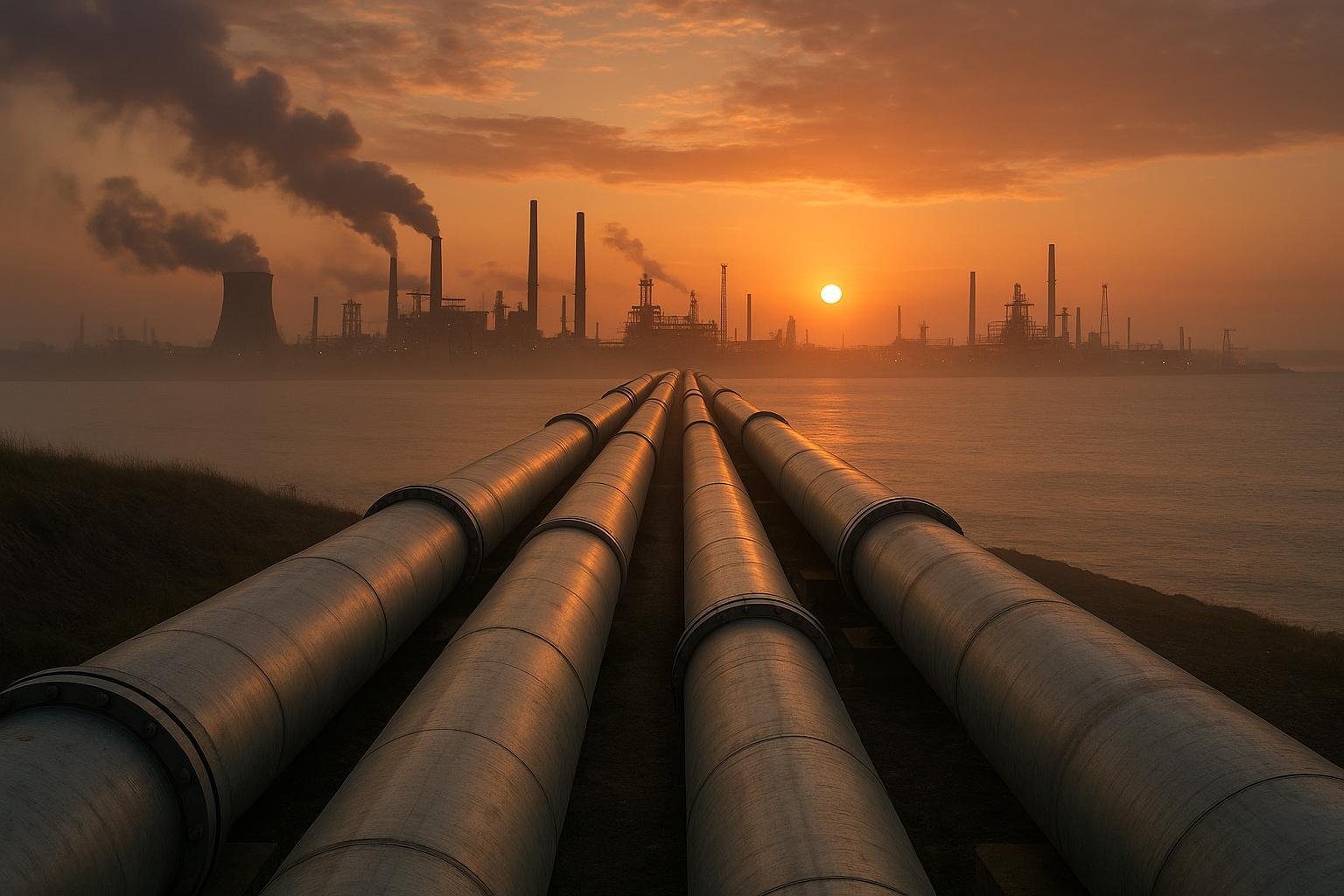
Major contracts announced for the UK’s key East Coast CCS initiatives, signalling rapid progress in decarbonising industrial regions through major infrastructure and project developments by 2028-2032.

Fresh contracts aimed at advancing key projects within the East Coast Cluster, an ambitious UK carbon capture and storage (CCS) initiative centred around the Teesside and Humber regions, have recently been published on the North Sea Transition Authority’s (NSTA) Pathfi...
Continue Reading This Article
Enjoy this article as well as all of our content, including reports, news, tips and more.
By registering or signing into your SRM Today account, you agree to SRM Today's Terms of Use and consent to the processing of your personal information as described in our Privacy Policy.
Saipem, the engineering and construction firm engaged since December 2024, has issued three major tenders worth over £25 million for the NEP. These include contracts for the supply of carbon and stainless steel aboveground pipes, a fuel supplier, and helicopter services, with procurement activities scheduled through early 2026. NEP, a joint venture led by BP, Equinor, and TotalEnergies, reached financial close late in 2024 and commenced construction promptly thereafter. The initiative focuses on establishing a 90-mile offshore pipeline infrastructure to transport CO₂ captured from industrial emitters for offshore sequestration, targeting operational status by 2028.
Complementing NEP is the Net Zero Teesside Power project, envisaged as a 742MW gas-fired power plant incorporating carbon capture technology to utilise NEP’s CO₂ storage capacity. BP, in partnership with Equinor, leads the NZT development, supported by collaborators including Technip Energies, GE Vernova, and construction partner Balfour Beatty. Balfour Beatty is progressing tenders related to reinforced concrete structures and the installation of heat recovery steam generators (HRSG), with contract releases scheduled for late 2025 and early 2026. The project forms a crucial part of the UK government’s £21.7 billion CCS support scheme, aiming to start construction mid-2025, achieve first commercial operation in 2027, and commence CO₂ injection by 2028.
The scale of investment and activity surrounding these projects is underscored by a €650 million combined contract award to Saipem related to transportation and CCS infrastructure, spanning a 30-month duration. Industry confidence is bolstered by the completion of regulatory clearances and positive final investment decisions, aligning with the UK’s commitment to decarbonising its most carbon-intensive industrial hubs.
Quality assurance and technical integrity are assured via a three-year contract awarded to DNV, which will oversee inspections and quality control across both NEP and NZT projects. Similarly, Schlumberger (SLB) has secured a contract to provide carbon storage services for NEP, encompassing drilling, measurement, and cementing essential for safely developing offshore storage sites in the North Sea, a testament to the project’s technical complexity and critical role in the transition to net zero.
Beyond these CCS initiatives, related offshore projects highlight the region’s wider energy evolution. Hartshead Resources is advancing its exploration and appraisal drilling with tenders for site surveys and jack-up drilling units targeting the Stephenson prospect in the Southern North Sea, aiming to commence well drilling in 2027. Meanwhile, Thistle Wind Partners is gauging market capacity to support environmental services across two forthcoming 1GW offshore wind farms , Ayre, a floating installation off Orkney, and Bowdun, a fixed-bottom farm near Aberdeenshire , with final investment decisions anticipated by 2028 and construction to follow between 2029 and 2032.
Furthermore, decommissioning activities are set to begin for Perenco’s Indefatigable gas field, with a tender for a jack-up barge to remove platform infrastructure scheduled for mid-2026, reflecting the industry’s parallel efforts to responsibly manage legacy assets amid the energy transition.
Together, these developments collectively map out a comprehensive push in the UK’s east coast to integrate cutting-edge carbon capture infrastructure, renewable power generation, exploratory drilling, and asset decommissioning. This cluster not only aims to reduce carbon emissions in one of Europe’s most industrialised regions but also diversifies the local energy landscape toward sustainable, low-carbon solutions. The coming years will be pivotal as construction ramps up across these projects, cementing the East Coast Cluster’s role as a cornerstone of the UK’s net-zero ambitions.
Source: Noah Wire Services
Subscribe to Industry Updates

