


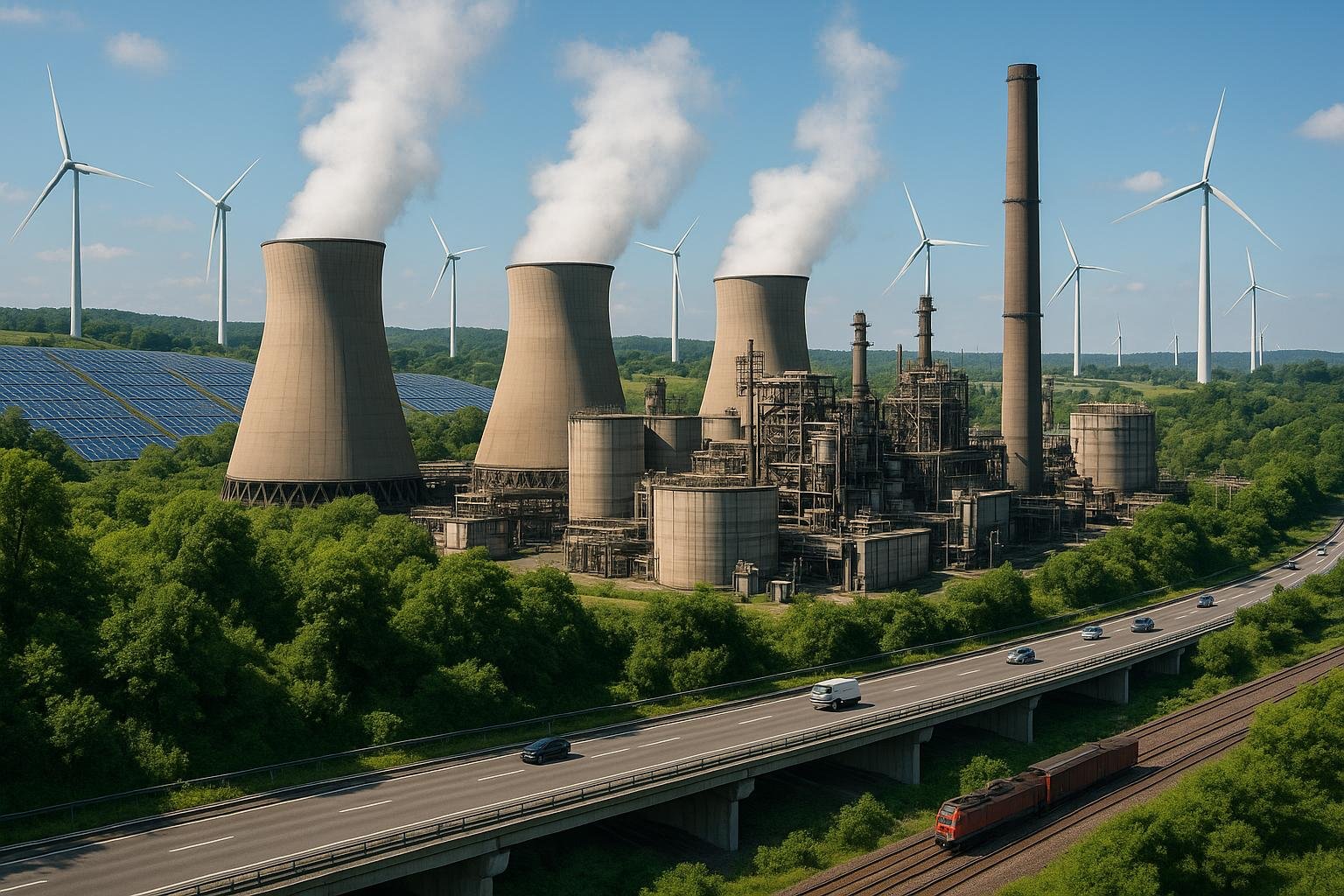
As the decarbonisation effort intensifies, industry and policymakers emphasise the need for diversified, resilient supply networks, leveraging advanced analytics and strategic standards to counter geopolitical and climate risks.

Global efforts to decarbonise depend on technologies whose supply chains are increasingly brittle, concentrated and exposed to geopolitical and climate risks. Industry and policy reports point to a narrowing set of suppliers for the minerals and...
Continue Reading This Article
Enjoy this article as well as all of our content, including reports, news, tips and more.
By registering or signing into your SRM Today account, you agree to SRM Today's Terms of Use and consent to the processing of your personal information as described in our Privacy Policy.
The problem is not only the geography of supply but also the physical fragility of production networks. The OECD and PwC have highlighted how single-region dominance of value chains , from polysilicon for solar to catalyst and membrane supply for fuel cells , creates single points of failure. The OECD’s analysis of solar manufacturing, for example, shows a striking concentration of capacity in a single province and even a handful of facilities, while PwC’s work presented at APEC emphasises that climate-driven stresses such as heat and drought add a further layer of disruption risk for key commodities including lithium, copper and bauxite. Together these findings underline that scaling clean technologies requires both broader sourcing and resilience to climate impacts.
Against this backdrop, firms are rethinking procurement and engineering to reduce sole-source dependencies. One practical model comes from projects led by Irshadullah Asim Mohammed, who set out to convert supplier risk into an operational advantage. Faced with dependency on a single domestic vendor for mechanical components crucial to fuel-cell systems, his team surveyed more than 50 prospective manufacturers, raised technical specifications to tighter industry tolerances and aligned procurement to ASME and ISO standards to bring multiple suppliers into qualification. “Our objective was to reframe supply chain risk as a competitive advantage; building networks where every partner contributed in strengthening the system rather than becoming a potential point of failure,” he said.
The results reported from those efforts were tangible: reduced lead times, lower unit costs and a diminished reliance on single vendors that otherwise threatened production schedules. Beyond the immediate gains for the company involved, the approach offers a replicable template for other firms in the clean-energy sector. When major buyers demonstrate that multi-sourcing and rigorous qualification can deliver cost and timing benefits, market incentives shift and the broader supply ecosystem can become more distributed.
There is an economic logic to that shift. Diversified sourcing can make projects more bankable by reducing the likelihood of delays and cost overruns that deter long-term capital. Industry data and policy analysis suggest that equipment produced closer to deployment sites and validated across several suppliers improves competitiveness versus incumbent fossil-fuel options, thereby accelerating uptake. At the same time, broader supplier networks create opportunities for technology transfer, upskilling and local industrial development in new regions, strengthening both commercial and diplomatic ties.
Technological tools amplify these gains. Academic work by Irshadullah Asim Mohammed explores machine-learning approaches to make supplier selection and monitoring more reliable, using random forests, support vector machines and neural networks to predict supplier risk and flag quality concerns. Other papers by the same author lay out AI-driven risk frameworks for carbon-capture and energy-storage chains, arguing that real-time data and predictive analytics can materially improve decision-making and reduce the probability of supplier-related shocks. Such capabilities are particularly valuable where supplier performance and environmental exposure vary rapidly.
Policy measures will remain necessary to complement corporate strategies. The IEA and OECD both call for government interventions to reduce strategic dependencies , through incentives for domestic processing, trade partnerships, standards harmonisation and targeted investment in alternative production hubs. PwC’s assessment adds that adaptation planning for climate impacts on commodity supply must be integral to these strategies if resource production is to be reliable over decades. Without coordinated public–private action, market-led diversification alone will struggle to close projected shortfalls in materials such as copper by 2030.
Practical initiatives that combine rigorous engineering standards, diversified procurement and advanced analytics can therefore move markets from fragility to resilience. They also produce social returns: cheaper, more reliable clean energy reduces emissions and air pollution, with attendant public-health and development benefits in emerging economies. For the United States and other importing economies, distributing production and qualification work across a wider set of partners strengthens energy security and reduces exposure to single-country risks.
The lessons from recent initiatives are clear. Strengthening supply chains requires simultaneous upgrades to technical standards, data-driven supplier assessment and strategic policy support. When companies and governments adopt these measures in concert, the energy transition becomes not only technically feasible but materially more robust and inclusive. The shift from vulnerability to resilience remains an urgent priority if global net-zero ambitions are to be delivered at scale.
Source: Noah Wire Services
Subscribe to Industry Updates

