


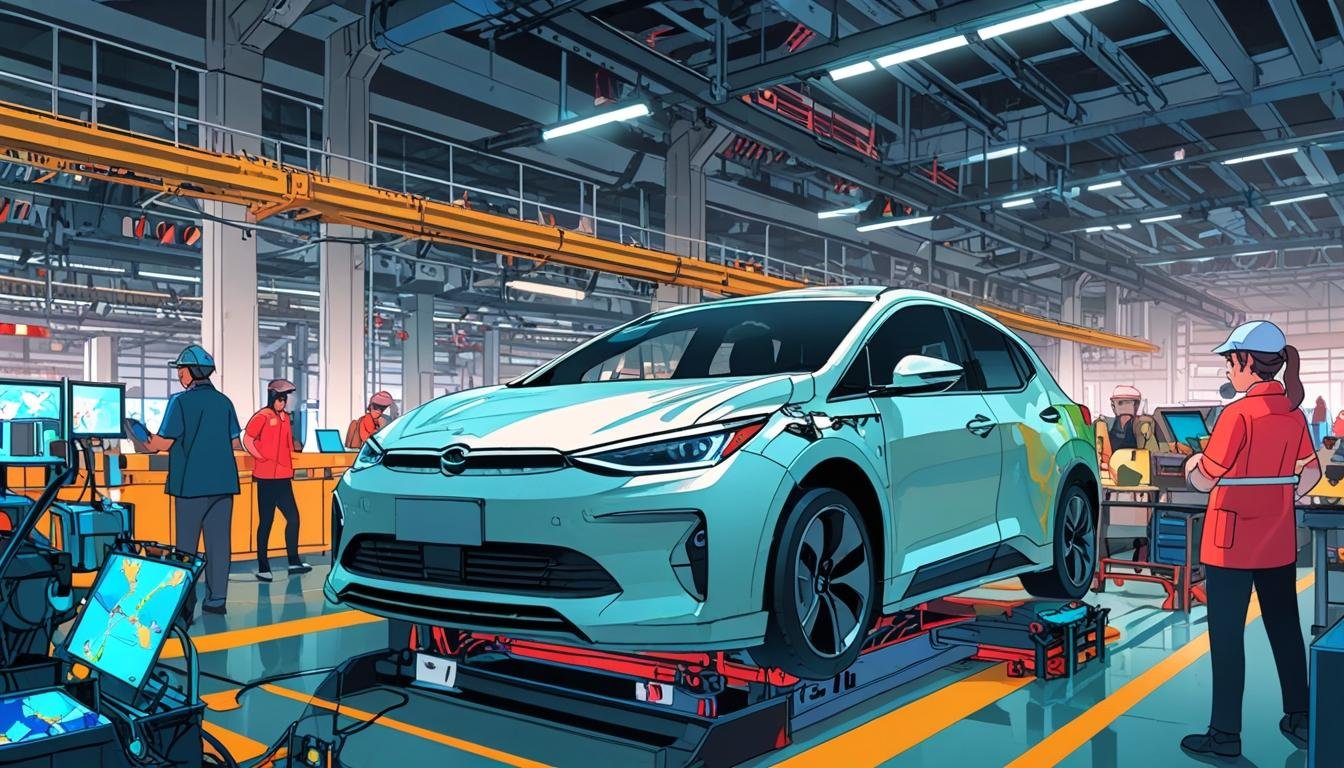
**Detroit**: Chinese automotive manufacturers are rapidly gaining a competitive edge in the global market, highlighting the necessity for agility amidst trade barriers and supply chain challenges. Industry experts urge Western firms to adapt their strategies or risk falling behind by 2025.
In the rapidly evolving world of automotive manufacturing and racing, agility in navigating trade barriers and supply chain disruptions has become a crucial determinant of success. Currently, Chinese automotive manufacturers appear to be positioned advantageously within the global market, a trend likely to continue unless other nations adapt their competitive strategies by 2025. Peter Maithel, who serves as the Global Automotive Industry Strategy Lead with Infor in Detroit, emphasises the importance of agility in this landscape, stating, “There is a lot of transition in the industry right now, but fortunes are made in moments of transition.”
Recent insights indicate that Chinese firms are capable of bringing new vehicles from conception to market in a time frame significantly shorter than their U.S. counterparts. Reports suggest that in 2024 alone, Chinese manufacturers may introduce as many as 31 million vehicles into various markets, with projections rising to 50 million in subsequent years. Additionally, strategic use of loopholes in the United States-Mexico-Canada Agreement (USMCA) may allow Chinese firms to enter the North American market through Mexico, facilitating further penetration under more favourable conditions. Maithel characterises this scenario as “the Wild East,” where speed and agility drive success.

Various challenges face Western carmakers, largely due to governmental regulations and legal frameworks that constrain production and delivery timelines. In contrast, China’s political leadership is perceived to expedite processes, including the rapid excavation of mineral resources crucial for automotive production. Maithel highlights this disparity, noting that, “Their thumb is on every chokepoint in the world right now,” which complicates supply procurement for just-in-time production processes favoured by the industry.
The evolving automotive landscape has prompted major players to rethink their supply chain strategies. Maithel points out a trend towards regionalisation, where manufacturers seek to mitigate exposure to political risks and global shipping disruptions. The emphasis is shifting towards proximity in sourcing materials, particularly as the new U.S. administration seeks to leverage strategic locations such as the Panama Canal and Greenland to its advantage.
Companies must also adapt to the advances in technology that accompany changing customer preferences. According to the Detroit Free Press, software-related automotive recalls in the United States have spiked sharply, indicating vulnerabilities in systems that rely heavily on digital features. In 2023, 15 percent of recalls were attributed to software glitches, a figure that rose dramatically to 42 percent the following year. The implications of such issues are significant, with financial repercussions that can amount to millions in losses daily for major manufacturers.
Maithel suggests that the focus must shift towards creating software that delivers tangible value to customers, stating that, “That’s what OEMs want to build.” The need for collaboration with technology companies is emphasised in the Roland Berger’s Automotive Outlook report, which argues that these partnerships can help traditional manufacturers bridge technological gaps and modernise operations to elevate customer experiences.
In anticipation of forthcoming market fluctuations, General Motors’ CEO Paul Jacobson has announced the creation of “multiple playbooks” to navigate potential policy changes regarding tariffs that could impact cross-border production costs. Maithel clarifies that sustained tariffs could exert upward pressure on prices across various sectors, not just automotive, thereby demanding a strategic response from manufacturers.
Adapting to a rapidly changing market requires a forward-thinking approach, and companies are recognising the importance of integrating technology into their operations. With advances in artificial intelligence facilitating improved design and operational efficiencies, companies are encouraged to rethink their strategies regarding vertical integration, particularly concerning battery-electric vehicles. The Roland Berger report raises the consideration of whether to manufacture components internally or outsource them as technology matures.
Maithel concludes by acknowledging that substantive change in the industry often arises from discomfort with the current state of affairs, stating, “Car companies only change due to pain from the status quo. It’s human nature.” As the automotive sector continues to evolve, manufacturers are urged to remain vigilant and adaptable, prepared to redefine their strategies in response to the shifting landscape.
Source: Noah Wire Services

