


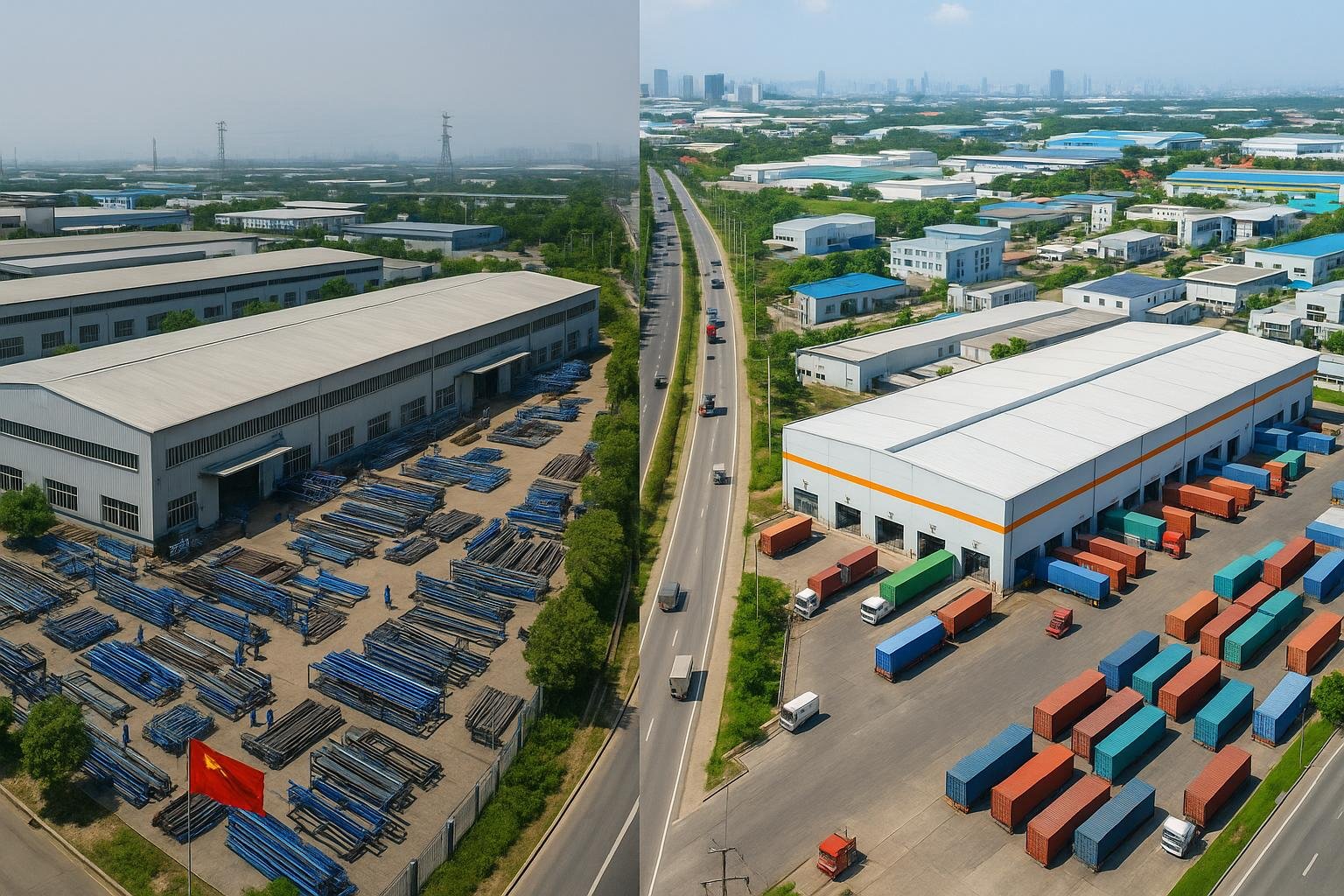
As firms increasingly adopt multi-hub production models, digital innovation and regional policy shifts are transforming the traditional supply chain landscape, making diversification an essential, strategic pursuit for resilience and growth by 2026.

The calculus of global production is being reworked. Firms that long relied on a single sprawling supply base are now treating diversification as operational imperative rather than optional strategy. According to DocShipperâ...
Continue Reading This Article
Enjoy this article as well as all of our content, including reports, news, tips and more.
By registering or signing into your SRM Today account, you agree to SRM Today's Terms of Use and consent to the processing of your personal information as described in our Privacy Policy.
The alternatives dominating corporate planning are Vietnam, India and Mexico, each presenting a different mix of cost, speed and resilience. Vietnam and India are frequently pitched as routes to lower labour costs and expanded capacity; Mexico offers nearshoring advantages for companies serving North America. Industry commentators frame the choice as one between minimising unit cost, shortening lead times or spreading exposure across multiple jurisdictions. According to analysis on ChinaGlobalPulse, many companies are choosing combinations of those objectives rather than a single criterion.
The reasoning behind the shift is familiar but freshly urgent. MIT Sloan describes China Plus One as a deliberate effort to limit dependence on a single country by establishing operations elsewhere, thereby cushioning firms from rising labour expenses, logistical shocks and diplomatic friction. That basic logic is reinforced by consultancy and market commentary: MSAdvisory highlights benefits including risk reduction, greater supply-chain flexibility and access to incentives and trade agreements, while MoveToAsia emphasises how digital tools and automation have reduced the friction of managing multi-country production networks.
These structural forces are already driving capital and technology flows. ABI Research forecasts, via a PR Newswire release, a dramatic increase in digital investment across Southeast Asia: smart-manufacturing and Industry 4.0 spending is expected to climb from roughly US$75 billion in 2023 to more than US$300 billion by 2028. That projected surge underlines how foreign direct investment is accompanying factory relocation, not merely shifting labour.
Practical trade-offs vary by destination. Vietnam’s manufacturing base offers relatively quick scale-up for apparel, footwear and certain electronics subassembly, but firms must weigh rising wages and infrastructure bottlenecks. India touts a vast labour pool and government incentives aimed at boosting domestic manufacturing, but companies often confront complex regulatory environments and slower logistics in some regions. Mexico provides the fastest route to North American markets and the advantages of nearshoring, yet industrial capacity constraints and sectoral specialisation mean it is not a universal substitute for China.
As the strategy matures, firms are employing more nuanced operating models. Some adopt a “split production” approach, retaining high-skill, capital-intensive processes in China while shifting labour-intensive assembly elsewhere. Others pursue multi-hub footprints that deliberately duplicate capabilities across locations to avoid single-point failure. Wikipedia’s overview of the China Plus One phenomenon characterises the trend as a macro-level rebalancing of investment toward multiple emerging economies, reflecting exactly this diversification of tactics.
The economics are not uniformly favourable. Logistics specialists warn of hidden costs: fragmented sourcing can raise inventory-carrying expenses, complicate quality control and increase coordination overhead. DocShipper’s experts flag port congestion, inland transport reliability and local supplier maturity as variables that can erode expected savings. Firms therefore need granular, scenario-based modelling rather than headline comparisons of labour rates.
Policy and incentives are shaping choices as well. Several Southeast Asian governments are actively courting manufacturers with tax breaks, training programmes and infrastructure projects; Thailand, for example, is positioning itself as an innovation and education hub to attract higher-value investment, according to commentary from MIT Sloan. Meanwhile, trade policy developments and regional agreements are altering the relative attractiveness of specific locations, reinforcing the need for continuous reassessment.
For small and mid-sized enterprises, the path forward tends to be incremental. Many begin by qualifying alternate suppliers, piloting small-batch production runs and investing in digital oversight so that multi-site operations remain visible and controllable. MoveToAsia notes that advances in automation and real-time monitoring have lowered the barrier to operating across borders, making dispersed manufacturing more practicable for firms without the scale of multinational corporates.
The broader implication is that China Plus One is no longer a simple contingency plan but a strategic posture. As firms weigh nearshoring against Southeast Asian expansion and Indian capacity growth, decision-makers must balance cost, speed to market and resilience, supported by data-driven modelling and on-the-ground logistics intelligence. According to industry forecasts and consulting analysis, the companies that treat diversification as an ongoing operating model, supported by digital investment and selective duplication of capacity, are most likely to convert short-term disruption management into long-term competitive advantage.
Source: Noah Wire Services
Subscribe to Industry Updates

