


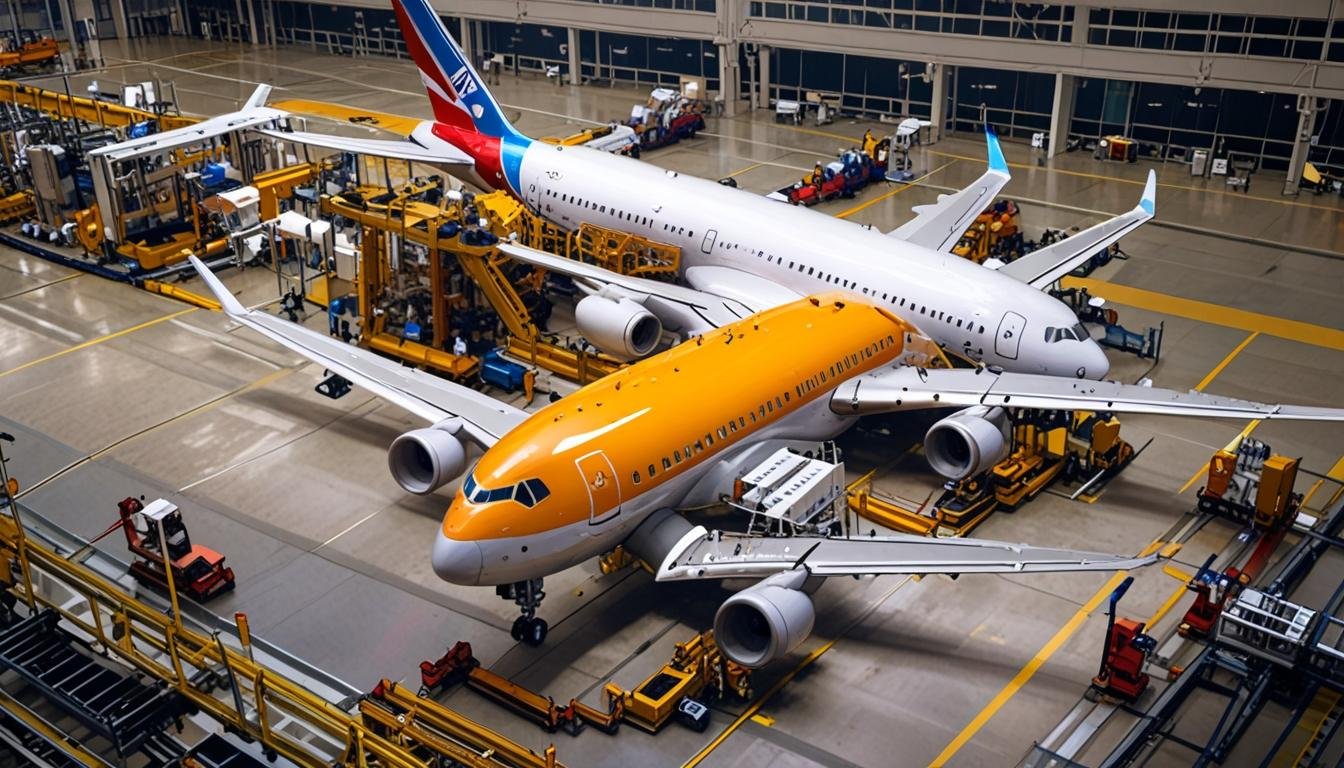
**London**: The aviation industry faces uncertainty due to tariffs affecting key players Boeing and Airbus. Boeing’s fragile supply chain is vulnerable, while Airbus’s diverse global strategy positions it better amidst trade tensions. The outcome could reshape competitive dynamics in the aerospace sector.
Over the past two months, the commercial aviation sector has encountered significant fluctuations and uncertainties predominantly due to the evolving concerns surrounding tariffs and other barriers that may affect the free movement of goods and services, particularly in the realm of aircraft manufacturing. The competition between two of the world’s leading aircraft manufacturers, Boeing and Airbus, has been at the forefront of this issue, as each company has its own unique advantages and vulnerabilities within the current trade climate.
Observers have expressed concerns that the newly imposed tariffs could disproportionately affect Boeing more than Airbus. Boeing’s supply chain is notably fragile and is fully exposed to tariffs enacted by the US government. As the largest exporting company in the United States, Boeing faces potential challenges in adapting to supply and demand shocks that might arise from prolonged tariff conditions. Most of Boeing’s clients are situated overseas, meaning retaliatory tariffs from entities such as the European Union and Canada could have adverse effects on its operations.

Boeing’s reliance on imports for raw materials and components manufactured abroad could lead to increased production costs, which may pose long-term risks for the manufacturer. In contrast, Airbus appears to have a smoother path ahead in light of these tariffs. The European giant has a more diverse market strategy, with a significant portion of its business not heavily reliant on the US. Additionally, Airbus’s wide-ranging global manufacturing footprint enables it to produce aircraft in locations such as the United States, thus mitigating the effects of tariffs.
The focus now turns to Airbus’s extensive global assembly network, which might serve as a crucial asset in managing the risks associated with the current trade tensions. The company operates multiple final assembly lines around the world, each tailored to specific aircraft and market demands. In Europe, Airbus has major facilities situated in Toulouse, France for the A320 family and A330/A350 models, and in Hamburg and Bremen, Germany for other aircraft types. Furthermore, Airbus has a defence division in Seville, Spain, which produces military aircraft models.
Beyond Europe, Airbus’s global presence is substantial. Its assembly plant in Tianjin, China, has been operational since 2009, contributing to the production of the A320 family since its inception. Reports indicate that this location has recently reached a notable milestone, delivering its 700th aircraft. Plans for expanding production capabilities in China are also underway with a second assembly line in the works.
In North America, Airbus maintains an influential assembly line in Mobile, Alabama, which produces aircraft including the Airbus A220 and A320 families, alongside other component facilities in Mirabel, Quebec. Airbus’s footprint in the US market is significant, as around 35% of its annual jet orders stem from North American customers. Furthermore, the American aircraft manufacturing sector comprises a substantial number of subcontractors contributing around $5.5 billion annually to the economy and employing approximately 120,000 individuals. Many Airbus models, like the Airbus A380, are built with a considerable fraction (over 50%) of American components.
Airbus has also made significant investments to support its international manufacturing operations. For the transport of aircraft components assembled in Europe, the company utilises its Beluga and Beluga XL fleets, ensuring effective logistics between sites. This strategy allows Airbus to sidestep tariffs when assembling aircraft in both China and the US, especially as components are gathered in Europe before shipment for final assembly in places like Alabama.
In addition to aircraft assembly, Airbus continues to establish its footprint in technological innovation, most recently by leasing a large office space in Bengaluru, India, which will house its Global Capacity Center.
Analysts suggest that Airbus’s diverse manufacturing presence protects it against potential trade barriers, most evident from its acquisition of the A220 program from Bombardier. This acquisition provided Airbus with an advantageous assembly location in the US, thus circumventing tariffs implemented by the US government. These strategic decisions may offer Airbus a substantial competitive edge in ensuring tariff-free market access.
On the other hand, Boeing’s strategy of maintaining its final assembly lines exclusively within the US has garnered support from politicians and the government alike, endorsing the employment of US labour. However, this has rendered Boeing vulnerable to international tariffs, as its exclusively American manufacturing base means all exported jets face potential tariff consequences without a means of reducing exposure through offshore facilities.
As the landscape of international trade continues to evolve, the contrasting strategies of Boeing and Airbus in navigating the current tariff environment will likely have significant implications for their operational capabilities and market positions in the aerospace sector.
Source: Noah Wire Services

