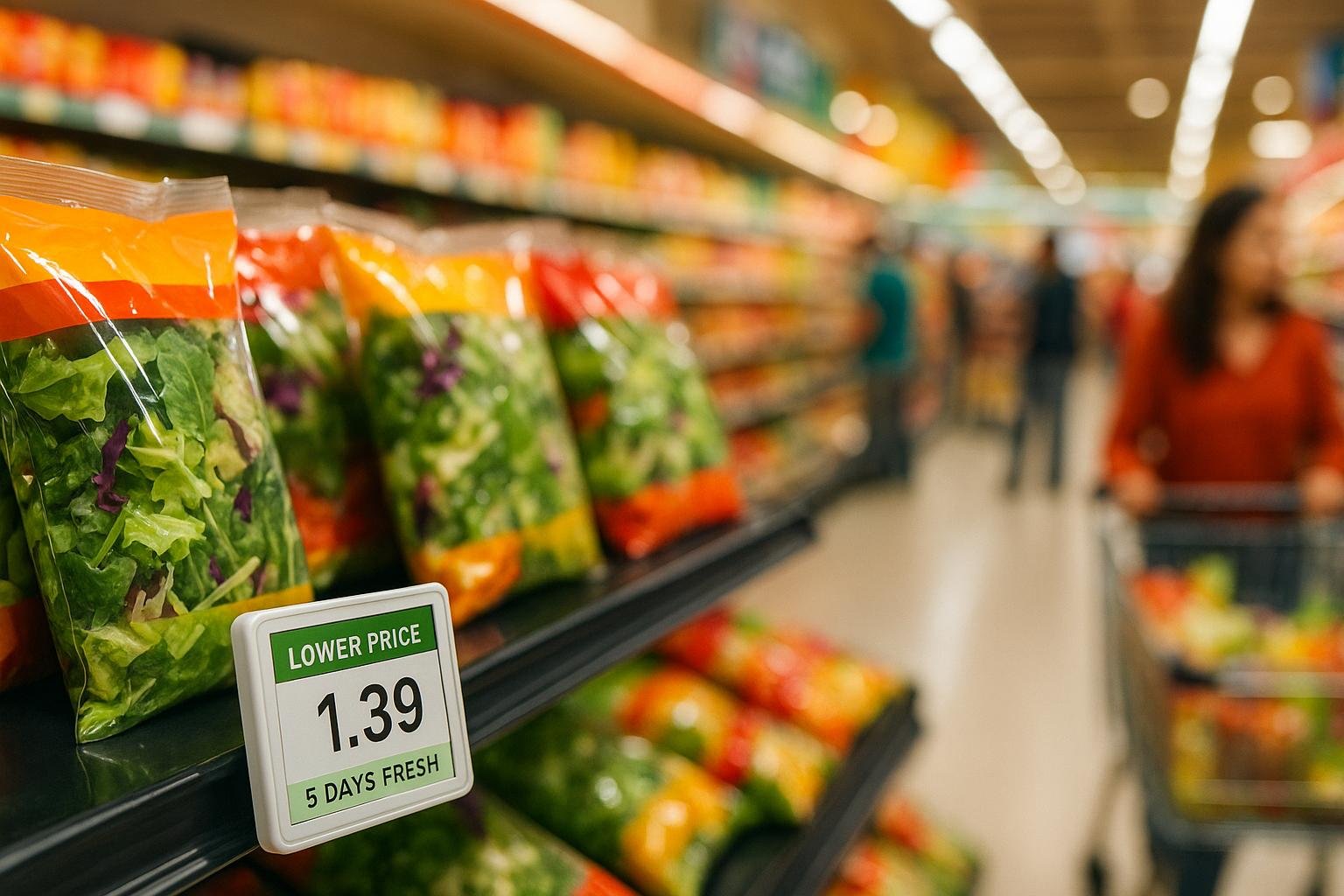
At NRF 2026, Avery Dennison showcased how smart label technology, including RFID and Bluetooth Low Energy sensors, is set to revolutionise inventory management and reduce food waste across retail supply chains, with collaborative efforts from major retailers like Walmart and Kroger driving the shift toward transparency and efficiency.

Avery Dennison used NRF 2026 to press the commercial case for “intelligent” labels, pairing demonstrations of new radio frequency ide...
Continue Reading This Article
Enjoy this article as well as all of our content, including reports, news, tips and more.
By registering or signing into your SRM Today account, you agree to SRM Today's Terms of Use and consent to the processing of your personal information as described in our Privacy Policy.
At the Javits Convention Center in New York from January 11–13, the materials‑science and digital‑identification group mounted two Big Ideas sessions and an interactive booth programme to show how item‑level digital identity can give store teams faster, more accurate visibility from source to shelf. According to PackagingTechToday, Bill Toney, vice‑president of advanced technology, joined a panel moderated by Dr Bill Hardgrave, president of the University of Memphis, to explore how RFID is becoming a foundational layer for AI‑driven analytics that extend beyond inventory accuracy to factory, retail and consumer use cases. The session was billed as The Future of Retail: How RFID Lays a Foundation for AI‑Driven Analytics in Supply Chains and In‑Store Experiences.
A second session, Revolutionizing Fresh Operations: Embracing RFID in Grocery to Reduce Waste and Drive Sales, brought Julie Vargas of Avery Dennison together with Jonathan Olsen of The Kroger Co. to outline how sensor‑enabled tags are being used in store to manage fresh inventory and lift availability. According to the NRF session listing, Kroger discussed translating RFID use cases into operational efficiency and sales gains as part of its Zero Hunger | Zero Waste ambitions.
Avery Dennison also published a major piece of research at the event. According to the company’s report, “Making the Invisible Visible: Unlocking the Hidden Value of Food Waste to Drive Growth and Profitability,” independent modelling based on a survey of 3,500 global retail and supply‑chain leaders found that the economic cost of food waste across the retail supply chain is forecast to reach $540 billion by 2026, with food‑waste costs equivalent to, on average, 33% of total revenues in the food retail supply chain from post‑farm to point‑of‑sale. The report identifies meat as the single most challenging category, with waste projected to cost $94 billion in 2026, followed by fresh produce at $88 billion. Labels & Labeling noted the study’s finding that 61% of businesses lack full visibility into where waste occurs, singling out transit as a critical blind spot where smart labels could add value.
Industry partnerships underpinned the company’s message. Avery Dennison has signalled collaboration with major retailers on fresh‑food tagging: the company said it is working with Walmart to develop a sensor‑enabled RFID label for meat departments, aiming to transform inventory processes and improve freshness management. The company’s press materials framed such collaborations as steps toward expanded use cases for intelligent labelling in grocery, and as proof points for source‑to‑store traceability that can also support loss prevention and circularity.
At the booth, Avery Dennison showcased new RFID inlays designed for the particular challenges of fresh items and highlighted demonstrations across inventory management, loss prevention and packaging integration in categories such as beauty, where the company says integrated source‑tagging can deliver full item visibility without compromising premium design. Francisco Melo, president, Intelligent Labels Technologies and Digital Solutions at Avery Dennison, said: “Building intelligence into every item helps supply chains become more transparent, while maximizing efficiency and productivity of retail operations and improving the consumer experience. We’re reimagining what’s possible by building innovative, connected solutions. We can’t wait to bring this to life at NRF.”
While the company presented the research as a call to action for retailers, the findings also underline the scale of the operational and commercial challenge. Industry commentary around the event emphasised two linked points: that better visibility is a precondition for tackling avoidable loss, and that deployment of item‑level sensors raises practical issues around tag design, cost, integration into store workflows and data governance. Avery Dennison’s announcements and demonstrations at NRF form part of a broader move by retailers and suppliers to pilot sensor and RFID strategies in fresh categories, but the transition from pilot to wide‑scale adoption will be measured by demonstrable reductions in waste and improvements in sales and margins.
According to Avery Dennison’s corporate materials, the company employs about 35,000 people in more than 50 countries and reported $8.8 billion of sales in 2024. The company framed its NRF activity as an illustration of its “Making Possible” strategy: marrying labelling materials, sensor hardware and software to give brands and retailers the information they need to act with speed and confidence.
Source: Noah Wire Services
Subscribe to Industry Updates