


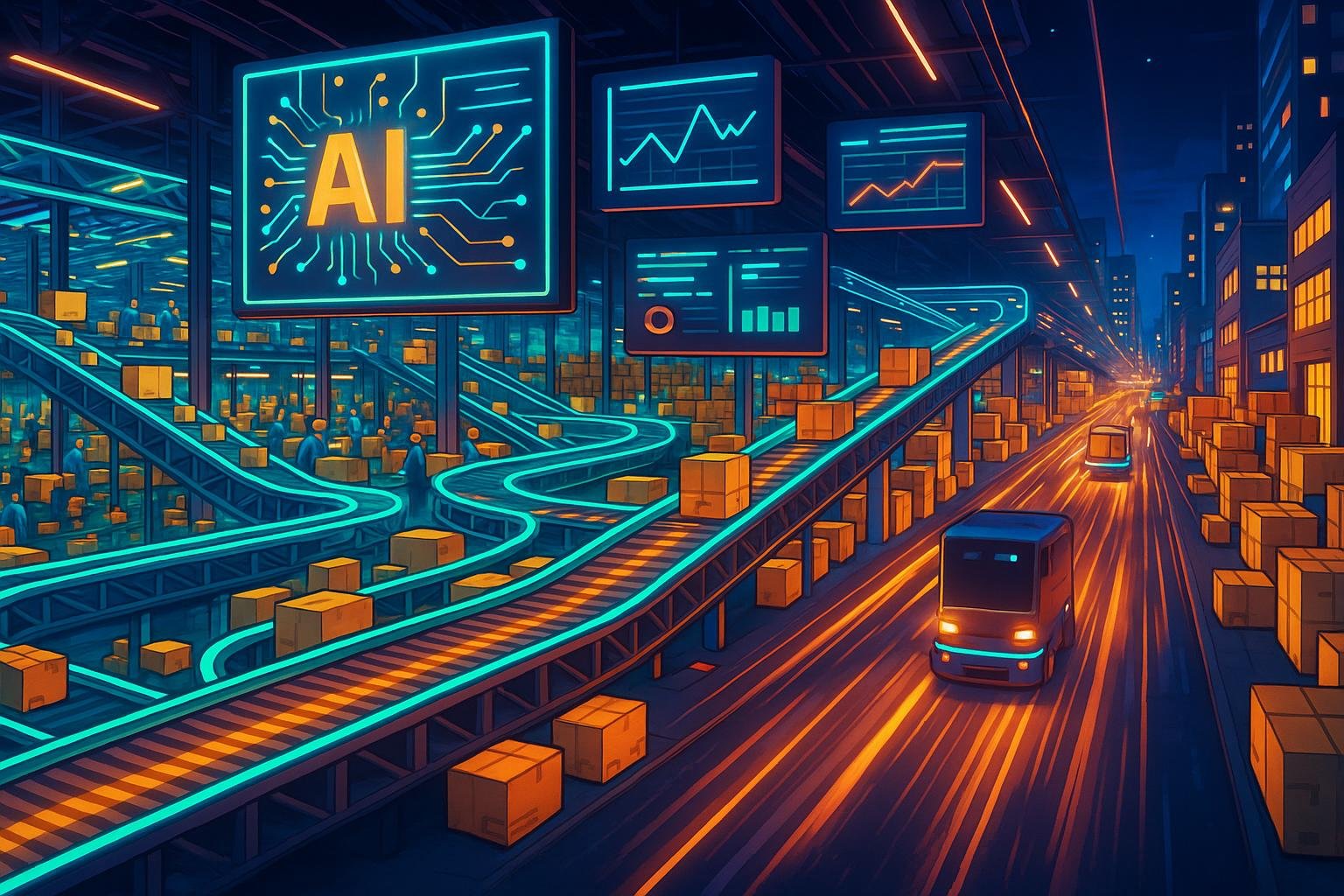
At 4.47am on a Monday, a supply chain leader can find their network unravelling in minutes: a dispute at a key site, a sudden loss of capacity, and a customer commitment now hanging by a thread. In a conventional operating model, the response is usually a blur of spreadsheets, manual checks, delayed calls and expensive rerouting. In an AI-native model, the same disruption can trigger instant analysis, scenario testing and corrective action before the morning shift even starts.
That contrast is driving renewed attention on autonomous supply chains, where intelligence is not bolted on after the fact but built into the operating core. The argument made by SRM Tech and Enmovil is that many enterprises have spent years adding digital tools to old structures, creating visibility without true execution. Their view is that the real shift now is from systems that merely report problems to platforms that can sense, decide and act in real time.

The broader market suggests they are not alone. Logility says its AI-powered supply chain platform is designed to turn fragmentation into clarity by connecting siloed systems and improving orchestration. Kinaxis has positioned its Maestro platform around real-time, synchronised decision-making, while C3 AI says its supply chain orchestration offering uses AI agents to continuously optimise plans and respond to disruptions. AIDOLS, meanwhile, describes its own logistics operating system as AI-native and autonomous, spanning transportation, warehousing, procurement and retail flows in a single self-optimising environment.
What distinguishes these efforts from earlier rounds of supply chain software is the move from prediction to execution. The SRM Tech and Enmovil model places emphasis on an AI command layer that can coordinate logistics decisions rather than simply recommend them. That reflects a wider industry realisation: insight has little value if it cannot be translated quickly into action.
The central challenge is that most organisations are still operating between integration and intelligence. Data may now be connected, but decision-making often remains slow, human-heavy and batch-driven. In that setting, AI can produce better forecasts or alerts, yet value leaks away if those outputs still have to pass through multiple manual approvals before anything changes on the ground.
That is why advocates of autonomous supply chains increasingly frame the issue as one of maturity. At the lowest level are manual processes built around spreadsheets and reactive firefighting. Higher up the scale are connected and predictive systems. At the most advanced end are adaptive or autonomous operations, where AI handles routine decisions within set limits and people focus on strategy, exceptions and governance. SAP has described a similar progression, from digital to adaptive to autonomous.
The practical payoff is most visible in five areas. Demand sensing becomes more responsive when systems ingest market, weather and behavioural signals in real time. Procurement gains speed when supplier risk, tariff exposure and financial weakness are monitored continuously. Logistics can be optimised dynamically through load pooling and rerouting. Warehousing benefits from more accurate replenishment and faster quality checks. And disruption management improves when digital twins and scenario modelling are used to prepare responses before a crisis hits.
But the article’s strongest warning is that autonomy does not mean eliminating people. The biggest barrier is often trust. If planners do not believe the system will make the right call, they will override it, work around it or ignore it altogether. The more successful implementations, the argument goes, are human-in-the-loop models in which AI executes routine tasks and humans retain oversight, escalation authority and accountability.
That makes leadership as important as technology. The companies most likely to succeed are those that define human-machine boundaries early, decide where overrides are required and measure success not just in cost savings but in decision speed and resilience. According to SRM Tech and Enmovil, the future supply chain is one where the architecture itself is designed to learn continuously, absorb disruption and recover without waiting for manual intervention.
The direction of travel is clear. The next phase of supply chain transformation will be judged less by how much data a company can collect than by how fast it can convert signal into action. For organisations still relying on layered tools and disconnected workflows, the message is blunt: the architecture chosen now will shape the supply chain they are able to run tomorrow.
Source: Noah Wire Services

