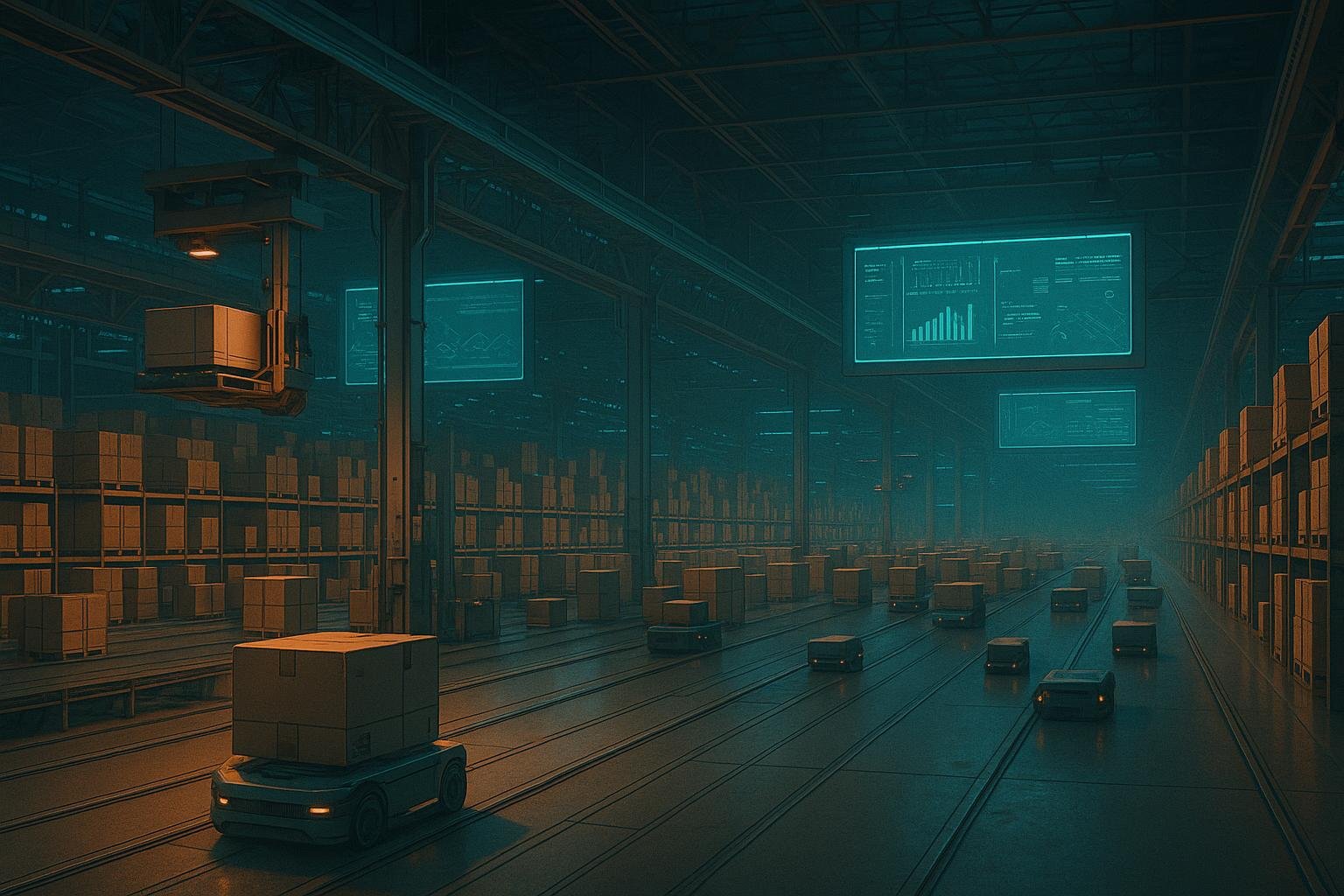
Emerging autonomous AI agents are moving beyond pilot phases to promise real-time, goal-directed responses in supply chains, potentially transforming operations, reducing costs, and enhancing resilience amid growing complexity and regulation.

For supply chains long defined by crisis-driven responses, a new class of software is promising to shift the balance from damage limitation to continual, automated adaptation. Autonomous AI agents, software entities that perceive c...
Continue Reading This Article
Enjoy this article as well as all of our content, including reports, news, tips and more.
By registering or signing into your SRM Today account, you agree to SRM Today's Terms of Use and consent to the processing of your personal information as described in our Privacy Policy.
According to a Fluent Commerce report cited by TechRadar, more than 70% of retailers have at least trialled agentic AI tools to drive operational efficiency, and 71% expect measurable improvement within a year. Yet only 8% report full deployment across operations and just 5% consider their implementations mature. Those figures underscore a familiar pattern: strong interest and promise, but limited scale and readiness.
What distinguishes agentic systems from classic analytics is their capacity to operate as goal-directed, semi-autonomous actors within a larger “multi-agent” society. In practical terms this can mean a monitoring agent that fuses telemetry from IoT devices, GPS and customs feeds detecting a port delay; a logistics agent that reroutes freight and books alternative transport; and a procurement agent that negotiates supplementary supply, each executing within predefined governance limits so decisions remain bounded by budgetary, compliance and risk constraints.
Industry analysis shows those use cases span the core pain points supply chain leaders cite. Forbes Councils has highlighted persistent problems, fragmented systems, slow decision cycles and underused data, and notes that tightly integrated AI can reconnect disjointed applications, automate routine decisions and surface proactive options to planners. Vendor and industry commentary suggests benefits ranging from lower logistics cost and reduced inventory carrying levels to faster customs clearance and more reliable forecasting. SDCE Executive lists rapid transformation in transportation management and demand forecasting among the trends reshaping operations in 2026.
Analysts are placing agentic AI on a clear adoption trajectory. Gartner predicts that by 2030 half of cross‑functional supply chain management solutions will incorporate agentic capabilities to autonomously execute decisions across the ecosystem. Proponents argue such systems effectively create a virtual workforce that augments human teams, allowing planners and procurement specialists to concentrate on strategy, governance and exceptions.
But moving from pilots to pervasive, safe autonomy requires addressing hard socio‑technical challenges. Security and resilience are central: agents that can commit spend or alter routing become high‑value targets for cyber attack, and firms must adopt zero‑trust architectures and robust audit trails. The “black box” problem also looms large, companies and regulators demand explainability and traceability so that every automated decision can be justified and inspected. 66Degrees and other consultants stress that scalable deployment depends on solid infrastructure, clear roadmaps and comprehensive change management, including extensive training to close skills gaps and transparent communication to build trust with customers and partners.
Inter‑company agent communication presents additional complexity. Standards and secure protocols are needed before autonomous negotiation between firms becomes routine; absent interoperable frameworks, ad hoc integrations risk replacing one form of fragility with another. Governance frameworks must codify spending limits, ethical boundaries and escalation paths so that agents operate inside acceptable risk envelopes while learning from outcomes.
The commercial trade‑offs are already visible in the field. Fluent Commerce’s findings show many organisations are experimenting with limited, tightly governed uses where economic upside is concrete, inventory rebalancing, expedited logistics for high‑value SKUs and supplier prioritisation. Wider ambitions, full autonomous negotiation across procurement ecosystems or completely self‑healing production schedules, remain constrained by integration effort, regulatory uncertainty and organisational readiness.
For early adopters, the near‑term prize is improved resilience and decision velocity without wholesale headcount replacement. For laggards, the risk is growing operational disadvantage: a company that can reconfigure supply and logistics in minutes will outcompete peers still reliant on weekly planning cycles. Yet the race for autonomy is not simply technical; it is organisational and regulatory, requiring firms to redesign processes, invest in cybersecurity, formalise governance and work with industry bodies on standards.
As deployments expand, the conversation is shifting from whether agents can act to how they should be constrained, audited and certified. That shift matters because the benefits, lower disruption costs, greater agility, and leaner inventories, are contingent on trustworthy, transparent operation. Industry observers caution against treating agentic AI as a magic bullet; rather, it must be integrated into a broader regimen of data quality, systems engineering and human oversight.
The emergence of autonomous agents represents a substantial evolution in supply‑chain tooling: not merely predictive dashboards but systems capable of executing and learning from decisions in near real‑time. If the current trajectory continues, the next decade will be defined less by human firefighting and more by orchestrated, machine‑speed responses governed by explicit business rules and external standards. The companies that combine sound engineering, disciplined governance and clear change management are most likely to realise that future safely and at scale.
Source: Noah Wire Services
Subscribe to Industry Updates