


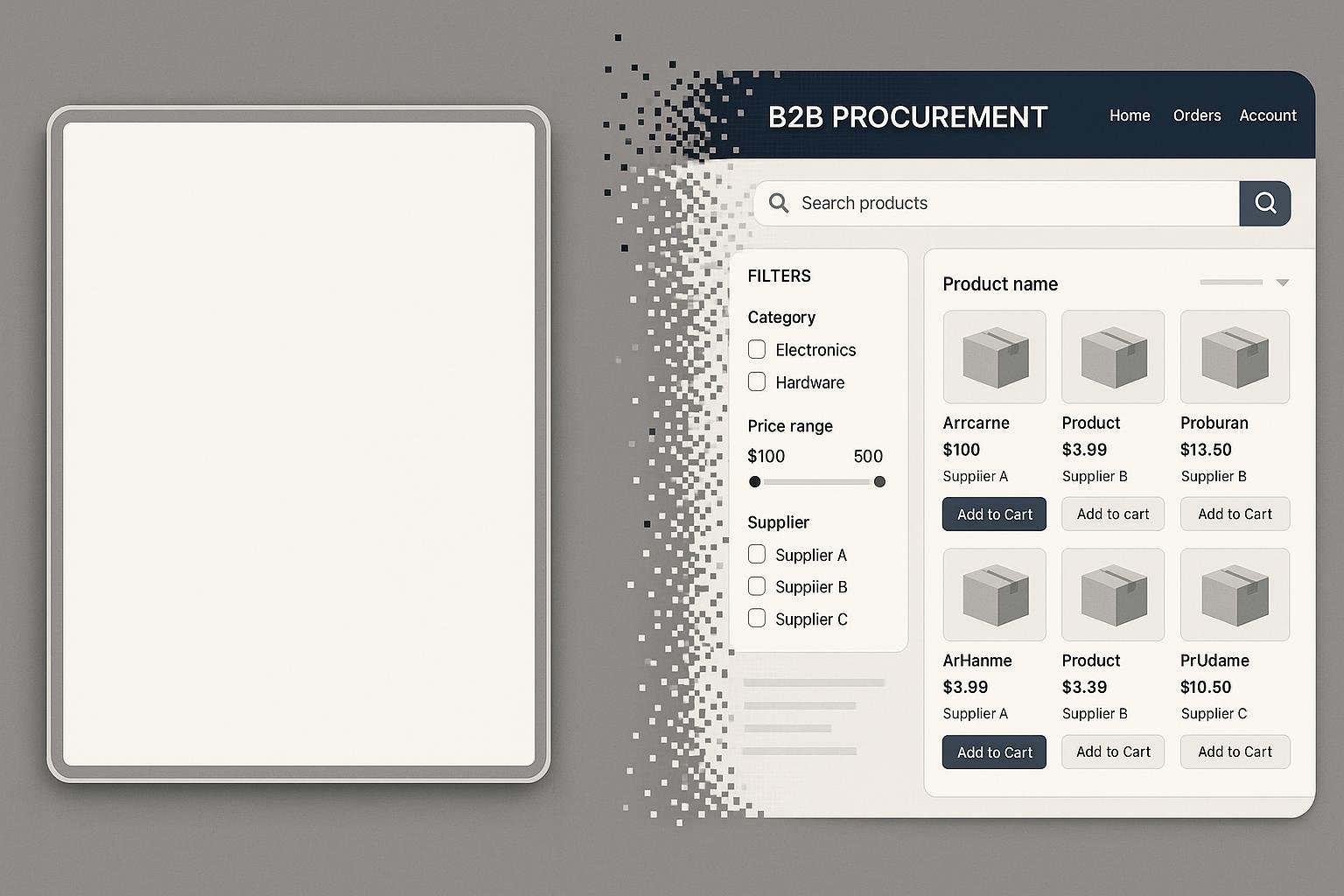
The rapid adoption of generative AI in B2B procurement is reshaping search dynamics and presenting urgent opportunities for early adopters to secure a decisive advantage in the evolving digital landscape.

The AI search revolution that has reshaped consumer discovery is now remaking B2B buying markets, and companies that fail to adapt risk being sidelined as decision-makers migrate to generative interfaces. TechBullion’s analysis of industry data frames a market expect...
Continue Reading This Article
Enjoy this article as well as all of our content, including reports, news, tips and more.
By registering or signing into your SRM Today account, you agree to SRM Today's Terms of Use and consent to the processing of your personal information as described in our Privacy Policy.
Industry adoption is widespread and rapid. According to Forrester, 89% of B2B buyers adopted generative AI within two years, making it a primary source of self-guided information during procurement. Gartner’s 2025 figures underscore the scale of the underlying technology shift: the generative AI models market expanded from $1.4 billion to $5.7 billion in 2024, a 320.4% increase that underpins the commercial momentum driving AI search platforms.
Buyer behaviour has pivoted. Multiple surveys show large proportions of B2B buyers now rely on AI tools early in their research. G2’s 2025 report finds that 79% of global B2B buyers say AI search has altered their research methods, while Responsive’s 2025 study reports that 25% use generative AI more often than traditional search engines for supplier research and that nearly two-thirds rely on AI chatbots as much as or more than Google or Bing. Strategic Media’s 2025 planning report adds that 72% of buyers encounter Google’s AI Overviews during vendor research and that trust in AI tools is rising year on year.
Those shifts are compressing the commercial funnel. TechBullion cites 6sense research showing that large language models are employed at scale in buying journeys while buyers still average the same number of vendor touchpoints with winning suppliers, meaning AI makes prospects far more informed before they engage sales. The result is an attribution “dark funnel” where discovery occurs inside opaque LLM interactions and traditional demand-generation metrics undercount decisive early signals.
Search engine changes compound the threat to legacy visibility. Studies cited by TechBullion show Google AI Overviews have depressed organic click-through rates: analysis by Seer Interactive of thousands of search terms found CTRs for queries with AI Overviews fell markedly, and Bain’s 2025 work estimated that 60% of searches end without clicks. BrightEdge and GrowthSRC Media reporting similarly indicate steep declines in top organic CTRs as AI Overviews expand. The consequence is binary for many vendors: brands cited within AI responses see materially better traffic and paid performance, while uncited brands risk long-term marginalisation.
Platform diversification intensifies the competition for citations. Perplexity, ChatGPT, Google’s Gemini and other AI search entrants have all scaled rapidly; the lead article cites Perplexity’s surge to hundreds of millions of queries and ChatGPT weekly user counts in the hundreds of millions. Enterprise adoption is visible: the lead material notes large-company usage of Perplexity and wider GenAI uptake across Fortune 500 organisations, signalling that AI search is not a fringe channel but a core procurement touchpoint.
The commercial case for action is direct. TechBullion reports conversion multipliers ranging from 4.4x to 23x in favour of AI search traffic and gives concrete examples, Vercel attributes roughly 10% of new sign-ups to ChatGPT referrals, illustrating measurable pipeline impact. ICODA’s market observations, quoted in TechBullion, reflect buyer urgency: “CFOs and CTOs are now asking about AI search optimization ROI with the same urgency they previously reserved for paid media. The conversion data is simply too compelling to ignore,” Vlad Pivnev from ICODA said in TechBullion.
Practical implications are already visible across sectors. Fintech, crypto, AI infrastructure and SaaS firms are among the earliest adopters of AI search optimisation strategies, driven by digitally literate buyers and fast innovation cycles. Market estimates place the specialised Generative Engine Optimization (GEO) services market in rapid expansion: what was an $848–886 million allocation among large enterprises in 2024 is modelled to grow into the multi‑billion dollar range by the early 2030s, as vendors treat GEO as a distinct channel alongside traditional SEO.
Technically, AI search optimisation departs from classic keyword playbooks. The emerging playbook prioritises entity recognition and knowledge-graph presence, semantically structured content designed for extraction, verifiable author expertise (E‑E‑A‑T signals) and platform-specific citation strategies. Each AI system favours different content formats and citation behaviours: some reward concise recommendations with confident assertions, others prioritise transparent sourcing and data citations. Successful programmes combine audits of AI visibility, prioritisation of high-intent queries, content restructuring for machine consumption, and systematic authority-building across trusted domains.
Organisations are responding with new service tiers and investments. SEO vendors report meaningful revenue from AI-driven products and acquisitions to bolster capabilities; a proliferation of GEO tools has entered the market, while service pricing reflects the specialist skills required, basic multi-platform packages at lower monthly rates up to enterprise engagements commanding tens of thousands per month for full‑stack integrations.
The competitive reality is stark. As AI platforms consolidate preferred sources and citation habits, early visibility becomes defensible and harder to dislodge. Data from the cited research and vendor reports collectively indicate that AI search is not a transient experiment but a structural channel shift. For marketing leaders, finance chiefs and technology officers, the imperative is execution: audit current presence in AI responses, prioritise conversion-driving queries, rearchitect content for extraction and credibility, and integrate AI visibility with wider go-to-market programmes before buyer discovery habits calcify.
The consequence of delay is clear in the evidence: buyer journeys are already migrating into generative environments; AI platforms are scaling rapidly; and organic click dynamics are changing permanently. Treating AI search optimisation as a distant initiative risks systematic exclusion from how modern B2B buyers discover, evaluate and select vendors.
Source: Noah Wire Services
Subscribe to Industry Updates

