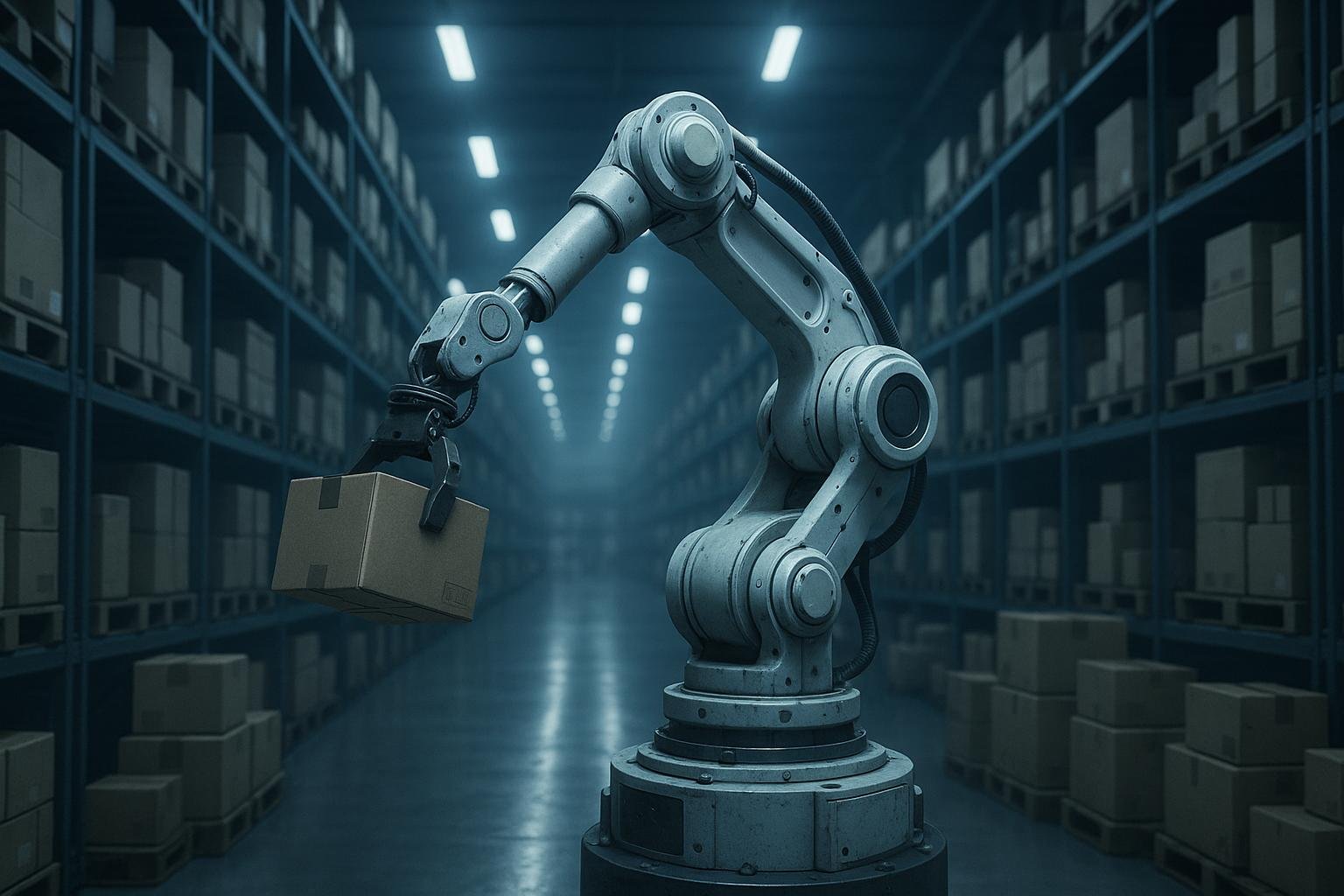
A new study reveals that 60% of warehouses worldwide now integrate AI into core functions, with rapid investment growth, workforce evolution, and industry forecasts pointing to widespread automation and smarter logistics by 2030.

Artificial intelligence and automation have moved from pilot projects to mainstream infrastructure in warehousing, reshaping productivity, workforce composition and investment priorities across global supply chains. A new study by Mecalux and t...
Continue Reading This Article
Enjoy this article as well as all of our content, including reports, news, tips and more.
By registering or signing into your SRM Today account, you agree to SRM Today's Terms of Use and consent to the processing of your personal information as described in our Privacy Policy.
The study highlights rapid return on investment and shifting technology budgets: businesses report allocating between 11% and 30% of warehouse technology spend to AI and machine learning, with typical payback periods of two to three years. Industry data shows the benefits are wide ranging , improved inventory accuracy, higher throughput, greater labour efficiency and fewer errors , and that investment drivers include labour shortages, customer expectations, sustainability goals and competitive pressure.
The research also documents a changing labour picture. Contrary to simple automation‑displacement narratives, the study reports that over three‑quarters of organisations saw higher productivity and satisfaction after AI deployment and that more than half experienced workforce growth. New roles emerging in logistics include AI/ML engineers, automation specialists, process‑improvement experts and data scientists , skills that companies increasingly prioritise as they integrate people, data and analytics into legacy systems. “The hard part now is the last mile: integrating people, data and analytics seamlessly into existing systems,” says Dr Matthias Winkenbach, director of the MIT ILS Lab.
Mecalux’s chief executive, Javier Carrillo, underlined operational resilience as a competitive advantage: “The data show that intelligent warehouses outperform not only in volume and accuracy, but in adaptability,” he said, adding that AI‑enabled operations are “more resilient, more predictable and better positioned to navigate volatility” during peak seasons. The report further notes that nearly every company surveyed plans to expand AI use over the next two to three years, with generative AI singled out as the next frontier for automating documentation, optimising layouts and even generating code for automation systems. “Traditional machine learning is great at predicting problems, but generative AI actually helps you engineer the solution,” Dr Winkenbach said.
Broader industry research supports the trajectory. Forecasts by Getac and Statista project warehouse AI adoption rising sharply , from low double digits in 2019 to roughly three‑quarters of sites by 2030 , while vendor and trade reporting points to growing deployment of autonomous material movers, inventory drones and other robotics that complement AI‑driven warehouse management systems. Consultancy and operator case studies have likewise reported double‑digit efficiency gains and material cost reductions where automation is well implemented.
Challenges remain: the report and industry commentators point to technical expertise gaps, integration costs, data quality issues and the complexity of retrofitting legacy facilities. For many operators, the strategic question is not whether to adopt AI but how to sequence investments, build in‑house capability and align technology with workforce development so that productivity gains translate into resilience and service improvements. The combined evidence suggests a fast‑moving transformation in which intelligent warehouses become platforms that boost efficiency, create higher‑skilled jobs and enable new capabilities across global supply chains.
Source: Noah Wire Services
Subscribe to Industry Updates