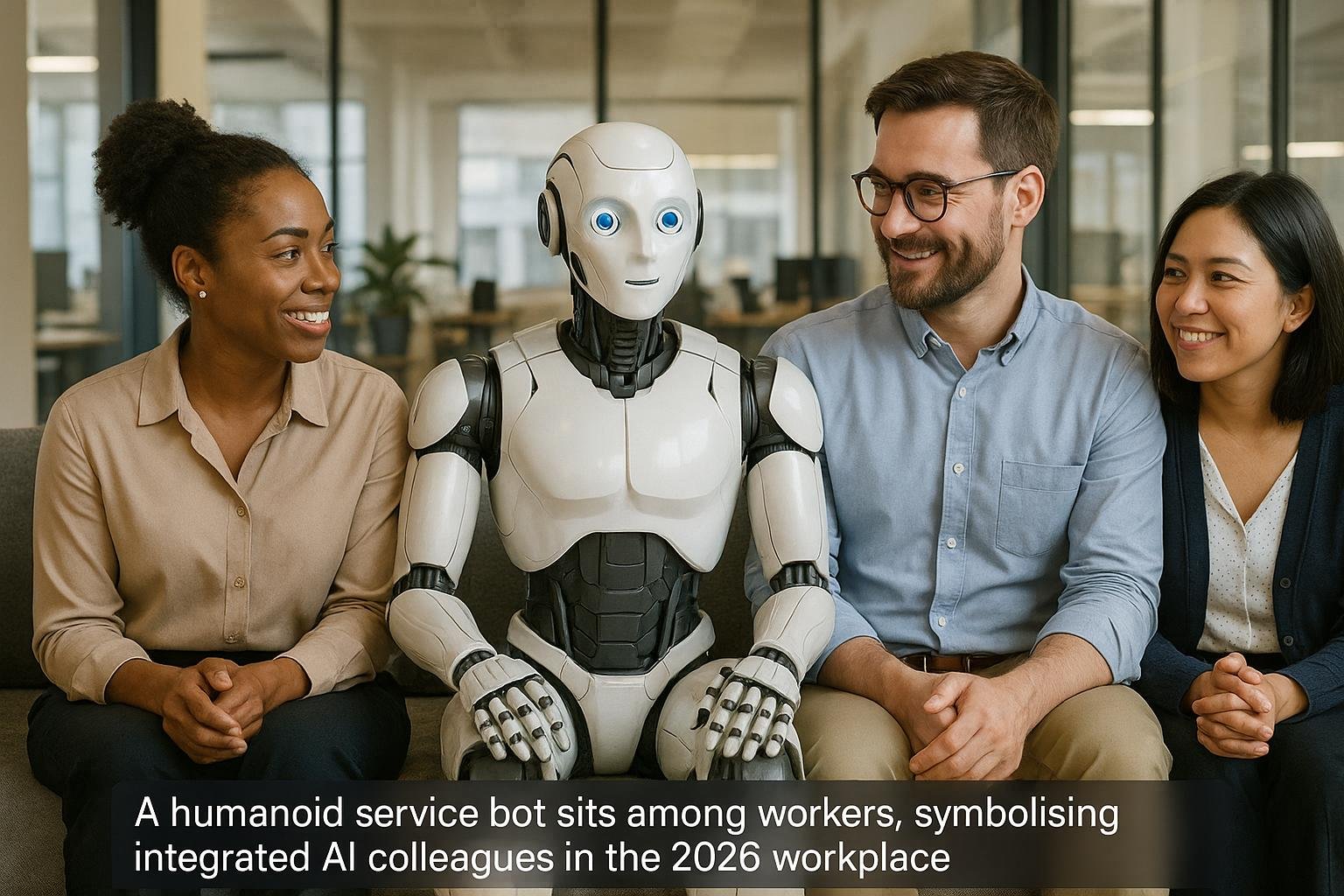
As businesses shift from automation to embedding autonomous AI agents as everyday colleagues, 2026 promises a profound redefinition of work, collaboration, and organisational structures, demanding new skills and governance approaches.

2026 is shaping up to be the year work changes from being assisted by AI to being organised around it, as businesses move beyond automation toward embedding autonomous AI agents as everyday colleagues across workflows.
After two yea...
Continue Reading This Article
Enjoy this article as well as all of our content, including reports, news, tips and more.
By registering or signing into your SRM Today account, you agree to SRM Today's Terms of Use and consent to the processing of your personal information as described in our Privacy Policy.
Industry leaders say the shift will force new skills and fresh organisational thinking. Nesan Govender, a managing director at Accenture, told Techgoondu that “workers now need to learn how to work with and lead digital teammates.” Technical savviness combined with enduring human strengths such as judgement, critical thinking and interpersonal skill will increasingly define performance, he added.
That assessment is echoed by academic and vendor research. An arXiv study of an experimentation platform called MindMeld found that human-AI collaboration increased communication by 137% in a large marketing experiment and helped teams produce higher-quality ad copy, while a separate arXiv paper on MultiColleagues showed multi-agent systems can generate ideas rated higher in quality and novelty than single-agent baselines. Those findings suggest AI colleagues can amplify human creativity and throughput when integrated thoughtfully.
Public- and private-sector guidance is converging on similar conclusions. An Australian Government webinar framed the coming era as one in which small businesses and creators partner with AI “as teammates, not just time-savers,” offering practical use cases for automating strategy, content and customer experience while stressing the need to preserve the human touch. Vendor roadmaps from the likes of Cisco and Microsoft also project a workplace of “connected intelligence,” where people, data and digital workers collaborate and business leaders reconfigure team structures around combinations of humans and agents.
But leaders warn that the technical transition is only one piece of a broader organisational puzzle. HR, governance and financial models must adapt to hybrid human-AI teams. Govender cautioned that traditional HR frameworks for performance, remuneration and productivity “were not designed for human-AI teams and will have to be reframed,” with questions over how to measure co-produced output and redesign roles rising to the top of leadership agendas in 2026.
Digital stewardship has emerged as a central governance issue. Ben Tan, senior executive partner at Gartner Advisory in Asia‑Pacific, told Techgoondu that enterprises “must own the entire prompt-to-outcome lifecycle.” He argued that prompts now embed internal and external knowledge, conversation histories and situational context, making both inputs and outputs sensitive intellectual property. “If I instruct the LLM with all that internal and external context, you must own all the information, output and analyses,” he said, adding that ownership “must be locked down so that no one can touch it,” to avoid confidential data leaking into public models.
Financial control is another pressure point. AI adoption typically converts predictable capital projects into variable operating expenses as compute and service usage scale. Peter Marrs, president of Dell Technologies, Asia‑Pacific, Japan and Greater China, told Techgoondu that organisations should tie every dollar to a “clear value proposition, with transparent usage, ownership, and payback expectations,” and that shared AI platforms with rigorous governance can keep spend aligned with returns.
Readiness rather than budget remains a major barrier for many firms. Govender described three global enterprise cohorts: front-runners and fast followers that are reinventing themselves to be AI‑first; intermediates centralising data and deploying vertically; and slow starters hampered by fragmented systems and unstructured data. He predicted Southeast Asia will mirror that pattern, but expects momentum to accelerate over the next 12 to 24 months as organisations unify data and shore up infrastructure. In banking, “very rules driven with clear policies and regulatory guidelines”, Govender said adoption should be relatively straightforward; Techgoondu noted Singapore’s DBS has been steadily building AI capabilities and was named World’s Best AI Bank by Global Finance’s inaugural AI in Finance Awards.
Practical experiments and vendor pilots point to concrete design principles for human‑agent teams. Microsoft’s WorkLab envisions leaders overseeing “teams of agents” alongside people and recommends organisations find the right human-to-agent ratios for different tasks. Cisco argues that AI agents managing network complexity will let IT teams focus on strategy and innovation, while vendor and academic studies show gains are task-dependent: human-AI teams outperformed on communication and copy generation in marketing tests, whereas human-human teams retained advantages in other creative domains such as imagery.
The policy and ethical implications are unavoidable. As agents take on fluent, autonomous roles in decision-making and customer interaction, regulators, compliance teams and corporate counsel will be pressured to define accountability, auditability and liability for outputs that are co-produced by humans and models. Public guidance and vendor claims diverge on pace and approach; organisations adopting agentic systems will need to reconcile vendor roadmaps with legal and regulatory obligations in their jurisdictions.
The competitive advantage, industry observers say, will not come merely from acquiring the most advanced model, but from how organisations redesign work around human strengths, governance and measurable value. According to Techgoondu, the firms that “use AI intelligently alongside human talent to elevate workers, speed up insight and redesign roles around higher-value, judgement-driven work” will gain the edge.
As 2026 begins, the emerging consensus from government briefings, vendor essays and academic experiments is clear: AI agents will be integrated colleagues rather than hidden tools. The challenge for the year ahead lies in redesigning organisations, HR systems, stewardship practices, financial controls and team structures, so that those digital teammates deliver value without compromising control, privacy or human judgment.
Source: Noah Wire Services
Subscribe to Industry Updates