


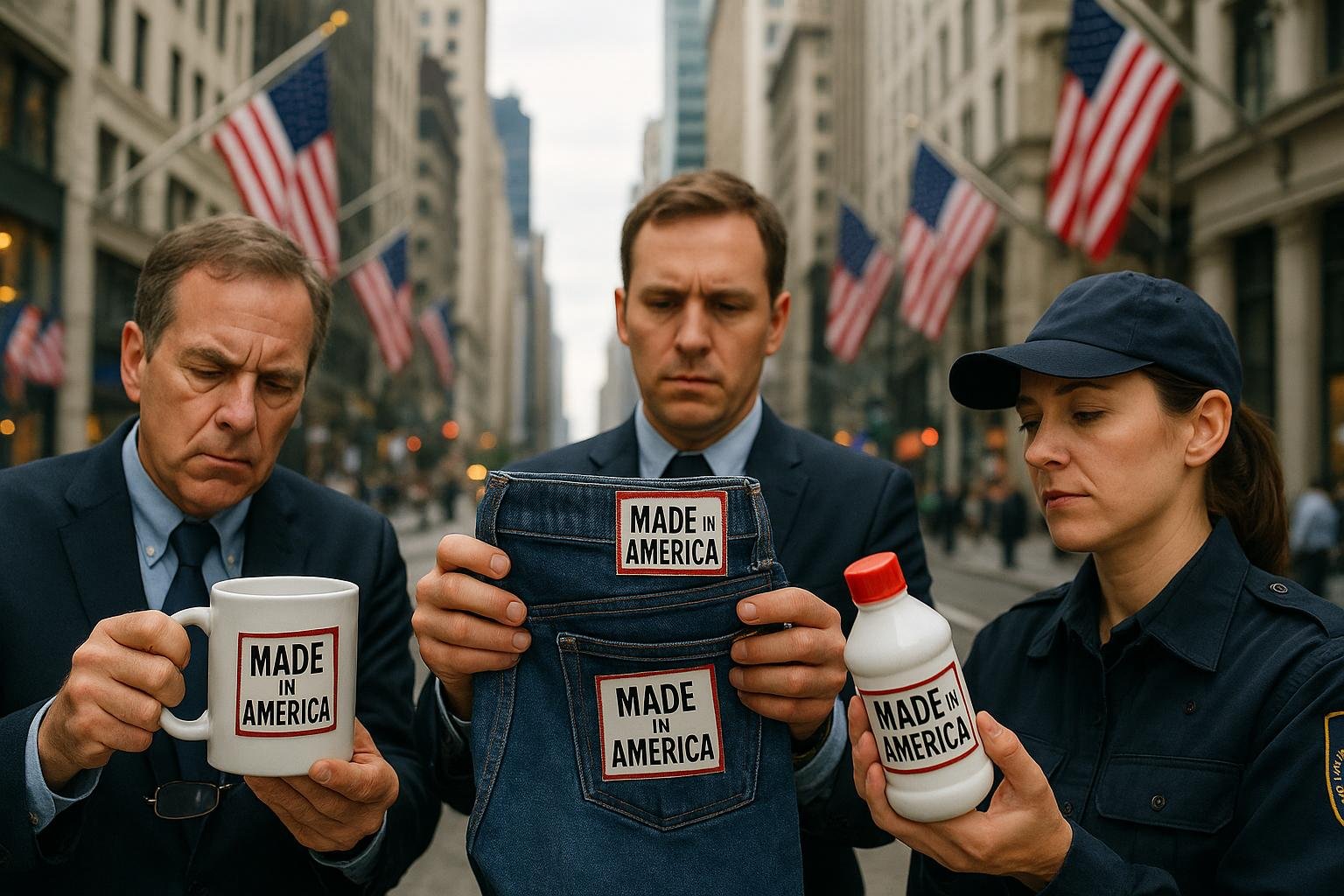
The US administration has ordered a stricter federal crackdown on businesses misrepresenting products as American-made, pointing to increased civil and criminal penalties and tighter scrutiny of origin claims.

The White House has ordered a stepped-up federal response to businesses that advertise products as American-made when they are not, directing regulators to tighten scrutiny of “Made in America” claims and signalling heightened exposure to both civil and crimin...
Continue Reading This Article
Enjoy this article as well as all of our content, including reports, news, tips and more.
By registering or signing into your SRM Today account, you agree to SRM Today's Terms of Use and consent to the processing of your personal information as described in our Privacy Policy.
According to a White House statement issued on March 13, 2026, the Executive Order titled Ensuring Truthful Advertising of Products Claimed to be Made in America instructs federal agencies to prioritise detection and enforcement against misleading origin claims in commercial and government procurement markets. The statement says the measures aim to give consumers clearer information and to protect firms that genuinely manufacture products in the United States from unfair competition.
The Order explicitly tasks the Federal Trade Commission with elevating enforcement against sellers and manufacturers that falsely or misleadingly represent products as Made in America. It also directs the FTC to consider whether an online marketplace’s failure to adopt verification procedures for country-of-origin claims should itself be treated as an unfair or deceptive practice under the Federal Trade Commission Act. According to the White House, agencies with country-of-origin oversight should weigh adopting rules that encourage voluntary labelling for US-made products, and contracting authorities are to more routinely review origin claims tied to government-wide acquisition contracts and similar purchasing vehicles.
The Administration warned that contractors or vendors found to misstate product origin in federal procurement will be removed from government purchasing lists and referred to the Department of Justice for potential False Claims Act actions. DOJ enforcement under that statute can result in treble damages and statutory penalties, while FTC matters may lead to injunctive relief and civil fines.
The Order builds on existing FTC policy and rulemaking. Industry guidance and the agency’s 1997 Enforcement Policy Statement long set the benchmark that an unqualified Made in USA label should mean the product is “all or virtually all” made in the United States. In July 2021 the FTC finalised a formal rule codifying that standard; the rule applies to labels on packaging, in online listings and in promotional materials, and permits the Commission to seek civil penalties for violations. The FTC’s published guidance for business also describes the elements , including final assembly or processing in the US and the domestic sourcing of components , that typically inform compliance assessments.
Administration officials framed the EO as part of broader trade and enforcement priorities. The measure dovetails with recent DOJ initiatives to confront tariff evasion and trade-related fraud. Department of Justice announcements in 2025 established a cross-agency Trade Fraud Task Force with the Department of Homeland Security and created a Market, Government, and Consumer Fraud unit in the Criminal Division to pursue large-scale trade and customs fraud, including schemes to evade duties or to obtain government contracts through misrepresentations. Since January 2025, DOJ has publicly disclosed multiple significant enforcement actions and settlements tied to alleged tariff fraud and country-of-origin misstatements; the Order indicates those efforts are likely to continue.
For businesses, the practical implications are immediate. Companies that promote the US origin of their products, whether in commercial channels or when bidding for government work, should review labelling practices, supply-chain documentation and internal controls supporting origin assertions. Industry lawyers note that failure to substantiate claims could expose firms to parallel actions by the FTC and DOJ , a combination that may carry substantial monetary and reputational consequences.
The White House statement and the Order stop short of creating new statutory definitions of “Made in America,” but by directing interagency action and explicitly connecting origin claims to procurement oversight and False Claims Act referrals, the Administration has signalled a more aggressive enforcement posture aimed at curbing deceptive origin assertions and strengthening protections for American manufacturers.
Source: Noah Wire Services
Subscribe to Industry Updates

