


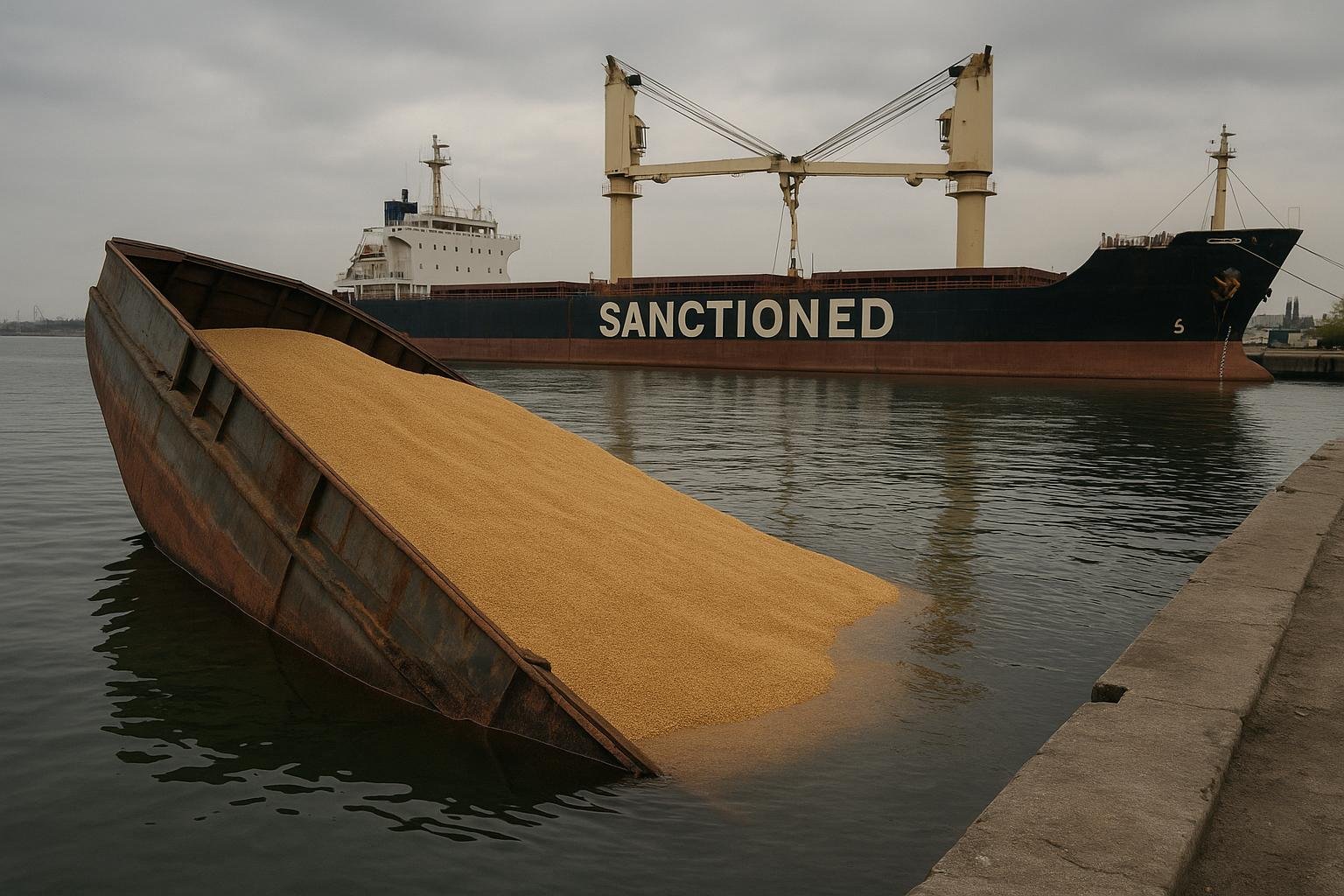
Kyiv targets 56 maritime ships linked to smuggling Ukrainian agricultural products stolen from occupied territories, escalating its effort to cut off Russia’s war financing and enforce maritime sanctions against illicit trade.

Ukraine has taken a significant step in intensifying its economic measures against Russia’s wartime activities by sanctioning 56 maritime vessels accused of exporting grain stolen from territories occupied by Russian forces. On November 26...
Continue Reading This Article
Enjoy this article as well as all of our content, including reports, news, tips and more.
By registering or signing into your SRM Today account, you agree to SRM Today's Terms of Use and consent to the processing of your personal information as described in our Privacy Policy.
The sanctioned vessels are alleged to have transported thousands of tonnes of Ukrainian wheat, sunflower seeds, and other agricultural products smuggled from closed ports under Russian control, such as Sevastopol and Feodosia in Crimea, as well as areas in Zaporizhia, Kherson, Donetsk, and Luhansk. These ports have been used as hubs for moving stolen grain onto international markets, including Middle Eastern, African, and sometimes European destinations. Ukraine argues that this illegal trade not only strips Ukrainian farmers of their livelihoods but also violates international law and global food security.
President Zelenskyy highlighted the move in an evening address, stating: “This is an important step, we imposed sanctions on maritime vessels that transported Ukrainian grain from the occupied territories. We will increase this pressure. Every Russian crime must receive an appropriate response, and sanctions are the quickest response.” This policy shift marks a focused attempt by Kyiv to enforce maritime sanctions as a strategic front in the ongoing conflict.
These sanctions obligate various Ukrainian government bodies, including the Cabinet of Ministers, National Bank of Ukraine, law enforcement, and intelligence agencies, to bar the targeted ships from Ukrainian ports, financial transactions, and navigation systems. The Foreign Ministry is tasked with alerting international partners, particularly the European Union and the United States, encouraging coordinated adoption of similar sanctions to magnify the restrictions’ global effect.
Several of the sanctioned vessels have already been under scrutiny and previous sanctions by the EU, the US, and Switzerland. Notably, a joint investigation by the Organized Crime and Corruption Reporting Project (OCCRP) and Syrian outlet SIRAJ uncovered that three of the ships, Finikia, Laodicea, and Souria, were linked to the Syrian regime of Bashar al-Assad. These vessels were transferred to an offshore company in the Seychelles, an arrangement that analysts interpret as a tactic to obscure ownership and evade sanctions while maintaining operational control despite Syria’s challenging geopolitical conditions. The ships were documented entering Russian-occupied Crimean ports and loading large volumes of grain believed to be unlawfully confiscated from Ukrainian agricultural sources.
In April 2025, related enforcement actions included the detention of a vessel in the Black Sea involved in transporting approximately 5,000 tonnes of Ukrainian wheat from Sevastopol. The ship operated under a flag of convenience from an Asian country to mask the illegal origin of its cargo. Ukrainian authorities seized navigation equipment and ship documents, which confirmed involvement in the illicit grain trade.
The list of sanctioned vessels is diverse, encompassing 39 ships registered in Russia and others flying flags from countries such as Panama, Cameroon, Togo, Eswatini, and Barbados. Among the named vessels are the Russian ships Enisey, Viktor Zabelin, Matros Koshka, which in October 2025 alone exported over 27,000 tonnes of stolen grain from occupied Crimea, and the foreign-flagged vessels Bayaze D, San Cosmas, Monte Rosa, San Damian, and others.
Ukraine’s move underscores the importance it places on its agricultural sector, seen as both an economic backbone and a symbol of national identity. Kyiv’s authorities view the grain theft as a grave affront that must be countered with robust measures, particularly in the maritime domain where enforcement is complex due to Russia’s continued territorial control over parts of Ukraine’s coastline.
By urging Western allies to impose matching sanctions, Ukraine aims to isolate the vessels from essential services, port access, insurance, refueling, and financial transactions, thereby immobilizing them on a global scale. Despite Russia’s attempts to evade detection through flags of convenience, shell companies, and altered transponder signals, continuous exposure raises the risk of further sanctions and legal repercussions.
This intensified campaign against stolen grain exports, conducted alongside broader Western sanctions against Russia since the conflict’s start in 2022, signals Kyiv’s ambition to serve as a key maritime compliance enforcer worldwide despite the ongoing war. As the fight over Ukraine’s agricultural resources escalates, the sanctioning of these 56 ships sends a firm message: illegal exploitation of occupied territories will not be tolerated, and international cooperation is vital to uphold sanctions and ensure accountability.
President Zelenskyy’s decree reflects a determined, evolving strategy to protect Ukrainian resources and punish those enabling Russia’s wartime profiteering, an effort that may well deepen Moscow’s economic isolation and complicate its ability to sustain its military operations through illicit trade.
Source: Noah Wire Services
Subscribe to Industry Updates

