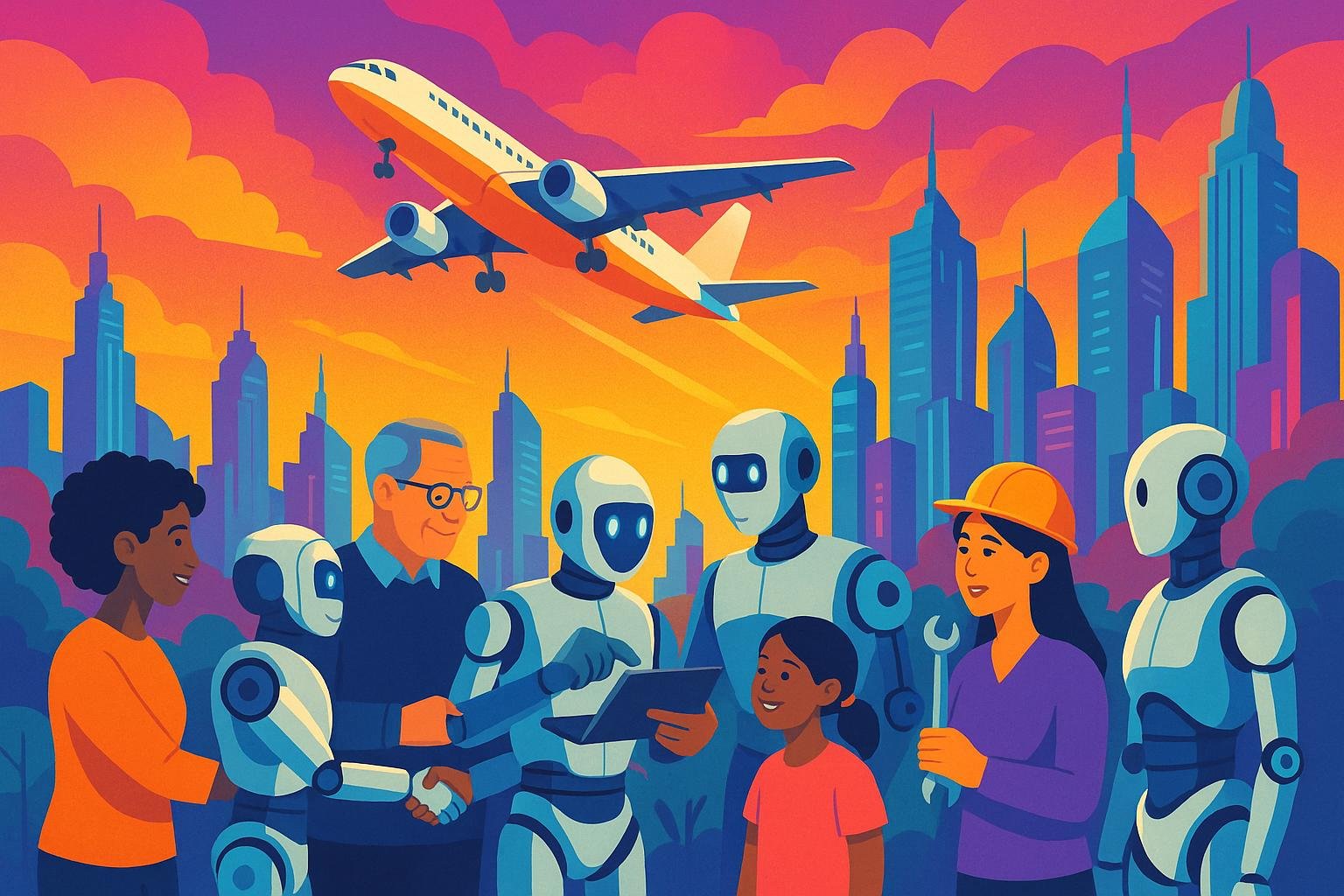
Major travel companies are embedding artificial intelligence skills into their operations, with recruitment and upskilling efforts aiming to harness the transformative potential of agentic AI for improved customer experiences and operational efficiency.

Recruiters and talent teams across the travel sector are increasingly prioritising artificial intelligence capabilities as firms reconfigure operations and product roadmaps around advanced machine learning and agentic AI...
Continue Reading This Article
Enjoy this article as well as all of our content, including reports, news, tips and more.
By registering or signing into your SRM Today account, you agree to SRM Today's Terms of Use and consent to the processing of your personal information as described in our Privacy Policy.
Major travel groups have started to embed AI skills into job descriptions, reorganise teams and launch internal upskilling programmes as they prepare for a shift from purely transactional services towards technology-driven platforms. Expedia Group, Booking.com, Sabre, Skyscanner and Travelport have all advertised roles explicitly centred on generative AI, machine learning and agentic capabilities, reflecting a broader demand for staff who can design, implement and govern AI-driven experiences.
According to an industry note from Expedia, the company is expanding its B2B technology footprint while investing in generative-AI initiatives such as a Trip Matching concept that converts social-media content into travel suggestions; the firm has also restructured parts of its organisation and is hiring to lead its agentic AI strategy. Speaking broadly about the technology, McKinsey has outlined how agentic AI, systems that can take autonomous decisions and orchestrate complex workflows, could reshape customer journeys and operations across travel and hospitality, urging leaders to accelerate adoption while managing risk.
Recruitment adverts and public statements from vendors mirror that strategic pivot. Booking.com has moved beyond research hires to operational roles tied to GenAI and AI governance, while Skyscanner’s technology leadership has said it expects all employees to be AI-literate and to use AI tools to boost creativity and productivity alongside critical human judgement. Travelport is seeking staff who can apply machine learning to travel retail and customer service, and Sabre’s hiring emphasises the ability to interpret and act on AI outputs rather than specific input methods or tenure. OAG, the travel-data company, reports hiring “AI-native” engineers and cites clear productivity gains as justification for that bet.
The business case for the change is already visible. Company-level pilots and internal metrics indicate measurable uplift when teams adopt generative tools: engineering groups at Skyscanner have documented a notable productivity gain using AI assistants, and Salesforce research shows that agents supported by AI chatbots can focus a greater share of their time on complex problem-solving. Phocuswright’s research finds that a substantial majority of travel firms consider their cultures favourable to generative AI innovation and that many are either scaling or testing agentic approaches. Meanwhile a McKinsey global survey from March 2025 signalled that half of organisations using AI expect to increase demand for data scientists over the following year, underscoring a structural need for new skills.
Companies are balancing recruitment with upskilling. Rather than exclusively seeking fresh hires, several operators are investing in training to broaden AI fluency across functions; Travelport, OAG and Skyscanner have described programmes that make AI platforms and guidance available beyond product engineering teams. Industry research from McKinsey also highlights that AI can help mitigate workforce strains in travel and logistics by improving scheduling accuracy and responsiveness, potentially reducing the high costs of understaffing or overstaffing during peaks.
The shift is altering the profile of “must-have” capabilities. Employers increasingly prioritise adaptability, curiosity and the ability to evaluate when and how to deploy AI tools over narrow technical credentials or seniority. Commentators in the sector argue that generative and agentic technologies are not replacing experienced travel advisers but raising professional expectations, turning conversational planners and AI copilots into mainstream features of booking ecosystems.
Risk and governance remain front of mind. Firms emphasise human validation of AI-driven recommendations and are creating roles focused on data governance, model oversight and ethical use as part of recruitment drives. McKinsey’s work cautions that failure to navigate the agentic-AI transition effectively could amplify competitive pressures and disrupt business performance, prompting legal, operational and product teams to weigh adoption against control frameworks.
As travel companies recast themselves as technology platforms, the labour market is responding in tandem. Job postings now routinely list AI literacy, prompt engineering, model evaluation and governance experience alongside domain knowledge in inventory, retailing and customer experience. For employers this represents a dual strategy: hire scarce specialist talent where needed and build AI fluency across existing workforces so that staff can shift from executing routine tasks to delivering differentiated service and product innovation.
The result is a sector in which recruitment and workforce planning are no longer ancillary to strategy but central to how companies intend to compete in an AI-dense marketplace. Industry data and vendor research suggest the transition will be iterative: organisations that combine new hires, structured training and governance are positioning themselves to exploit productivity gains while attempting to manage the complex operational and ethical questions that agentic AI raises.
Source: Noah Wire Services
Subscribe to Industry Updates