


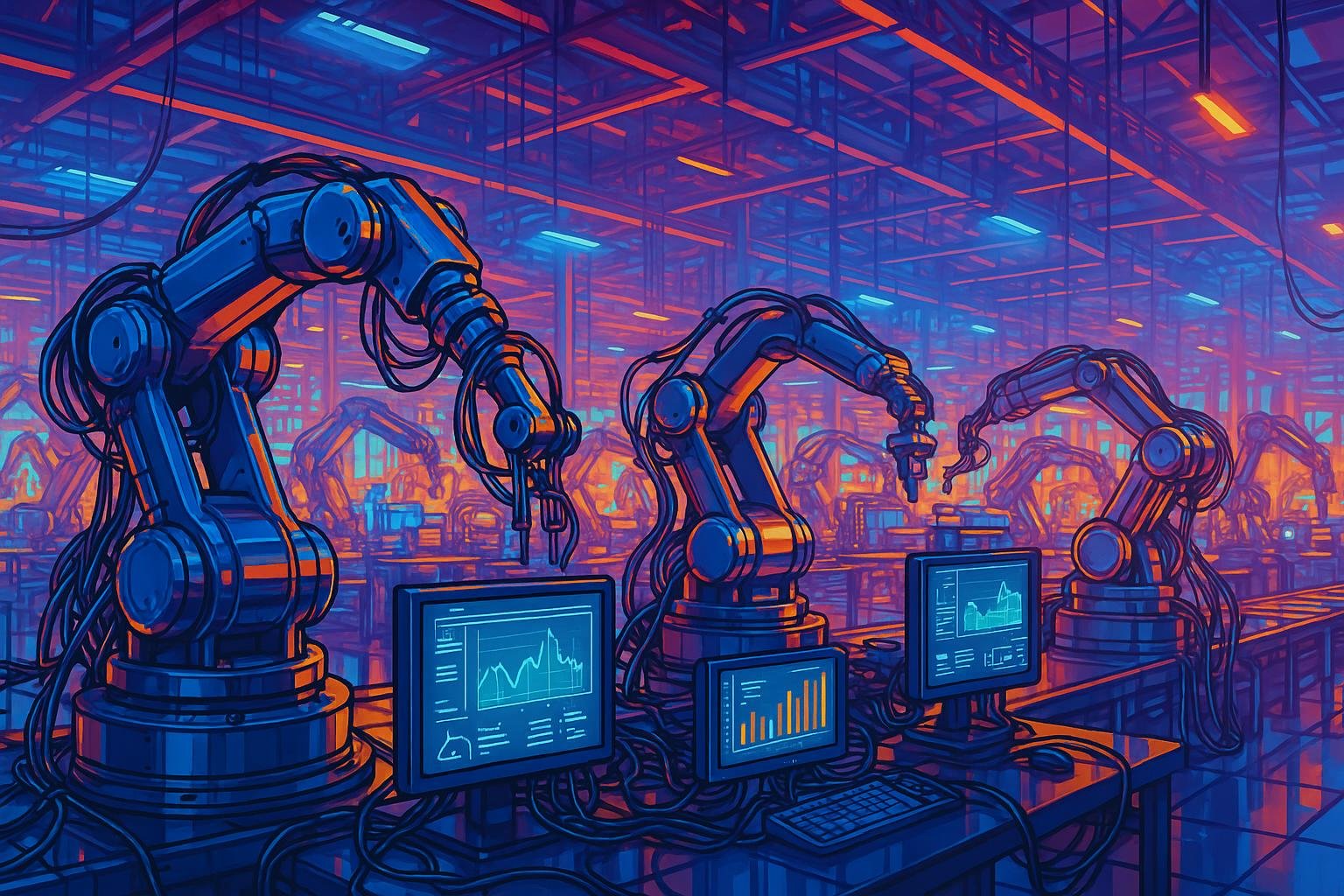
The global smart manufacturing sector is experiencing rapid growth as AI-driven technologies revolutionise factory operations, enhance efficiency, and support sustainability initiatives amidst increasing public-private collaboration and regional investment.

The global smart manufacturing sector is accelerating into a more automated, data-driven era as manufacturers embrace Industry 4.0 technologies to boost efficiency, cut costs and meet tighter sustainability and quali...
Continue Reading This Article
Enjoy this article as well as all of our content, including reports, news, tips and more.
By registering or signing into your SRM Today account, you agree to SRM Today's Terms of Use and consent to the processing of your personal information as described in our Privacy Policy.
Artificial intelligence is central to the shift. Industry reporting and vendor briefings detail three practical, high-value use cases that are already reshaping factory floors. First, predictive maintenance: AI models ingest real-time sensor streams to surface equipment anomalies well before failures occur, shortening unplanned downtime and lowering repair costs, benefits that are especially pronounced in capital-intensive sectors such as automotive and semiconductors. Second, machine learning combined with computer vision is automating quality inspection, enabling faster, more consistent defect detection than human inspection and reducing scrap and rework. Third, intelligent scheduling and planning engines reconcile demand signals, machine availability and supply‑chain constraints to raise throughput and responsiveness.
Independent trade coverage and vendor materials reinforce IMARC’s findings. Industry analysts note that connected devices and Industrial Internet of Things platforms are enabling continuous machine-to-machine communication and remote diagnostics, while cloud integration and digital twins are becoming mainstream tools for optimising workflows. Intel’s industry guidance highlights how AI-driven analytics reduce waste and free staff from routine tasks so they can concentrate on higher-value work. OEM Magazine describes similar gains in predictive servicing, quality control and cost reduction resulting from AI deployments.
Policy and public investment are accelerating adoption. IMARC’s reporting and country-level studies point to national programmes, such as China’s and Japan’s industrial modernisation initiatives and expanded institute networks in North America, that subsidise pilots, lower adoption costs and promote standards. Rockwell Automation’s sector survey, cited in technology press, finds particularly strong AI uptake in the UK, where a majority of manufacturers report production-floor AI use and near-universal plans to extend deployment; commentators attribute this to a dense ecosystem of integrators, start-ups and skills initiatives.
Corporate activity mirrors market momentum. Vendors have been enhancing platforms with generative and agent-based AI features, tighter cloud partnerships and supply‑chain risk tools designed to automate complex tasks and democratise specialised skills. According to market updates, recent product expansions aim to speed software-driven productivity gains, reduce reliance on scarce PLC programming expertise and integrate supply‑chain visibility directly into engineering workflows.
The growth of smart manufacturing carries strategic implications beyond productivity. IMARC emphasises that digital projects increasingly align with environmental, social and governance objectives: cloud-native controls, AI inspection and optimised scheduling help reduce energy consumption and material waste. At the same time, reports warn of a widening skills gap; workforce studies project millions of unfilled roles over the coming decade and show that upskilling remains a top executive concern even as companies expect automation investments to attract talent.
Sector segmentation underscores where investment is concentrated. Software, including manufacturing execution systems, enterprise planning, digital twins and analytics platforms, accounts for the largest component share, while industries such as automotive lead end‑use adoption, driven by electrification, robotics and digital‑first assembly lines. Regional analysis points to Asia Pacific hubs as dominant centres of deployment, with Europe and North America investing heavily in cloud integration and operational technology partnerships.
Taken together, the data and industry commentary portray a market at the midpoint of transformation: technologies that were once experimental are now operational levers for cost, quality and sustainability. The coming years look set to be defined by broader AI integration across software stacks, deeper cloud–OT collaborations and continued public‑private initiatives to close the skills gap and scale smart manufacturing from pilot projects to plant‑wide programmes.
Source: Noah Wire Services
Subscribe to Industry Updates

