


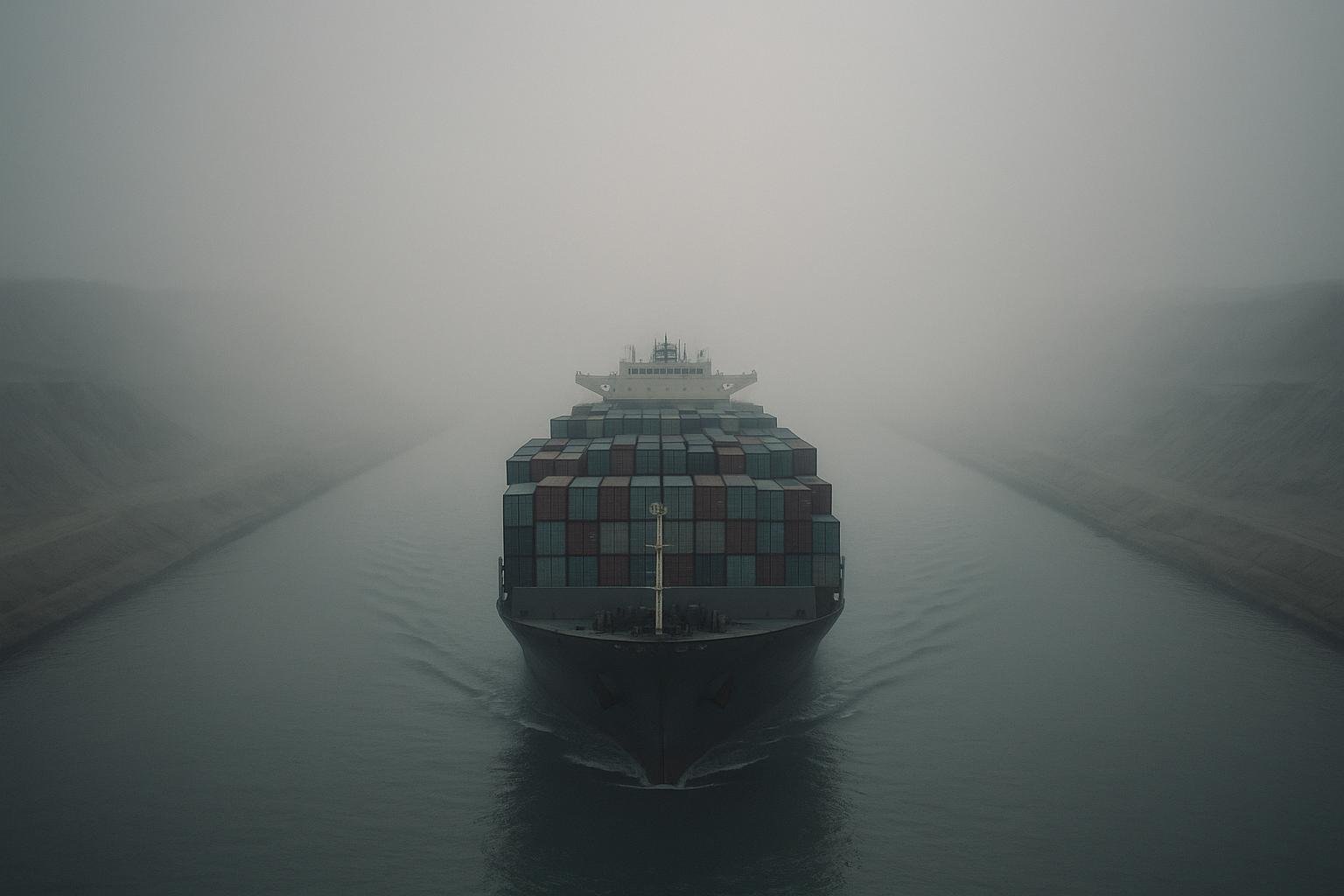
The container shipping sector is adapting to a new strategic landscape, with carriers balancing route security, port congestion, and rising costs as geopolitical tensions and infrastructure saturation reshape global trade pathways.

The container shipping sector is confronting a changed strategic landscape in which speed alone no longer secures commercial advantage. CMA CGM’s recent reversal on plans to send multiple Asia–Europe westbound loops back through the Red S...
Continue Reading This Article
Enjoy this article as well as all of our content, including reports, news, tips and more.
By registering or signing into your SRM Today account, you agree to SRM Today's Terms of Use and consent to the processing of your personal information as described in our Privacy Policy.
The Suez corridor remains a vital conduit for global trade. Before the crisis, an estimated 10–15 percent of seaborne trade and roughly a quarter to a third of container movements used the canal, making it a keystone of Asia–Europe and Asia–US East Coast services. Under normal conditions Suez saves voyages up to around ten days compared with the detour via the Cape of Good Hope; that time advantage translates directly into lower on-paper transport costs and higher vessel utilisation. But the security environment since late 2023 has altered that calculus.
Iran-backed Houthi attacks in the Red Sea forced a large-scale rerouting of shipping, with thousands of vessels avoiding the corridor and many transits halted. According to analysis by the Wilson Center, by January 2024 traffic for container, dry bulk and crude oil tankers through the Red Sea was down by more than 80 percent in some measures, with diversions adding ten or more days to voyages and pushing incremental fuel costs into the hundreds of thousands or, in extreme cases, close to a million dollars per round trip. The IISS reports a roughly 70 percent decline in Suez transits after the attacks began, and notes that war-risk premiums and the operational costs of longer voyages prompted widespread diversion around Africa.
Those added days at sea are more than an inconvenience. Project44’s supply-chain analysis shows average transit-time increases of seven to 14 days for lanes that normally use Suez; shipments to the US East Coast have taken as much as 47 percent longer, while Europe-bound cargoes have seen increases near 33 percent. The cost consequences have been felt unevenly: while some macroeconomic indicators avoided a large consumer price shock, local economies that depend on canal revenues suffered, and shippers and carriers absorbed higher freight, fuel and insurance bills. The Council on Foreign Relations estimated that rerouting represented some $200 billion in trade shifts and that insurance rates had surged nearly tenfold for vessels transiting the Red Sea at the height of the crisis.
Faced with these realities, carriers are adopting a mixed routing strategy rather than an all-or-nothing return to Suez. Industry commentators and shipping analysts describe a pragmatic approach: low-value or backhaul cargoes and selective sailings are used to test security conditions, while high-value headhaul volumes remain on the longer but perceived-to-be-safer Cape route. That approach reduces exposure of premium cargo and allows carriers to reintroduce capacity cautiously without triggering a sudden supply shock that would depress freight markets.
This calibration matters for market dynamics. A wholesale recommissioning of Suez transits by alliances would effectively release many weeks’ worth of latent capacity, increasing downward pressure on rates at a time when the order book for new vessels remains historically large. HSBC and other analysts have warned that a rapid reopening could produce only a transient uplift in spot rates before structural overcapacity resumed its dampening influence. Even so, the assumption that rate declines will automatically produce relief for shippers is complicated by land-side constraints.
Port bottlenecks, especially at major Chinese gateways such as Shanghai and Ningbo, are absorbing much of the freed ocean capacity. Ultra-large container vessels , now commonly 18,000–24,000 TEU , turn each call into a major logistical event, stressing yard capacity, labour and hinterland connections. Maritime operations data indicate that global vessel turnaround has not returned to pre-pandemic efficiency, meaning ocean-time savings can quickly be nullified by congestion on shore. In short, the problem has shifted from sea to port.
Procurement practices are adjusting accordingly. According to market reporting, many 2025 Asia–Europe contracts now contain dual-rate clauses or explicit review mechanisms tied to routing through the Red Sea, reflecting an acceptance that uncertainty is a contractual parameter rather than an exception. Corporate supply-chain directives at a number of multinationals also now forbid Red Sea routing outright for part or all of their volumes, while others will permit it only when insurance, visibility and carrier accountability are demonstrably in place.
Those demands expose practical frictions. Carrier alliances and slot-exchange arrangements can complicate voyage-level transparency: consignors who book with an operator avoiding Suez may nevertheless find their boxes sailing on a partner vessel that transits the corridor. War-risk insurance frequently requires voyage-specific endorsements; absent precise routing information, shippers can inadvertently be left underinsured. As legal analysis by the International Bar Association and UN trade agencies has emphasised, the combination of fluid routing and opaque partner networks places the onus on shippers and their logistics providers to secure tighter visibility and contractual protections.
For forwarders and logistics providers the opportunity is to convert uncertainty into value by offering rigorous routing oversight, risk-based guidance and contingency execution. Firms that can translate carrier-level movement into voyage-specific visibility, press for accountable routing commitments, and run credible alternatives will be more attractive to risk-averse clients. PNG Worldwide’s public stance , that its role is to challenge routings where risk eclipses reward, to hold carriers to account, and to provide customers with real-time operational intelligence , exemplifies the commercial pivot now under way in the sector.
The Red Sea episode is symptomatic of broader forces reshaping maritime trade: geopolitical fragmentation, infrastructure saturation, and the premium now placed on resilience. The merchant fleet and the ports that serve it must be viewed as an interconnected system in which security, capacity and predictability are equally important to delivering goods on time. In this environment, cheapest-on-paper options that lack robustness will be repriced by experience; long-term competitive advantage will accrue to those who secure continuity, not merely the lowest headline rate.
The coming months will test whether the hybrid routing approach endures and whether port infrastructure can accommodate shifts in ocean patterns. For carriers the choice is balancing commercial efficiency with a duty of care to crews, cargo and reputation. For shippers it is increasingly clear that buying certainty means paying for it. The era when speed alone decided routing strategy has passed; resilience now shapes winners and losers in global logistics.
Source: Noah Wire Services
Subscribe to Industry Updates

