


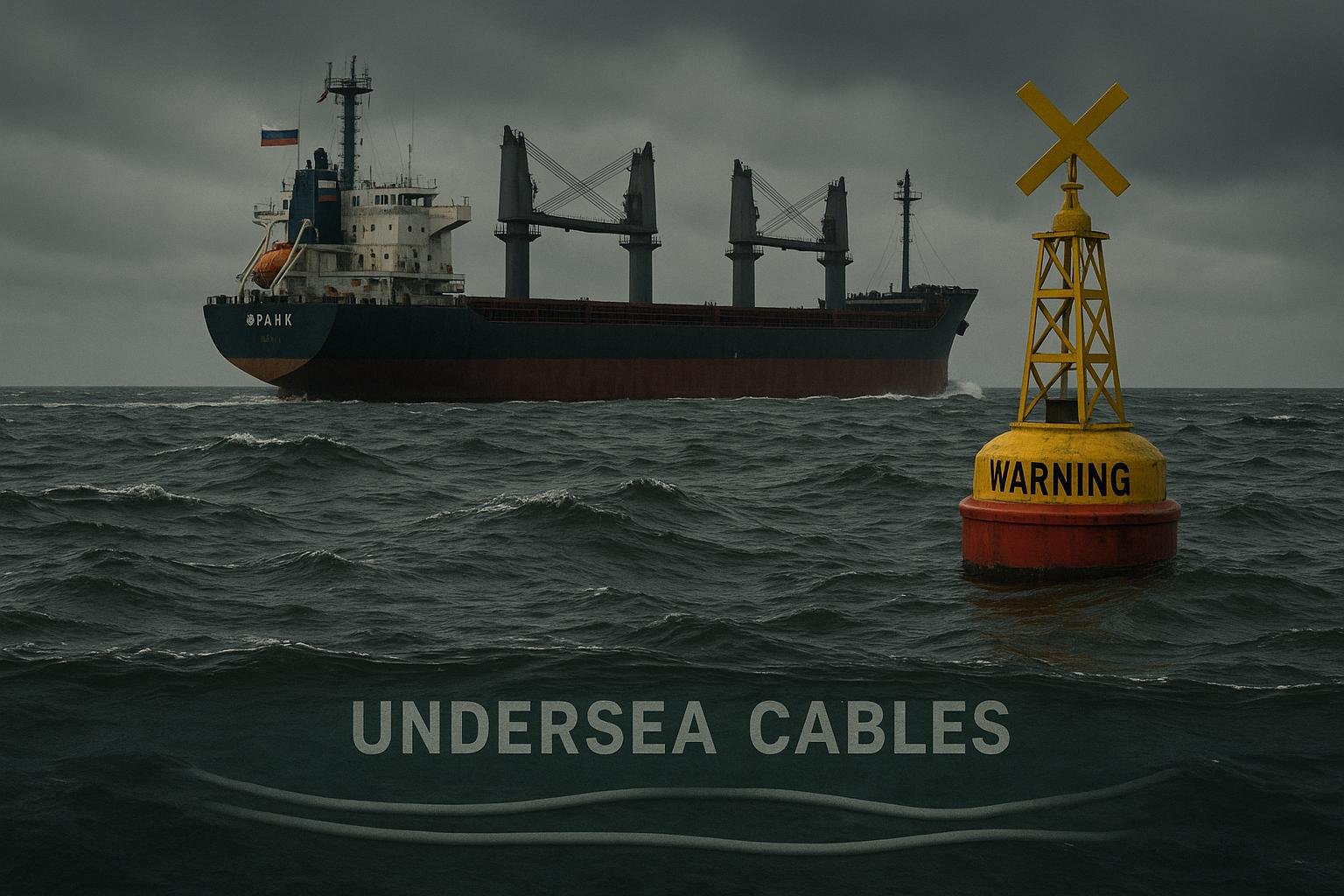
A Russian-flagged cargo ship’s suspicious activity near critical undersea communication links off the Somerset coast has led to heightened UK maritime surveillance and diplomatic concerns about Russia’s shadow fleet operations.

A Russian-flagged cargo vessel that anchored off the Somerset coast late last week has been ordered out of UK territorial waters after raising alarms over its proximity to vital undersea telecommunications links.
According to t...
Continue Reading This Article
Enjoy this article as well as all of our content, including reports, news, tips and more.
By registering or signing into your SRM Today account, you agree to SRM Today's Terms of Use and consent to the processing of your personal information as described in our Privacy Policy.
UK authorities deployed a Royal Navy Wildcat helicopter and an HM Coastguard surveillance aircraft to observe the ship’s activity, while defence officials said they were alert to the broader pattern of Russian interest in seabed infrastructure. The Sinegorsk’s most recent recorded port call was in Arkhangelsk three weeks earlier, a city that also hosts elements of Russia’s Northern Fleet, Reuters-style sources note.
The Russian crew told authorities they were conducting safety repairs, but British opposition politicians described the behaviour as highly suspicious. The Ministry of Defence has previously warned of attempts by Russian assets to survey undersea cables, pipelines and networks belonging to the UK and its allies; the government said it is taking such threats seriously.
The incident is being viewed in the context of an expanding and increasingly opaque maritime challenge often described as Russia’s “shadow fleet”. Industry estimates cited in reporting show the number of vessels linked to that phenomenon rose from just over 600 at the end of 2022 to between 1,100 and 1,400 by December 2023. Enforcement efforts have identified hundreds of individual ships: the European Union has designated 342 vessels, the United Kingdom 133, and the United States several hundred, but analysts warn that inconsistent listings and reflagging have left enforcement gaps exploited by operators.
Shadow-fleet activity has carried a strategic and financial scale: Western assessments suggest such tankers have moved roughly 1.4 million barrels of crude per day since Russia’s full-scale invasion of Ukraine, a flow that represents a sharp increase on pre-war volumes and has generated estimated annual revenues of $87–$100 billion. Observers also highlight environmental hazards: an ageing fleet, around 72 percent of these ships are over 15 years old, often operates with inadequate insurance, leaving coastal states exposed to potentially large cleanup bills in the event of a spill.
European states have taken a series of responses in recent months. National coastguards and navies have boarded or detained suspected vessels, and fourteen European governments jointly warned shadow-fleet tankers in the Baltic and North Seas that ships failing to maintain valid safety and insurance documentation would be treated as stateless. France, Finland and the United States have each taken direct action against suspect ships in separate incidents, according to reporting.
The UK has bolstered its monitoring capacity. Government sources told reporters that Royal Navy units have tracked specialised Russian vessels such as the Yantar as they operate in and around the English Channel, and that surveillance of underwater infrastructure remains a priority. Reporting in Jane’s and Anadolu Agency notes the activation of a UK-led Joint Expeditionary Force initiative codenamed Nordic Warden, an AI-enabled system intended to flag and monitor vessels posing a risk to subsea assets and to support partner navies and coastguards in responding to suspicious movements.
Officials caution that legal and practical tools exist to counter illicit maritime activity but require coordinated application. The UN Convention on the Law of the Sea gives coastal and port states authority to inspect, detain and deny entry to ships suspected of breaching safety and environmental rules, while enhanced port state control inspections targeting insurance irregularities, false registries and mechanical defects are seen as effective pressure points.
The Sinegorsk episode underscores how vessels operating near critical underwater communications infrastructure can quickly become public-security issues, blending maritime safety questions with geopolitical signalling. As Western governments refine surveillance and enforcement measures, analysts expect further probing manoeuvres by state-linked ships and non-state operators alike, testing the ability of coastal states to deter and, where necessary, interdict risky behaviour at sea.
Source: Noah Wire Services
Subscribe to Industry Updates

