


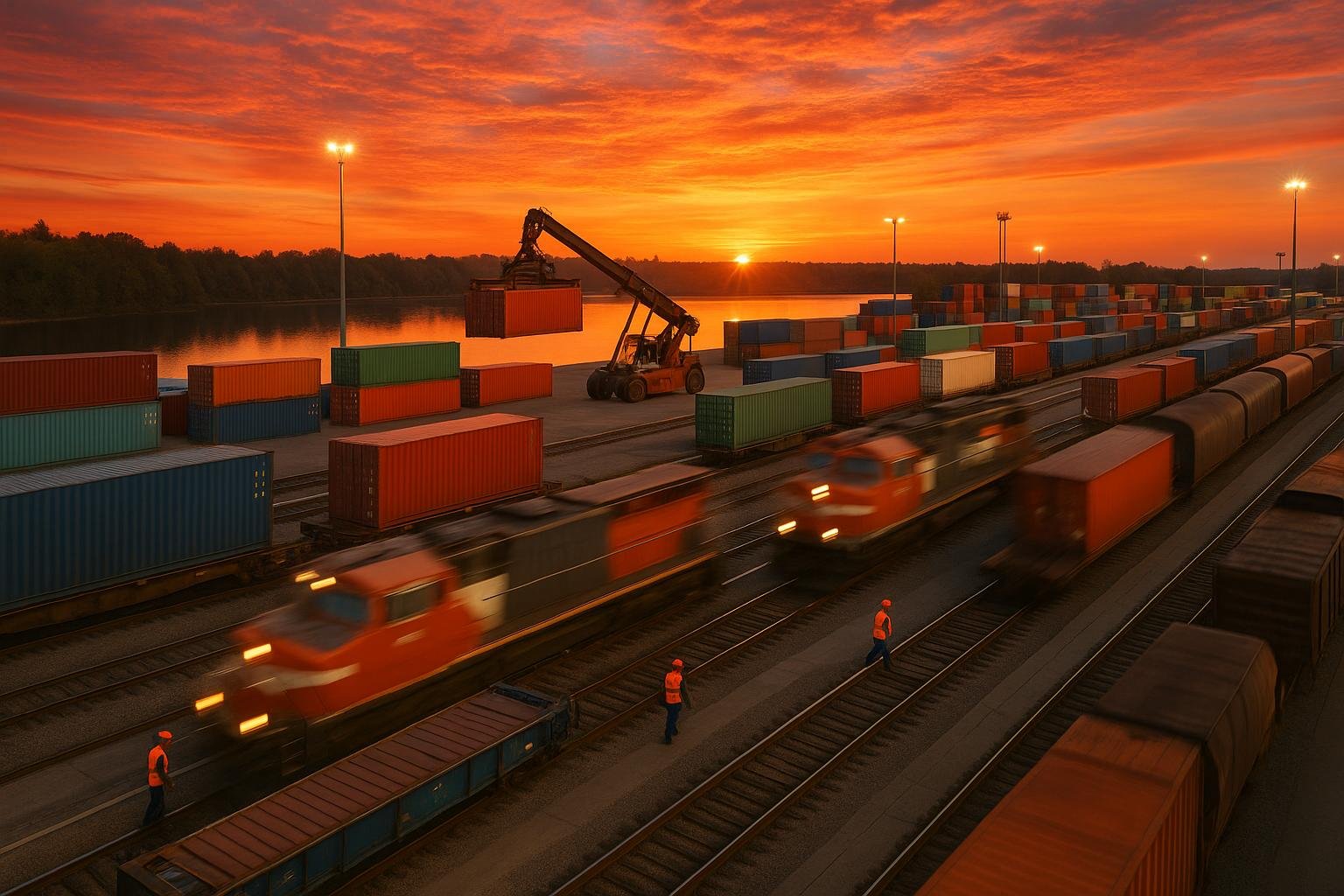
As market disruptions and environmental pressures increase, logistics experts turn to rail as a vital, strategic component to build resilient and sustainable supply networks, supported by digital innovations and collaboration.

Modern supply chains are facing intensifying headwinds from market shocks, tighter regulation, rising transport costs and mounting pressure to cut emissions. Against that backdrop, logistics executives are increasingly revisiting modal mix, with r...
Continue Reading This Article
Enjoy this article as well as all of our content, including reports, news, tips and more.
By registering or signing into your SRM Today account, you agree to SRM Today's Terms of Use and consent to the processing of your personal information as described in our Privacy Policy.
Industry analysis and recent e‑books on the subject argue that rail does not replace road transport so much as complement it. According to the G3 Enterprises e‑book on rail’s role in a future‑proof supply chain, long‑distance, high‑density movements are where rail delivers the most value: lower unit costs for bulk and long‑haul freight, steadier pricing that can hedge truck market volatility, and capacity that smooths seasonal peaks when truck availability tightens. The report frames those benefits around three pillars for long‑term performance: resilience through diversified modes and flexible routing; scalability by pairing trucking’s manoeuvrability with rail’s volumetric efficiency; and sustainability achieved via smarter modal decisions.
Quantitative comparisons underline the efficiency case. Analysis cited by logistics commentators shows rail can be markedly more fuel‑efficient than road: one commonly quoted metric is that trains can move a ton of freight hundreds of miles on a single gallon of fuel, figures range in published material from roughly 470 miles per gallon to more than 740 kilometres per litre equivalent, making rail up to four times more energy efficient than long‑haul trucking. The American Association of Railroads and third‑party observers note that switching freight from truck to train can cut greenhouse gas emissions by roughly three‑quarters on a ton‑mile basis, while rail overall accounts for a small share of national transport emissions despite carrying a large fraction of tonnage. Primecntrans and Area Development analyses both emphasise these comparative emissions gains.
Cost outcomes reported by practitioners also support increased intermodal use. Providers and case studies point to double‑digit reductions in logistics spend when road‑rail intermodal strategies are adopted, estimates in industry write‑ups cite annual savings in the high teens, typically 18–27 percent, for companies that optimise modal mix and routing. Beyond unit costs, rail’s predictable transit times and larger payloads can improve inventory turns and reduce the need for costly expedited truck moves during disruption, a benefit highlighted in the G3 e‑book’s real‑world example of a company that rebalanced transport, warehousing and intermodal capacity to boost delivery performance and inventory accuracy.
Operationalising rail’s promise, however, requires orchestration. Intermodal success depends on seamless interfaces between terminals, drayage providers and distribution centres, plus end‑to‑end visibility so planners can sequence rail legs alongside shorter truck hauls. That is why shippers are turning to integrated third‑party logistics partners who claim end‑to‑end rail‑truck solutions, intermodal expertise and the technology stack to coordinate movements and provide real‑time status. Such providers argue their platforms enable better capacity planning and risk mitigation across networks where rail is a strategic lane rather than a one‑off tactic.
Technology is accelerating rail’s appeal. Industry commentary on rail digitalisation highlights the growing use of cloud platforms, Internet of Things sensors, artificial intelligence and augmented reality to improve asset management, predictive maintenance and crew and energy optimisation. Enterprise asset management systems driven by AI are being adopted to extend asset life and reduce unscheduled downtime, while automation and improved telemetry enhance terminal throughput and container handling, capabilities that make intermodal schedules more reliable and easier to integrate with truck operations.
There are limits and trade‑offs to consider. Rail delivers greatest advantage on long distances and for high‑volume or heavy commodity flows; for short‑haul, time‑sensitive or highly fragmented shipments, trucks retain the edge for door‑to‑door responsiveness. Infrastructure constraints, terminal capacity, congested corridors and last‑mile drayage availability, can blunt potential gains unless addressed through coordinated investments and public‑private planning. Freight planners must also weigh the up‑front complexity of redesigning networks and the cultural changes needed within procurement and operations teams to plan by lane rather than by mode.
For logistics teams seeking to adopt rail more broadly, industry materials recommend a pragmatic, lane‑by‑lane approach: identify high‑density, long‑haul movements and pilot intermodal solutions; partner with 3PLs or rail‑centric integrators for execution; invest in visibility and planning tools; and quantify emissions and total landed cost impacts to build a business case. Where terminal access and drayage are constraints, collaborative solutions with carriers and local authorities can unlock bottlenecks.
In sum, rail is gaining renewed attention not as a panacea but as a strategic element in multimodal portfolios that must deliver cost, capacity and carbon advantages together. When combined with trucking for flexibility and supported by digital tools and coordinated execution, rail can materially strengthen supply chains against the disruptions and sustainability requirements that lie ahead.
Source: Noah Wire Services
Subscribe to Industry Updates

