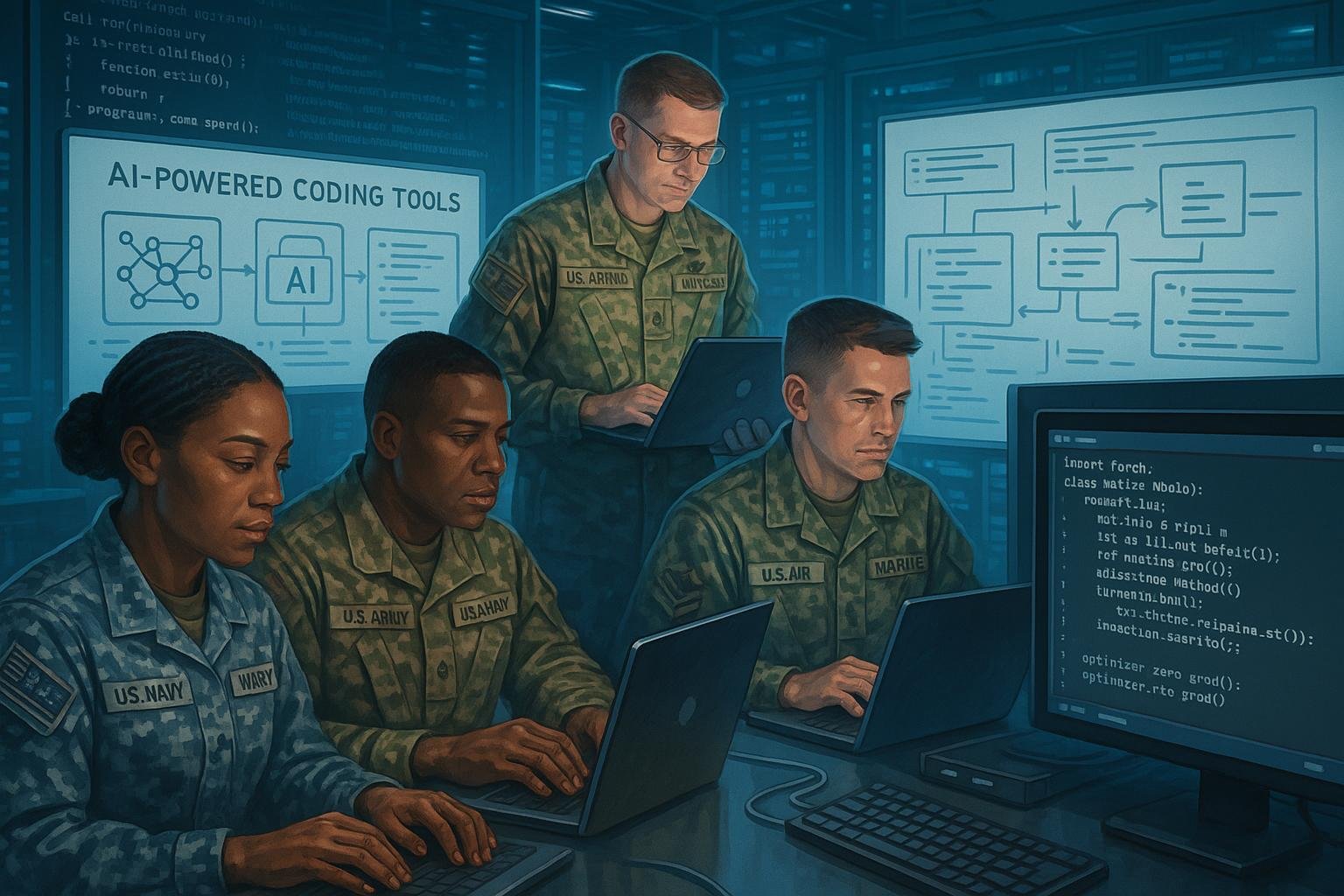
The US Pentagon is soliciting AI-powered coding tools designed for deployment across its diverse military and civilian computing environments, aiming to boost developer productivity and security standards amid a broader AI adoption strategy.
The Pentagon has launched a solicitation seeking AI-driven coding tools that can run at the edge, execute multi‑step engineering tasks with minimal human oversight and be deployed across the Department of Defense’s varied comput...
Continue Reading This Article
Enjoy this article as well as all of our content, including reports, news, tips and more.
By registering or signing into your SRM Today account, you agree to SRM Today's Terms of Use and consent to the processing of your personal information as described in our Privacy Policy.
ing environments, according to a DefenseScoop report. The effort, led by the DoD’s Chief Digital and AI Office in partnership with the Army, aims to bring commercial-grade automation into military and civilian developer workflows to accelerate delivery of mission software and raise code quality.
According to DefenseScoop, officials argue the department currently lacks standardised, enterprise-wide access to the sort of AI coding assistants common in industry, a shortfall that they say hampers developer productivity and slows the pace of software delivery. The solicitation seeks products that support AI-driven code generation, optimisation, debugging, refinement and support at the point where data is created or used.
The tools are expected to be offered in two principal forms. One is IDE‑integrated assistance that plugs into existing code editors and provides functions such as code completion and chat-style help; the other is command‑line, agentic systems that operate in terminals to perform multi‑step processes. Industry reporting notes the requirement for built‑in attribution and traceability so that AI‑produced code can be identified within development workflows.
Security and deployability are central to the request. The DoD wants solutions that can be hosted as SaaS but also run in customer‑managed cloud environments, on‑premise infrastructure and air‑gapped or disconnected networks, with the ability to scale to a large developer workforce, described in the solicitation as tens of thousands of users, across desktop, virtual desktop and web‑based environments. According to CIO and FedScoop coverage, the department requires that the solution or its underlying infrastructure be capable of obtaining FedRAMP High authorisation and a DISA IL5 Provisional Authorisation to handle Controlled Unclassified Information and National Security Systems data.
The initiative forms part of a broader push to prioritise applied AI across defence technology portfolios. Reporting by ArmyTimes and NextGov indicates the Army’s Chief Digital and AI Office is leading the drive to modernise software development practices and align them with commercial innovation, while stressing interoperability with existing systems and rapid time to delivery.
The government will evaluate submissions through an iterative, three‑phase process set out in the solicitation. Interested vendors were given a deadline of 11:59pm ET on 6 March 2026 to submit solution briefs; questions about Phase 1 were due on 27 February 2026. Spokespeople for the Army and the CDAO did not provide additional comment to DefenseScoop when asked.
Source: Noah Wire Services