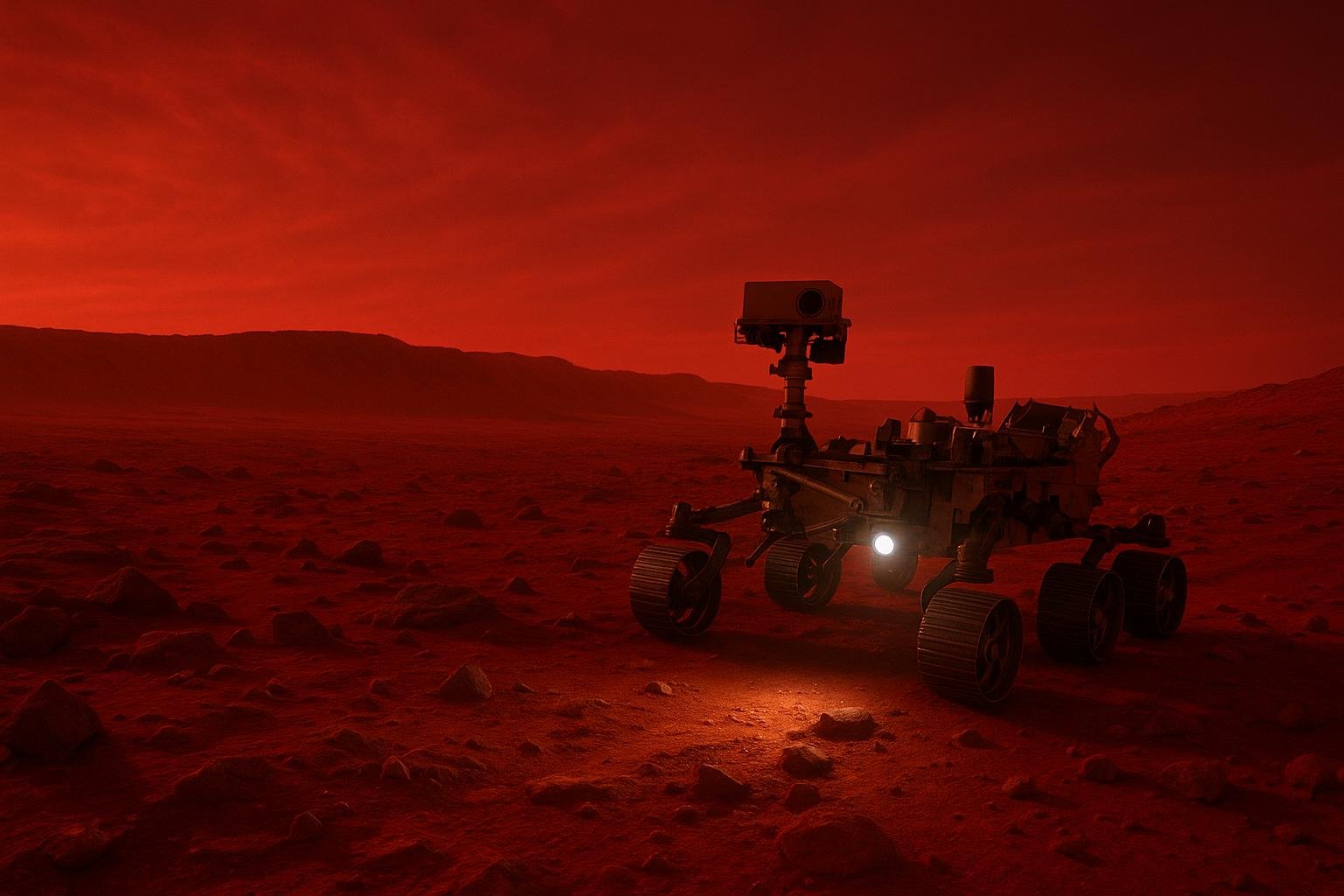
NASA’s Perseverance rover successfully completed two extensive traverses across Jezero Crater using route plans generated entirely by advanced generative AI, marking a significant step towards autonomous planetary exploration.

NASA’s Perseverance rover has for the first time followed driving instructions produced entirely by an advanced generative AI, completing two long, rover-scale traverses across the rim of Jezero Crater in December 2025. The missions on 8 and 1...
Continue Reading This Article
Enjoy this article as well as all of our content, including reports, news, tips and more.
By registering or signing into your SRM Today account, you agree to SRM Today's Terms of Use and consent to the processing of your personal information as described in our Privacy Policy.
The routes were planned from orbital data supplied by the Mars Reconnaissance Orbiter. The AI analysed high‑resolution imagery and digital terrain information to identify hazards and stitch together a continuous path made of short segments , ten‑metre steps rather than the traditional 100‑metre planning blocks that human teams at JPL typically produce. NASA says every AI‑recommended command was run through a detailed “digital twin” simulator of Perseverance and its software before being sent to the rover, with engineers checking hundreds of thousands of variables to verify safety and compatibility with the vehicle’s systems.
According to NASA, the demonstration was not fully autonomous in the sense of turning control over without oversight: the AI supplied the waypoints and a short sequence of commands, and human engineers reviewed and made only “minor changes” before uplink. That human oversight included ground‑level images and other context the AI did not have. The agency described the exercises as proof of concept for incorporating generative AI into operational planning to increase efficiency and reduce the manual workload of route designers.
The drives more than matched expectations: the rover traversed roughly 210 metres during the first test and about 246 metres in the second. NASA Administrator Jared Isaacman framed the outcome as an advance in exploration capability. “This demonstration shows how far our capabilities have advanced and broadens how we will explore other worlds,” he said, adding that autonomous technologies can improve operational efficiency, help vehicles respond to difficult terrain and boost scientific return as missions operate ever farther from Earth.
JPL officials emphasised the technology’s potential beyond a single experiment. “Imagine intelligent systems not only on the ground at Earth, but also in edge applications in our rovers, helicopters, drones, and other surface elements trained with the collective wisdom of our NASA engineers, scientists, and astronauts,” said Matt Wallace, manager of JPL’s Exploration Systems Office, in remarks circulated by the laboratory. JPL has proposed that AI‑assisted planning could halve the time engineers spend on routine route plotting, freeing staff to concentrate on higher‑value science and mission design.
NASA’s public materials and reporting by science outlets also placed the demonstration in an organisational context: with ambitions that include returning humans to the Moon, extended Mars exploration and missions to icy moons, the agency faces pressure to do more with fewer resources. A commentary in ZME Science cited workforce reductions and budgetary strains as background to the agency’s interest in automating time‑consuming tasks; NASA’s own releases focus on efficiency and safety gains while stressing continued human control and verification.
The experiment also underscores how planetary exploration workflows are evolving. Historically, human navigators at JPL have painstakingly examined imagery and produced commands for rovers sent across tens of millions of kilometres. The new approach blends that human expertise with machine speed: orbital reconnaissance provides the raw terrain maps, Claude proposes candidate traverses, and simulation plus human review close the loop before execution on the Martian surface. NASA describes the activity as a first step toward embedding smarter, edge‑capable autonomy in future surface architectures.
While the demonstration was confined to route planning, NASA and its partners underline that extensive validation remains essential. The agency’s accounts note the simulations and compatibility checks performed to ensure that AI outputs met operational constraints and would not compromise the multi‑billion‑dollar asset. The success of the December drives suggests generative AI can assist mission teams, but the roll‑out of the technology across other tasks and missions will be incremental and supervised.
The Perseverance rover continues its scientific campaign at Jezero, a former delta where river channels once fed a lake, providing prime targets for the mission’s rock‑sampling and astrobiology objectives. By combining human judgement, high‑resolution orbital sensing and machine planning, NASA says it hopes to accelerate surface exploration while maintaining safety controls , a model it believes will be essential as crews and robotic systems operate farther from Earth.
Source: Noah Wire Services
Subscribe to Industry Updates