


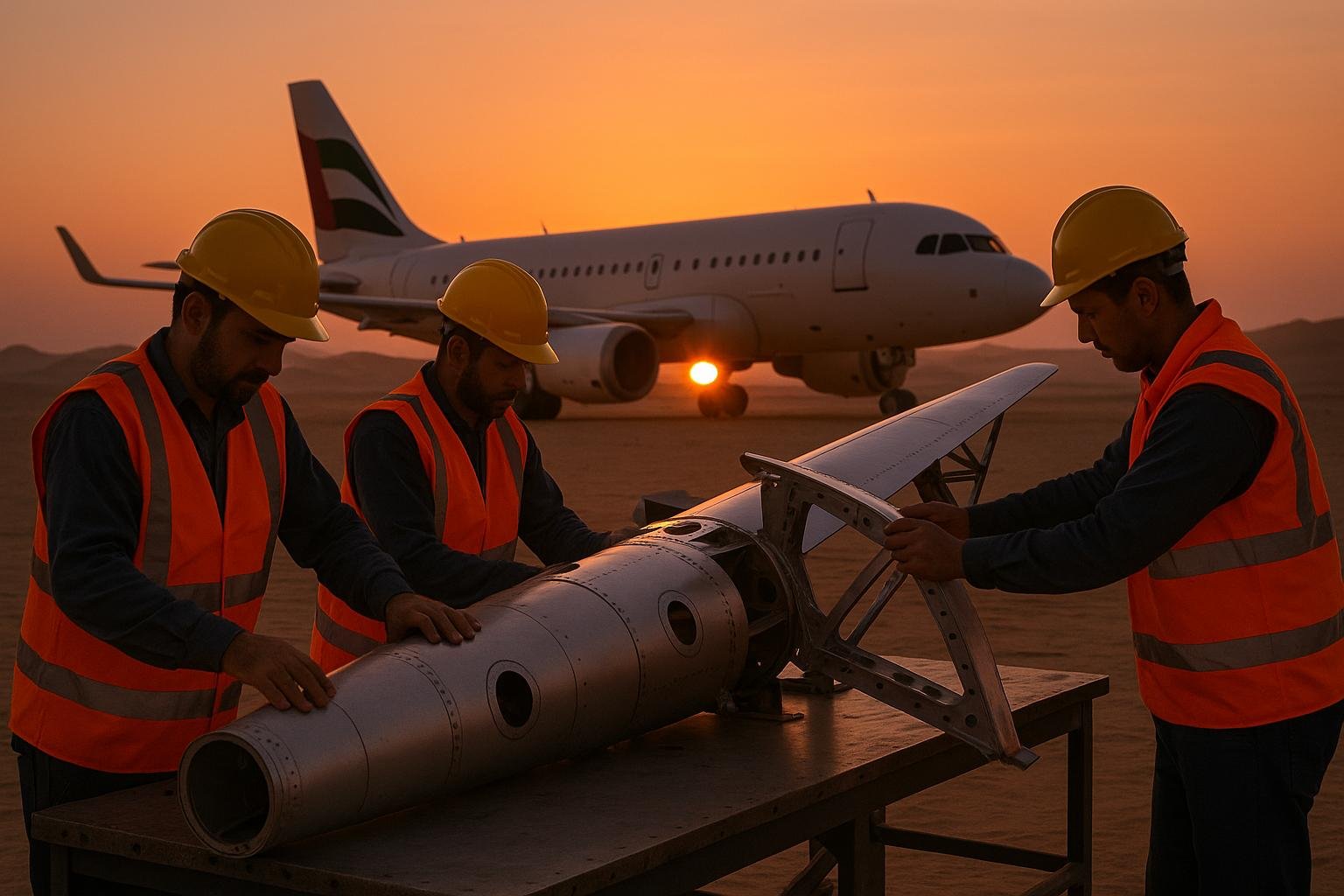
Amid recent crises, the Middle East is accelerating its role as a strategic resilience node in aerospace supply chains, with regional hubs, infrastructure growth, and diversified logistics transforming procurement and operational stability.

The aerospace sector’s recent crises have accelerated a shift in how suppliers and operators weigh procurement choices. Where cost, technical fit and longstanding relationships once dominated decisions, resilience now sits alongsid...
Continue Reading This Article
Enjoy this article as well as all of our content, including reports, news, tips and more.
By registering or signing into your SRM Today account, you agree to SRM Today's Terms of Use and consent to the processing of your personal information as described in our Privacy Policy.
Operational experience has made the risk tangible: interruptions from pandemic lockdowns, semiconductor shortages, constrained composite supplies, extreme weather and industrial incidents have all exposed vulnerabilities in narrowly concentrated supply chains. The consequence for operators is immediate and measurable , an aircraft unable to return to service because a single critical component is unavailable represents direct lost revenue. That reality is prompting more operators to favour suppliers who can demonstrate geographic depth and short regional lead times, not just technical competence.
For suppliers of specialised items such as precision bearings, the commercial advantage of regional presence is now plain. Manufacturing or distribution footprints that span Europe, North America and Asia reduce the likelihood that a single disruption will halt deliveries globally. Likewise, holding regional safety stock and cultivating multiple logistics routes shorten response times when demand surges or when international transport is constrained. Suppliers that combine proven engineering capability with demonstrable redundancy are winning preference from operators who prize uptime over marginal price savings.
The Middle East is emerging as a significant resilience node for aerospace supply chains. Its strategic geography between major markets, the growth of MRO capacity and rising airline activity create a market that is both large and time-sensitive. According to coverage by CBNME, Al-Futtaim Logistics launched a dedicated Aerospace Logistics division in the UAE to serve airlines, MROs, OEMs, parts suppliers and lessors, offering services that include airside delivery, multiple carrier options, Technician Onboard Charters and a 24/7 aerospace operations centre, together with storage meeting GCAA and ASA-100 standards. The company has since extended that division into Saudi Arabia and plans to enter Oman in the second quarter of 2025, illustrating private-sector investment to shorten regional supply chains and to provide compliant warehousing and rapid transport solutions.
Public and public–private infrastructure projects are reinforcing the region’s appeal. Dubai’s Mohammed Bin Rashid Aerospace Hub (MBRAH) has completed the first phase of its Aerospace Supply Chain Zone, delivering 11 facilities totalling more than 1.29 million square feet for engine shops, component and landing-gear MROs and workshop services, with a further 1.72 million square feet under development. MBRAH’s expansion, which includes a vertical aerospace complex intended to incubate smaller specialist firms, signals an intent to localise more of the value chain and to attract the small and medium enterprises that feed resilience into larger supply networks.
National-scale initiatives are adding to that momentum. Industry reporting highlights a joint venture between Aramco and DHL Supply Chain that will establish an integrated procurement and logistics hub in Saudi Arabia, expected to begin operations in 2025 and to serve industrial and energy sectors across the region. These kinds of hubs, designed for end-to-end supply services, can substantially reduce lead times for critical components and offer redundancy in procurement channels for customers beyond the energy sector, including aerospace.
Maritime and multimodal infrastructure also matter. Ports such as Khalifa Bin Salman in Bahrain provide deep-water capacity and modern handling equipment, improving connectivity for containerised and roll-on/roll-off cargo and linking the Gulf more closely to global trade lanes. Improved port capacity, combined with airside logistics and regional distribution centres, creates the layered transport options companies need to reroute shipments when particular corridors are congested or unavailable.
Designing resilient supply chains requires deliberate choices. Suppliers must weigh the capital cost of multiple production sites against the operational cost of extended aircraft ground time; they need disciplined inventory strategies that position safety stock where it will do the most work; and they must build relationships with several logistics providers to avoid single-route dependency. Where direct investment in-country is impractical, partnerships with capable regional distributors who maintain local stock can deliver many of the same benefits without the same capital outlay.
Carter Manufacturing, the originator of the supplied lead material, presents its own response as an example: the company describes investments in manufacturing capacity in the UK, distribution logistics in Europe and facilities in the United States, and says it is assessing options to serve the Middle East, including local inventory positioning and relationships with regional partners. The company frames these moves as efforts to ensure customers in the region can obtain precision bearings even when supply is constrained elsewhere. Such assertions should be viewed in the context of vendor statements; the practical measure is whether promised regional capabilities are demonstrably available to MRO customers when needed.
The commercial calculus for MRO operators in the Middle East now explicitly includes regional responsiveness. Events such as MRO Middle East provide venues where suppliers can show operational capacity, logistics arrangements and stock positioning to operators actively assessing resilience. Suppliers that can back claims with visible facilities, certified storage, rapid transport options and redundant procurement channels will be favoured, often at a premium that reflects the value of reduced downtime.
As just-in-time thinking evolves, it is giving way to a hybrid approach that preserves efficiency while embedding strategic buffers. Aerospace suppliers that invest in dispersed manufacturing, regional inventory hubs, certified warehousing and multiple logistics routes, and that engage with the wave of public and private infrastructure growth in the Gulf, are positioning themselves to meet operators’ rising expectations. In a sector where an hour on the ground is costly, the ability to deliver reliably across disruptions is becoming the defining commercial differentiator.
Source: Noah Wire Services
Subscribe to Industry Updates

