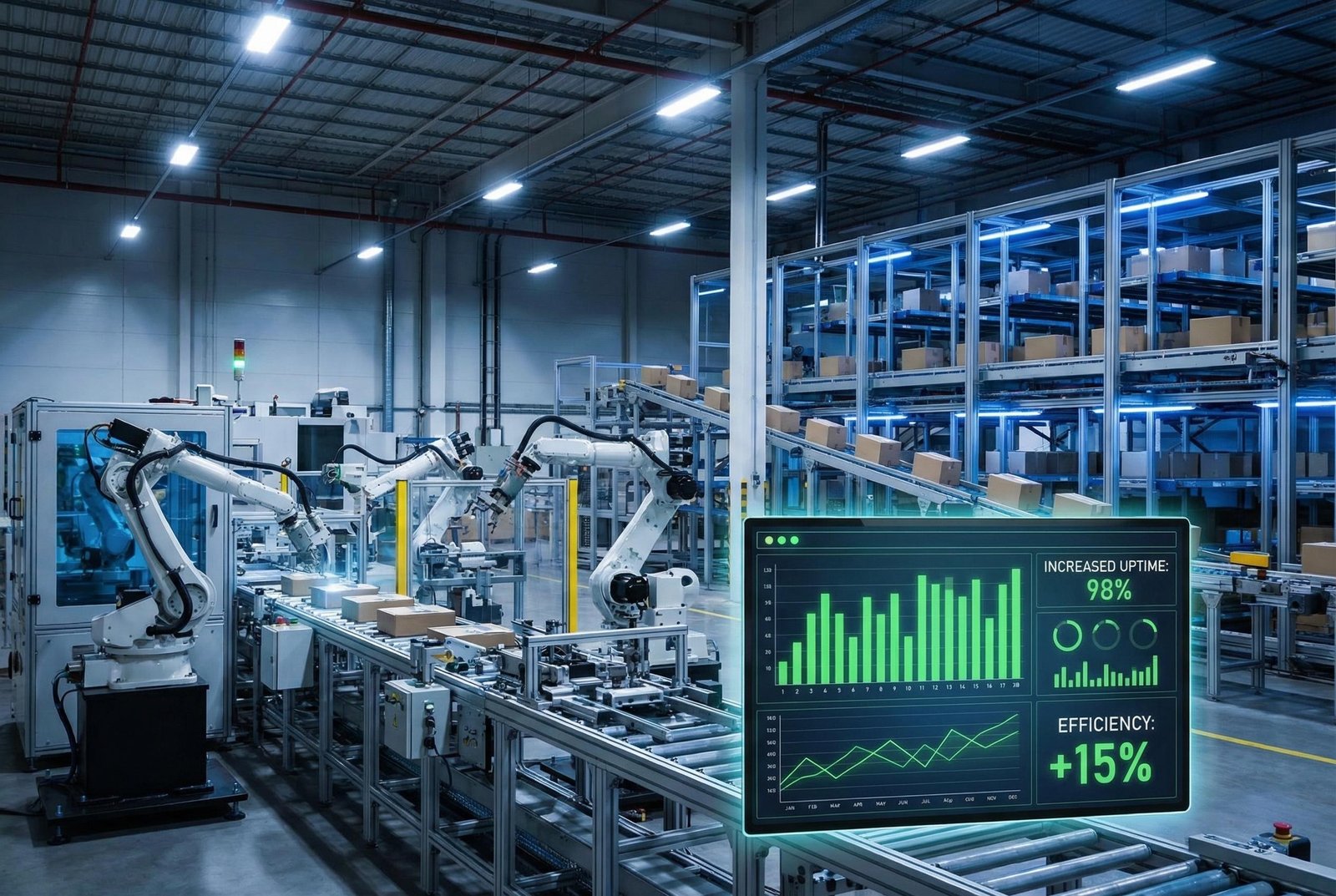
Manufacturers are transitioning from exploratory AI projects to strategic, results-driven applications that embed intelligence into daily operations, enhancing uptime, resilience, and decision-making across their networks.

How Manufacturers Are Turning AI Into Operational Advantage
By Nathanael Powrie
For much of the past decade, manufacturers approached artificial intelligence as an exploratory investment. Pilot projects multip...
Continue Reading This Article
Enjoy this article as well as all of our content, including reports, news, tips and more.
By registering or signing into your SRM Today account, you agree to SRM Today's Terms of Use and consent to the processing of your personal information as described in our Privacy Policy.
Today, manufacturers are reshaping their approach to AI around operational relevance. The central question has shifted from what AI is capable of to how it measurably improves performance. Across smart manufacturing, supply chain, and industrial operations, leaders are demanding faster payback, clearer accountability, and tighter integration between analytics and execution.
One of the most visible changes is the rise of AI accountability. Manufacturers are increasingly unwilling to fund initiatives that cannot be tied directly to business outcomes. Predictive maintenance, demand forecasting, and planning applications are now evaluated based on their impact on uptime, inventory turns, service levels, and margin performance. Accuracy and sophistication still matter, but they are no longer sufficient on their own.
This shift reflects a broader maturation of AI adoption. As the technology becomes more accessible, differentiation moves away from experimentation and toward execution. AI insights are being embedded directly into operational workflows, so they influence decisions as they are made, rather than appearing later in reports or dashboards that require interpretation and follow-up.
A global industrial manufacturer illustrates this transition. By integrating AI-driven maintenance recommendations into plant workflows and linking them to reliability and cost metrics, the company reduced unplanned downtime while maintaining human oversight of final decisions. The value came not from automation alone, but from aligning analytics with how work gets done on the shop floor.
Supply chain operations are undergoing a similar evolution, particularly through the transformation of control towers. Early control towers were designed to improve visibility by consolidating data from logistics providers, suppliers, and internal systems. While this represented an important step forward, visibility alone has proven insufficient in an environment defined by volatility and uncertainty.
Leading manufacturers are now extending control towers with predictive and prescriptive capabilities. Instead of simply showing what is happening, these platforms are designed to anticipate what is likely to happen next and recommend actions before disruptions escalate. Scenario modelling, risk sensing, and automated alerts are becoming core features rather than optional enhancements.
This evolution is changing how supply chain teams operate. Control towers are increasingly used as coordination platforms that connect planning, execution, and response across functions. Rather than reacting to events after they occur, teams can evaluate trade-offs in advance and act with greater confidence. This shift aligns closely with the broader movement toward intelligent, event-driven supply chains.
At the same time, manufacturers are redefining the relationship between humans and automation. Despite advances in AI, the prevailing trend is not full autonomy but augmentation. AI systems excel at processing large volumes of data, identifying patterns, and generating recommendations at speed. Humans remain essential for judgment, prioritisation, and exception management.
This hybrid operating model is especially important in high-mix and highly variable manufacturing environments. AI provides consistency and scale, while human expertise ensures flexibility and accountability. Rather than replacing planners, schedulers, or operators, AI is increasingly designed to support them, reducing cognitive load and enabling faster, more informed decisions.
Inventory strategy provides another lens into this shift. After years of disruption-driven stockpiling, manufacturers are reassessing how inventory is positioned and managed across their networks. The focus is moving away from maximising buffers toward optimizing flow, placement, and responsiveness.
Advanced analytics are enabling manufacturers to treat inventory as a dynamic, network-wide asset rather than a static safeguard. Multi-echelon optimisation and scenario analysis help determine not only how much inventory to hold, but where it delivers the most value. This approach is particularly impactful in capital-intensive industries where excess inventory ties up significant working capital.
Procurement organisations are also evolving in response to these trends. Traditional sourcing models based on periodic events and historical performance are giving way to continuous, risk-aware decision-making. Manufacturers are incorporating real-time signals related to supplier capacity, financial health, and external risk factors into their procurement processes.
This shift is especially pronounced in complex, tiered supply chains such as automotive and industrial manufacturing. By monitoring risk continuously rather than episodically, procurement teams can identify vulnerabilities earlier and respond proactively. The role of procurement is expanding from cost management to resilience and continuity, supported by data and analytics.
Transformation programs themselves are being rethought as well. Large, multi-year initiatives that promise comprehensive reinvention are increasingly viewed as risky and slow to deliver value. Manufacturers are instead favouring modular, fast-payback approaches that allow them to scale incrementally and adapt as conditions change.
This trend reflects a growing recognition that digital transformation is not a one-time event, but an ongoing process. By focusing on specific use cases and building momentum through early wins, manufacturers can reduce risk while maintaining flexibility. Speed to value has become a critical success factor.
Underlying all these developments is a renewed emphasis on data governance. As AI becomes embedded across operations, the limitations of fragmented and inconsistent data become more apparent. Manufacturers are discovering that even the most advanced algorithms cannot compensate for unreliable inputs.
Investments in data standardisation, integration, and ownership are increasingly seen as foundational to smart manufacturing initiatives. Organisations that establish clear governance and accountability around data find it easier to scale analytics, build trust in insights, and reduce friction between functions. Clean, trusted data is emerging as one of the most important enablers of operational intelligence.
Leadership expectations are evolving alongside technology. Operational leaders are not expected to become data scientists, but they are expected to understand how AI-generated insights should inform decisions. Manufacturers that invest in AI literacy across operations, supply chain, and procurement are seeing stronger adoption and more consistent results.
When leaders understand how to interpret recommendations, question assumptions, and act decisively, AI becomes a catalyst rather than a constraint. This capability is increasingly viewed as essential for navigating complexity and uncertainty.
Manufacturing’s next chapter will not be defined by the novelty of technology, but by how effectively it is applied. AI, analytics, and smart manufacturing platforms are now mature enough to deliver real value. The manufacturers that succeed will be those that focus on accountability, agility, and human-centred intelligence, translating insight into action across the enterprise.
Nathanael Powrie is Senior Director, Knowledge Management & Data Analytics at Maine Pointe, a global supply chain and operations consulting firm, where he leads the integration of Artificial Intelligence and Knowledge Management to help clients unlock the full potential of Agentic AI and data-driven transformation. With over a decade of experience across food & beverage, industrial, chemical, and logistics sectors, he modernises supply chains by combining human expertise with intelligent automation to drive better decisions and measurable results. He oversees Maine Pointe’s Combined Intelligence solutions, unifying data, analytics, and knowledge into actionable insights across procurement, logistics, and operations.
Subscribe to Industry Updates