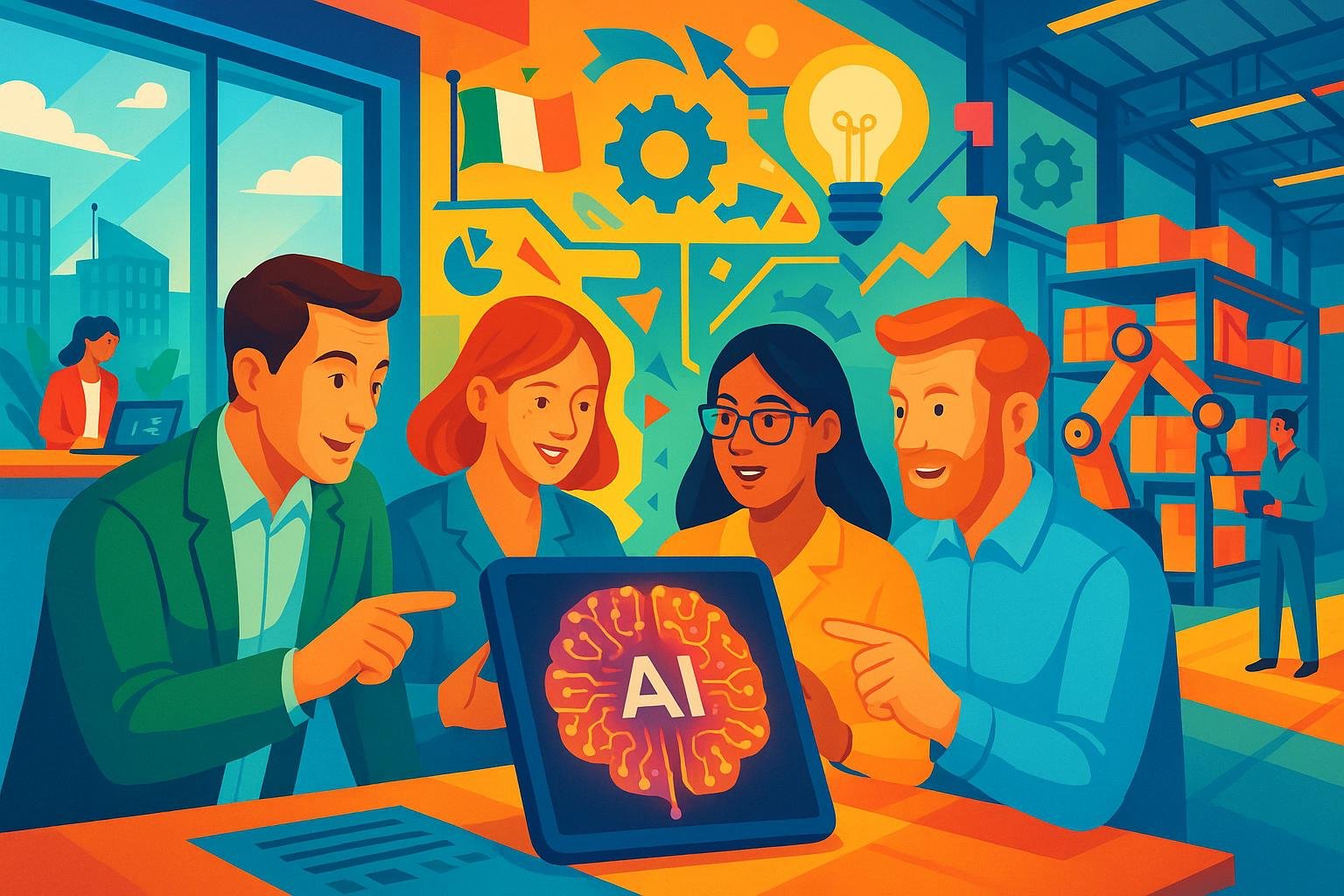
‘The real power of AI lies in using it to tackle the complex challenges rather than more simple use cases and reinventing how we do things’ , Jonathan Hayes, Director, AI, PwC Ireland.
Despite heavy investment and widespread experimentation, Irish firms have so far struggled to convert AI programmes into clear financial gains, according to a series of PwC surveys and reports. The PwC 2026 CEO Survey finds that just 17% of Irish chief executives said AI delivered increased r...
Continue Reading This Article
Enjoy this article as well as all of our content, including reports, news, tips and more.
By registering or signing into your SRM Today account, you agree to SRM Today's Terms of Use and consent to the processing of your personal information as described in our Privacy Policy.
evenues in the previous 12 months, well below the global figure of 29%. Cost reductions were also modest: 23% of Irish CEOs reported savings from AI, compared with 26% internationally. Only 9% of Irish leaders report broad application of AI across multiple business functions. According to the report by PwC Ireland, these shortfalls point to a widening gap between pilots and scaled deployment.
PwC’s analysis emphasises that companies which have embedded AI across products, services and customer experiences see measurable financial rewards. A global PwC study cited by the firm found that organisations applying AI widely achieved nearly four percentage points higher profit margins than peers that had not. Yet the local data suggests many Irish organisations remain at the early stages of that journey.
Agentic AI , autonomous, decision-capable systems , is central to the potential step-change. PwC Ireland’s AI Agent Survey 2025 shows substantial optimism about agentic technologies: 54% of business leaders expect agents to deliver a significant competitive advantage in the year ahead, and 70% plan to increase AI-related budgets. However, actual transformational use remains limited. Only 16% of Irish respondents are developing new agentic products and services, and just 11% are redesigning processes around agents. Fewer than 9% report broad adoption of AI agents, a stark contrast with 52% reported in the United States.
The surveys point to a pattern: firms that restrict AI to isolated efficiency projects rarely capture the broader value available from reinvention. PwC Ireland’s report Turning AI into Real Returns highlights the importance of building robust foundations , integrated technology environments, responsible AI frameworks and enterprise governance , if organisations are to turn AI experiments into sustained revenue and margin improvements. The 2026 global survey similarly finds that only a small minority of CEOs report both cost and revenue benefits from AI, underscoring that scale, not experimentation alone, drives returns.
Practically, AI is proving most potent where it enables personalised offerings and accelerates customer journeys rather than replacing human relationships. PwC’s findings suggest AI can cut routine friction from sales processes so customers reach the right expert faster, enabling firms to convert engagement into higher-value interactions. When applied across product development, delivery and customer experience, AI also opens the door to smarter subscription models and platform ecosystems that diversify and stabilise revenue streams.
Yet the shift required is cultural as much as technical. Jonathan Hayes at PwC Ireland argues that the real value lies in deploying AI to address complex problems and reimagine business models, not merely automating simple tasks. The surveys echo that view: as long as most activity remains in pilots or narrow use cases, the economy-wide impact will be muted.
The broader economic outlook adds pressure. The PwC 2026 Global CEO Survey reports falling confidence in near-term revenue growth, with only 30% of CEOs confident about revenue prospects over the next 12 months, down from 38% in 2025. Geopolitical uncertainty and cyber threats also feature as rising concerns, factors that make effective, well-governed use of AI both more urgent and more challenging.
For Irish businesses, the data suggests a clear pathway: move beyond isolated proofs of concept, invest in enterprise-grade infrastructure and governance, and redesign operating models to capture agentic AI’s strategic potential. Firms that make that transition stand to gain not only incremental efficiencies but fundamentally different ways of creating value , from tailored customer experiences to new product-led revenue streams. Until those changes become widespread, however, the promise of AI in Ireland will remain only partially realised.
Source: Noah Wire Services