


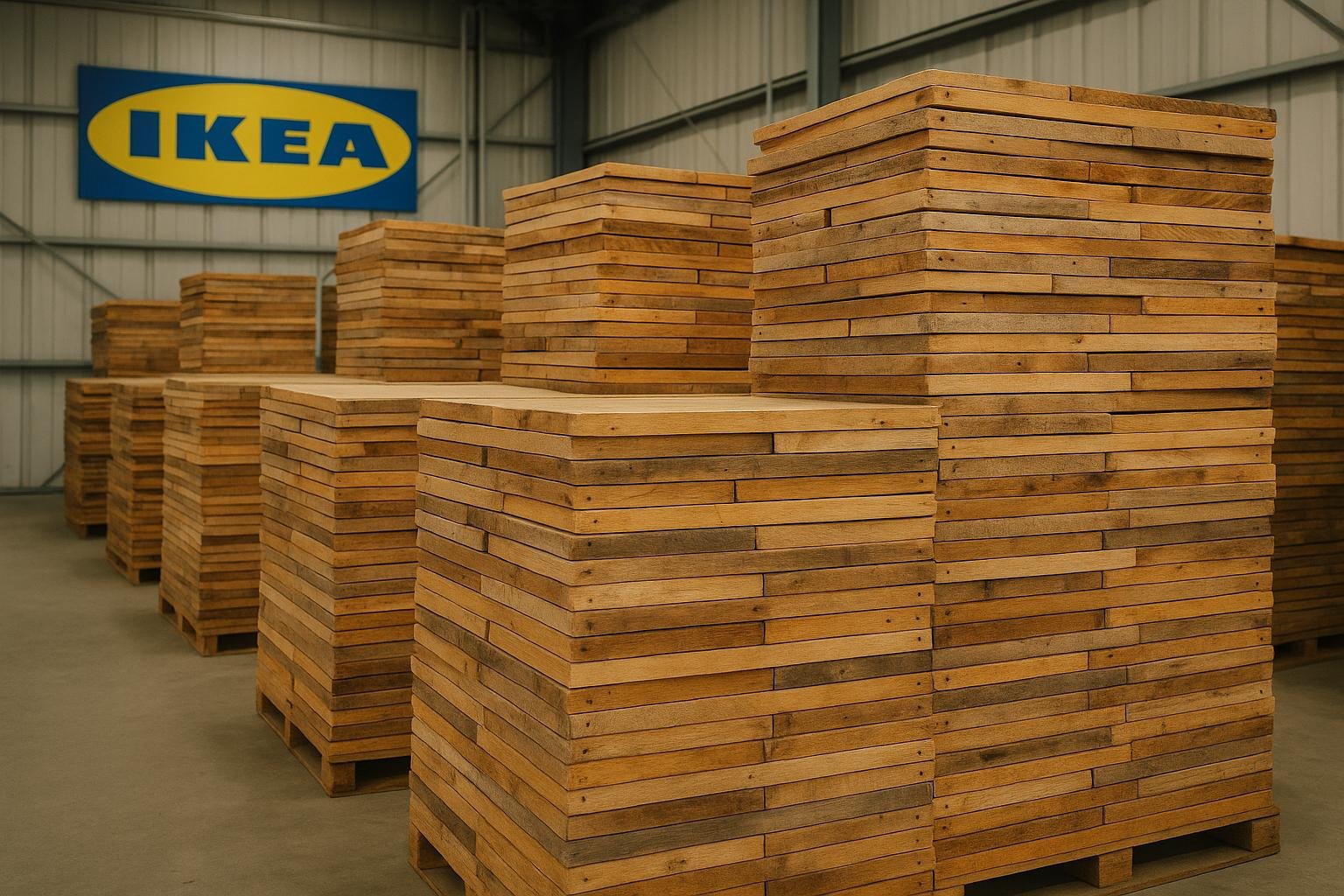
As global businesses strive to shift from traditional linear models, IKEA exemplifies how companies can operationalise circular supply chains, though widespread adoption remains challenging amid technical and managerial hurdles.

The last decade has seen a growing consensus among academics, industry groups and corporate leaders that the traditional “take‑make‑waste” model is increasingly unsustainable , economically, environmentally and operationally , and that a...
Continue Reading This Article
Enjoy this article as well as all of our content, including reports, news, tips and more.
By registering or signing into your SRM Today account, you agree to SRM Today's Terms of Use and consent to the processing of your personal information as described in our Privacy Policy.
According to the original report from the Penn State Center for Supply Chain Research, moving from linear to circular supply chains requires wholesale redesign of core supply‑chain processes , design, source, make, deliver and return , so that the objectives become: minimise use of virgin and hazardous materials; minimise waste; maximise product life and usage intensity; and maximise recirculation of resources. The authors argue that these aims cannot be achieved by bolt‑on initiatives alone: they demand coordinated changes to both the physical infrastructure (facility location, handling and recovery capabilities) and the relational networks (suppliers, service partners, industry coalitions) that underpin modern supply chains.
Practical strategies described in the Penn State framework include designing products for multiple life cycles and “fit for purpose” simplicity; sourcing from renewable and secondary material streams as well as “user markets” that return used goods; developing production systems that combine cleaner processes with value‑recovery capabilities such as repair, remanufacture and recycling; and reconfiguring logistics to integrate forward flows with reverse, redistribution and re‑commerce channels. The centre’s work places particular emphasis on reverse logistics as the cornerstone of end‑of‑life management , encompassing collection, sorting, authentication and transport back into recovery or resale pathways.
Independent organisations and industry analysts reinforce the framework’s central claims. The Ellen MacArthur Foundation highlights that circular supply chains can increase resilience, reduce costs and lower greenhouse gas emissions by enabling distributed partner networks and multidirectional flows of goods and information, with practical measures such as maintenance, refurbishment and remanufacture keeping materials in use. The World Economic Forum identifies multiple competitive advantages of circular models , from stronger customer intimacy to improved component utility , and positions reuse, repair and recycling as drivers of both sustainability and market performance. Gartner has explicitly urged supply‑chain leaders to pivot away from linear models, predicting that circular economies will supplant linear ones and signalling growing investor and consumer demand for continuous material reuse.
Yet progress is uneven. Industry reporting in late 2025 notes a worrying decline in global circularity even as resource consumption accelerates, underscoring that circular strategies remain more aspiration than universal practice for many firms. According to that coverage, businesses increasingly view circularity as a near‑term business imperative , promising additional revenue streams, lower operating costs and greater resilience , but translating ambition into industrial‑scale change remains a major managerial and technical challenge.
IKEA is presented in the Penn State analysis as a leading example of a retailer attempting to operationalise circular supply‑chain principles at scale. The report notes that, as of 2024, the company managed around 800 home‑furnishing suppliers and over 140 global food suppliers across more than 50 markets, offered some 9,500 products, and operated over 500 stores in more than 60 markets. IKEA announced in 2018 an ambition to become a circular business by 2030; the company says it is working to end dependency on virgin non‑renewable materials, increase the use of secondary raw materials, design products for recycling and reuse, and develop services that extend product life. Industry data shows IKEA has been piloting resale, rental and take‑back initiatives and increasing recycled content in materials such as aluminium and plastics, though the company’s own statements qualify these moves as part of a long transition rather than a completed transformation.
Implementing circular supply chains at scale will require new commercial relationships and governance models. The Penn State framework recommends a mix of outsourcing, joint ventures and participation in cross‑industry coalitions to acquire complementary capabilities, assemble circular know‑how, and create open‑loop partnerships that allow materials to flow across sectors. Practically, this means manufacturers must plan for a network of recovery points, refurbishment facilities and remanufacturing hubs whose location and capacity are determined by the scale of expected returns and the specific circular business models adopted.
For managers, the practical takeaways are stark. Circular supply chains are not merely sustainability projects: they are fundamentally different operating models that change where and how value is created and captured. Firms must reconcile short‑term cost pressures with the investment needed to build reverse logistics, develop technical expertise in reclaimed products, and redesign products for disassembly and high‑value recovery. Where companies succeed, the benefits extend beyond environmental gains to include new revenue from secondary markets, stronger supply resilience and closer customer engagement; where they fail, attempts at circularity risk becoming costly pilot projects that do not alter underlying resource dependencies.
As pressures from regulators, investors and customers escalate, the balance of risk and opportunity is shifting. The Penn State framework provides a structured lens for firms to evaluate which circular business models fit their product portfolios and to plan the physical and relational reconfigurations required. Complementary voices from the Ellen MacArthur Foundation, the World Economic Forum and industry analysts underline that circular supply chains can deliver resilience and economic value , but only if organisations commit to systemic change rather than incremental fixes.
The transition to circularity will be gradual and uneven, and claims of circular performance should be read with editorial distance. Nevertheless, the convergence of academic frameworks, non‑profit advocacy and corporate pilots such as IKEA suggests that circular supply chains are moving from theory toward practicable strategy , provided firms are willing to redesign their processes, assets and partnerships to make resource recirculation the operational norm rather than an occasional exception.
Source: Noah Wire Services
Subscribe to Industry Updates

