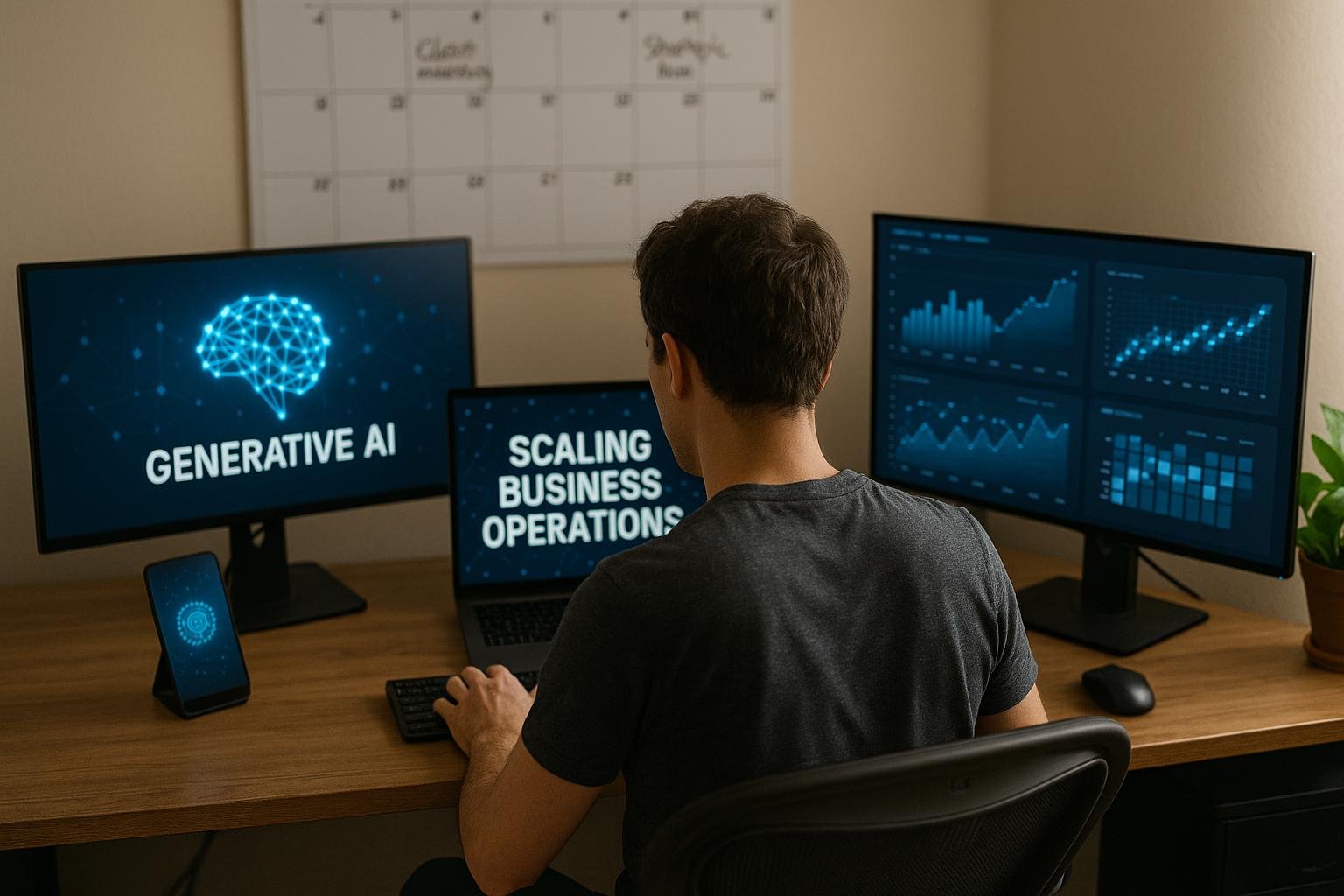
For solo founders accustomed to handling every aspect of their businesses, generative artificial intelligence has begun to change the arithmetic of growth. Two small-business owners in different sectors say AI has helped them codify tacit knowledge, attract clients and make their first hires , moves that, they contend, have materially expanded capacity without diluting service.
Katherine Pomerantz, who runs Money Storyteller, told Business Insider that after nearly a decade of ...
Continue Reading This Article
Enjoy this article as well as all of our content, including reports, news, tips and more.
By registering or signing into your SRM Today account, you agree to SRM Today's Terms of Use and consent to the processing of your personal information as described in our Privacy Policy.
operating alone she delayed hiring because she found it difficult to translate her strategic, voice-driven client work into repeatable tasks. “Being able to turn it into a step-by-step workflow for someone else, I just don’t think that way,” she said. After adopting ChatGPT, she used the tool to analyse call recordings, emails and brainstorming notes and to surface recurring patterns in how she advises clients. According to the Business Insider report, Pomerantz then converted those insights into procedural documents and decision guides that an administrator can use to prepare responses or triage client queries before she intervenes.
The result, she says, was operational leverage. Pomerantz hired an administrator in the United States and a bookkeeper in the Philippines; she told Business Insider the new team helps produce roughly twice the output she managed solo. She also uses AI to generate preliminary briefings when clients ask technical questions about financial choices, allowing her to focus her time on high-value decisions while clients receive prompt, detailed information. “We want them to feel like they get a lot more of my time than they do,” she said.
In New York, Danielle Nazinitsky of Decode Real Estate has taken a different but complementary approach. Speaking to Business Insider, she described ChatGPT as “a referral engine” after discovering prospective clients were being led to her name via generative-AI results. That prompted a deliberate investment in search visibility and brand content: she engaged a GEO firm, increased blog output and encouraged reviews to strengthen her presence on Google and in AI-driven discovery tools. According to reporting by Side, that focus on SEO played a role in winning a $12 million listing pitch, illustrating how digital discoverability can translate into high-value opportunities.
Nazinitksy also deploys AI for marketing and for enhancing property presentations. Reporting in SFGate notes she has used AI-powered staging and listing-copy tools to make older or modest properties more attractive, while cautioning that automated approaches lack the nuance of human judgement and can render content impersonal if overused. Nazinitsky told Business Insider she is careful to reserve specialist work , press releases, branding and transactional oversight , for paid professionals, arguing that outsourcing to true experts often yields better results than relying on AI alone. “When I spend the money on an actual expert, I get a much better result,” she said.
The two founders’ stories show a recurring theme: AI is most valuable where it externalises routine elements of expertise, turning implicit processes into templates that less experienced staff or contractors can follow. Industry examples back that up; profiles and interviews with Pomerantz and Nazinitsky, including a podcast in which Pomerantz outlines her Money Storyteller Method, emphasise storytelling and process design as central to scaling professional services. Customer reviews on platforms such as Zillow reflect the role of reputation and client experience in generating repeat business and referrals, reinforcing the need to combine digital tactics with credible, human-led service.
At the same time, both founders illustrate the bounds of automation. They use generative models to augment, not replace, human judgement: Pomerantz checks and signs off on final decisions; Nazinitsky hires specialists for high-stakes work. For solo founders considering their first hires, these examples suggest a hybrid path , use AI to extract and organise know-how, then invest selectively in people who can apply that scaffolded expertise with care and commercial judgement.
Source: Noah Wire Services