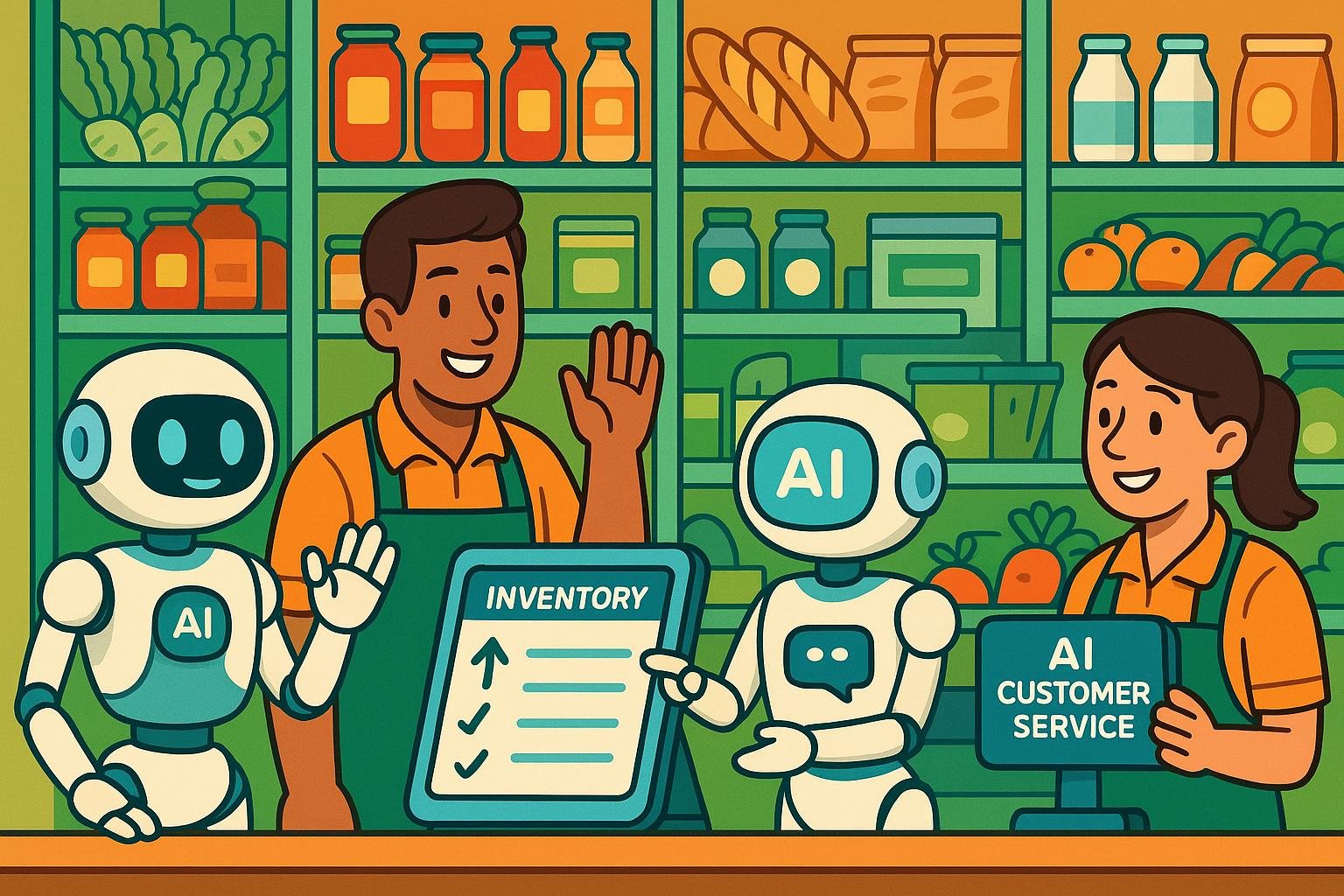
Retail giants like Kroger and Hy-Vee are investing in AI tools to streamline store operations and support staff, focusing on internal efficiency before expanding consumer-facing services amid trust barriers.

As grocers rush to harness artificial intelligence, the immediate battlefield is not the checkout lane but the staff locker room. Retailers including Kroger and Hy-Vee are directing AI investments toward store teams and operations, betting that equipping frontline e...
Continue Reading This Article
Enjoy this article as well as all of our content, including reports, news, tips and more.
By registering or signing into your SRM Today account, you agree to SRM Today's Terms of Use and consent to the processing of your personal information as described in our Privacy Policy.
According to Dunnhumby’s Consumer Trends Tracker published earlier this month, only about 15% of U.S. shoppers currently use AI tools when grocery shopping, with trust cited as the principal barrier. That hesitancy has not deterred retailers from pressing ahead; executives at this year’s National Retail Federation Big Show made clear that improving in-store efficiency and manager decision-making is the priority.
Kroger has expanded its collaboration with Google Cloud and highlighted Sage, an AI virtual assistant that consolidates multiple employee functions into a single access point. The retailer presents the system as a way for staff to handle scheduling, time-off requests, availability and pay information faster, while store and regional leaders gain near real-time visibility into labour metrics. The company frames the move as reducing administrative friction for floor teams and sharpening operational responsiveness.
Regional chain Hy‑Vee is pursuing a similar consolidation through an AI integration with Workday. Becky Olson, Hy‑Vee’s senior principal product manager, told attendees at NRF that the aim was to replace a patchwork of apps and logins with one mobile experience. “Employees are really focused on mobile , that was something [that is] really important to them,” she said. “And so when they’re having to log into multiple systems, have multiple logins and download multiple apps, it’s cumbersome for them.” Olson added that schedules which once required manual creation can now be generated by Workday’s AI so managers can “go in and make small tweaks and optimize.”
Beyond workforce tools, AI is being pressed into service to bolster retail media and personalisation efforts. PwC partner Kelly Pedersen told NRF that advanced models make vast quantities of consumer information far easier to analyse. “AI , it makes consumer data at mass so much more… processable,” he said, arguing that faster, automated optimisation will allow retailers and brand partners to craft tailored campaigns on shorter cycles and with greater precision.
Pedersen also flagged generational dynamics shaping in‑store experimentation. “[Gen Z] doesn’t necessarily shop in stores, but they like to be in stores. They shop digitally and in-store… So anything from an experiential perspective that improves the experience is what [grocers] are looking for,” he said, suggesting that AI-driven experiences will need to bridge the physical and digital worlds to resonate with younger shoppers.
Industry observers note that realising those benefits requires overcoming data limitations and privacy concerns, especially for in-store personalisation where tracking movement and behaviour is more challenging than online. Retailers are therefore focusing first on areas where AI can remove operational pain points and demonstrate return on investment , employee productivity, scheduling efficiency and faster retail media optimisation , before trying to drive mass consumer adoption.
The current trajectory positions AI as an internal productivity engine as much as a customer-facing innovation. If successful, the initiatives now being piloted at store level could form the foundation for more consumer-facing services later, but for the moment grocers appear intent on proving value to managers and associates before asking shoppers to trust and embrace AI.
Source: Noah Wire Services
Subscribe to Industry Updates